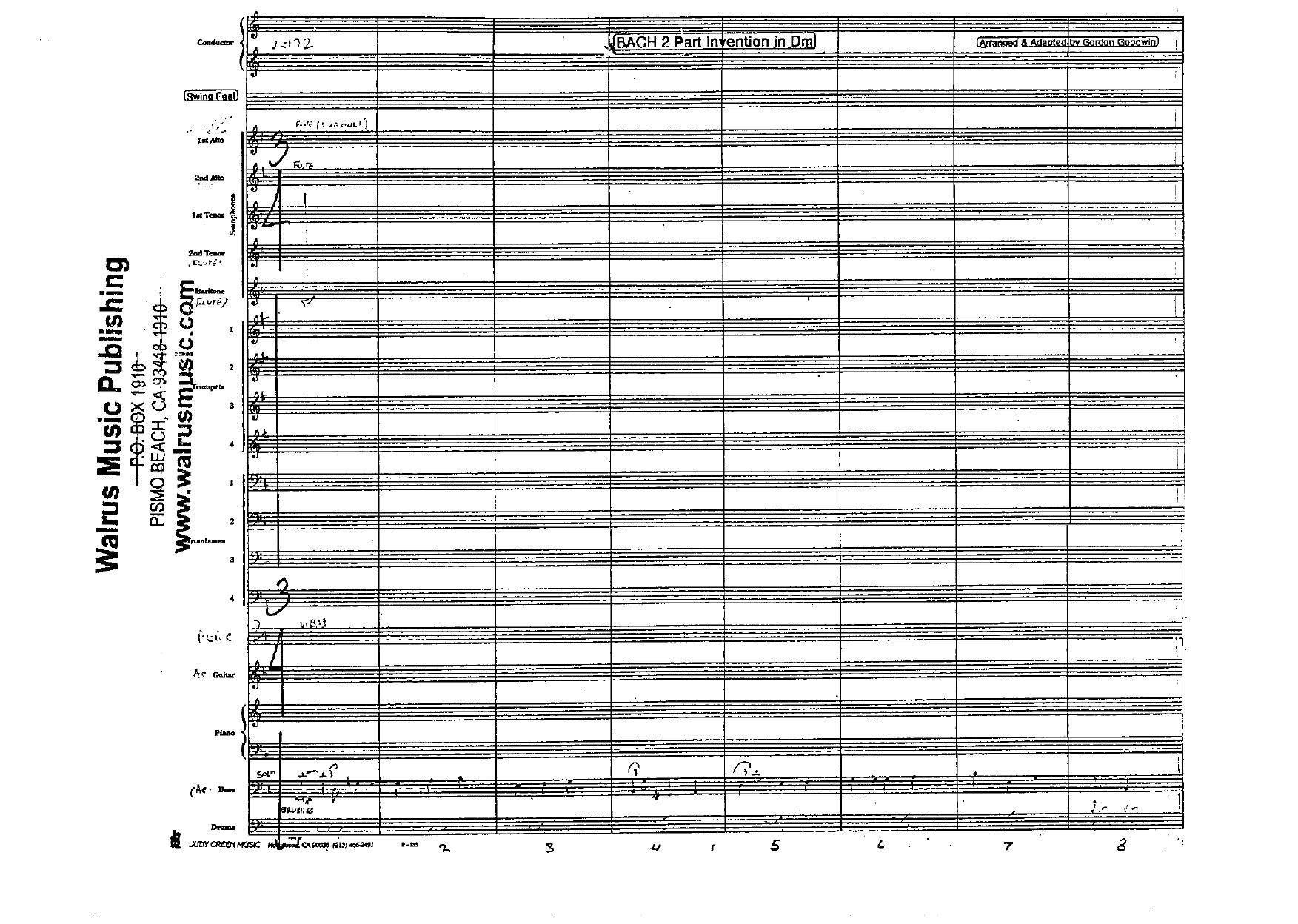
Bach 2 Part Inventions (G.Goodwin)
Composed by Johann Sebastian Bach
Arranged by Gordon Goodwin
- Ensemble: Big Band
- Pages: 144
- Instruments (18): Alto Saxophone 1, Alto Saxophone 2, Tenor Saxophone 1, Tenor Saxophone 2, Baritone Saxophone, Trumpet 1, Trumpet 2, Trumpet 3, Trumpet 4, Trombone 1, Trombone 2, Trombone 3, Trombone 4, Piano, Guitar, Bass, Drums, Percussion
- Difficulty: advanced
- Content: Individual Parts
- Format: PDF Download (Instant)
- Price: $24.99
Johann Sebastian Bach’s monumental *Two-Part Inventions*, originally penned in the early 18th century as pedagogical keyboard exercises for his eldest son Wilhelm Friedemann, represent the pinnacle of Baroque contrapuntal mastery. While conceived centuries before the birth of jazz, Bach's intricate independence of voices, linear counterpoint, and harmonic sophistication have long served as a wellspring of inspiration for jazz improvisers, from the legendary explorations of Jacques Loussier to the modern adaptations of the Swingle Singers. Transforming these pristine, two-voice keyboard blueprints into a roaring, contemporary big band chart is a formidable challenge, one met with unmatched brilliance by master arranger, composer, and saxophonist Gordon Goodwin. Goodwin reimagines Bach's rigorous counterpoint through a dynamic, high-energy modern big band lens, seamlessly fusing Baroque stricture with driving West Coast contemporary jazz sensibilities. Across this expansive 144-page score, the music shifts between intricate, intertwined linear conversations and explosive, brass-heavy harmonic punctuations. The mood alternates between cerebral, driving swing and moments of lush, sophisticated harmonic expansion. Goodwin respects the architectural integrity of Bach's original thematic subjects—the *dux* and *comes* entries of the fugue-like structures—while recontextualizing them with contemporary jazz extensions, chromatic voice-leading, and infectious rhythmic grooves that transform intimate keyboard counterpoint into a powerhouse orchestral statement. The arrangement demands absolute precision from all sections, functioning much like a chamber ensemble where no player can afford to coast. The melody is passed fluidly across the expanded instrumentation, featuring designated lines for alto, tenor, and baritone saxophones alongside crisp trumpet and trombone counter-lines that highlight Goodwin’s signature knack for dense, punchy voicings. Technical challenges abound in the sheer velocity of the contrapuntal lines, requiring immaculate articulation, uniform phrasing, and an advanced command of shifting tonal centers. Solo opportunities allow featured improvisers to stretch out over changes that brilliantly bridge Baroque harmony with modern jazz modal and altered extensions, making every single measure deeply rewarding for performers who relish sophisticated musical interplay. Tailored primarily for advanced collegiate, top-tier high school, and professional jazz orchestras, this chart requires an ensemble with mature listening skills and exceptional section cohesion. Because the texture relies heavily on interdependent melodic lines rather than a simple melody-with-accompaniment framework, every section must project equal clarity. Audiences familiar with classical repertoire will marvel at the seamless stylistic translation, while jazz purists will appreciate the sheer inventive vigor of Goodwin's harmonic vocabulary, making it a show-stopping centerpiece for any ambitious contemporary big band program. Success with this arrangement hinges on achieving absolute clarity in articulation and a unified concept of time. The primary technical challenge lies in executing Bach’s fast-moving contrapuntal lines with a modern swing or driving contemporary feel without blurring the rhythmic definition. Conductors should rehearse sections in isolation, having the saxophones and brass isolate their respective interweaving lines at a reduced tempo before integrating the rhythm section. Pay close attention to dynamic contrast; because the arrangement is texturally dense, letting the underlying voice-leading speak naturally prevents the chart from sounding muddy. The rhythm section, particularly the drummer, must maintain a steady, unyielding pulse that anchors the shifting harmonic weight without overplaying. Encourage the ensemble to listen horizontally rather than vertically—treating every sub-melody with the same melodic importance as the primary theme. Q: What instruments and parts are included in this arrangement? A: Scored for a flexible 9-instrument big band instrumentation, the package includes parts for Alto Saxophone, Tenor Saxophone, Baritone Saxophone, Trumpet, and Trombone, complemented by a full rhythm section. The 144-page score provides comprehensive cueing and expansive voicing details across all sections. Q: What is the overall difficulty level of this chart? A: This arrangement is designated for advanced collegiate, professional, and elite high school jazz orchestras due to its intricate contrapuntal demands, fast tempos, and advanced harmonic reading requirements. Q: How does this piece bridge Baroque music and jazz? A: Gordon Goodwin takes J.S. Bach's 18th-century *Two-Part Inventions* and reinterprets their strict contrapuntal subject-and-answer framework using contemporary big band voicings, swing feels, and extended jazz harmonies. Q: What makes Gordon Goodwin's treatment unique compared to standard big band charts? A: Unlike traditional big band arrangements that rely on standard shout choruses and block-chord backgrounds, Goodwin maintains true linear independence among the sections, turning classical counterpoint into an explosive modern jazz conversation. Q: What is the performance duration and recommended tempo feel? A: The arrangement is built around a brisk, energetic tempo feel that mirrors the nimble nature of Bach's original keyboard works, with performance duration varying based on the specific inventions selected and improvised solo lengths.
Questions and answers
- What is included in the Bach 2 Part Inventions (G.Goodwin) PDF?
- The verified current file contains a conductor score and individual parts across 144 pages.
- How many instruments or parts are listed for Bach 2 Part Inventions (G.Goodwin)?
- The verified instrumentation list contains 18 entries for this Big Band arrangement.
- Who is credited for Bach 2 Part Inventions (G.Goodwin)?
- Composer: Johann Sebastian Bach. Arranger: Gordon Goodwin.
- What difficulty is listed for Bach 2 Part Inventions (G.Goodwin)?
- The verified difficulty level is advanced.
- Can I preview Bach 2 Part Inventions (G.Goodwin) before buying?
- Yes. The product page provides a preview generated from the current PDF file.
- How is Bach 2 Part Inventions (G.Goodwin) delivered?
- After successful payment, the digital PDF is made available for download. The displayed price is $24.99.
Musicians Also Search For
Bach 2 Part Inventions Gordon Goodwin PDF • Bach 2 Part Inventions Gordon Goodwin sheet music • Bach 2 Part Inventions arranged by Gordon Goodwin • Gordon Goodwin big band charts • Gordon Goodwin jazz arrangements PDF • Bach 2 Part Inventions Johann Sebastian Bach sheet music • Bach 2 Part Inventions Johann Sebastian Bach big band arrangements • Johann Sebastian Bach big band charts • Bach 2 Part Inventions big band arrangements • Bach 2 Part Inventions big band PDF download • Bach 2 Part Inventions jazz sheet music • big band sheet music download • Bach 2 Part Inventions conductor score PDF • Bach 2 Part Inventions individual parts download • Bach 2 Part Inventions sheet music PDF • buy Bach 2 Part Inventions sheet music • download Bach 2 Part Inventions PDF • Bach 2 Part Inventions jazz charts • best Gordon Goodwin big band arrangements • Johann Sebastian Bach arranged by Gordon Goodwin • Bach 2 Part Inventions printable sheet music • big band repertoire PDF