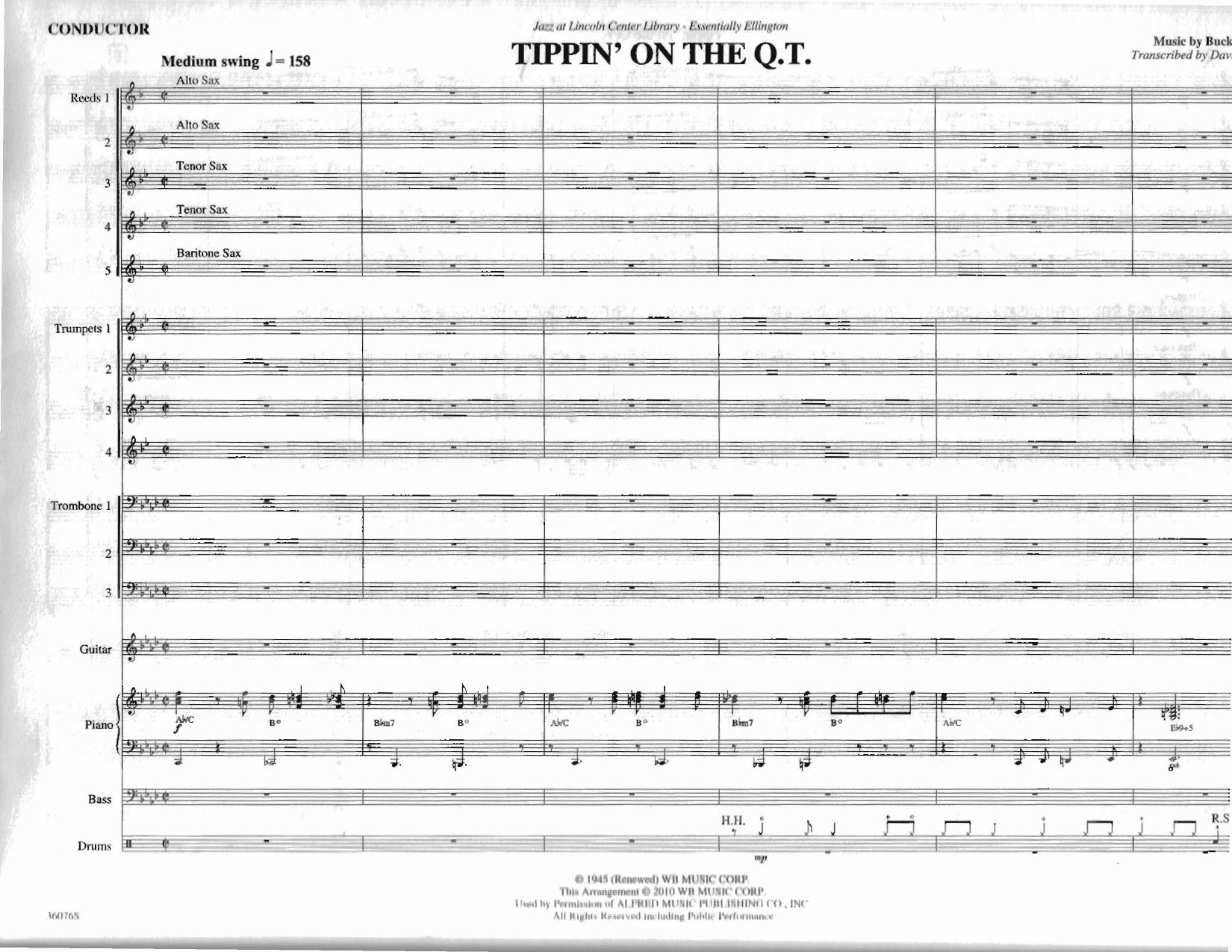
Tippin' On The Q.T. (B.Clayton) (D.Berger) sheet music preview

Tippin' On The Q.T. (B.Clayton) (D.Berger)

Composed by Buck Clayton

Arranged by Buck Clayton

  • Ensemble: Big Band
  • Pages: 60
  • Instruments (16): Alto Sax 1, Alto Sax 2, Tenor Sax 1, Tenor Sax 2, Baritone Sax, Trumpet 1, Trumpet 2, Trumpet 3, Trumpet 4, Trombone 1, Trombone 2, Trombone 3, Guitar, Piano, Bass, Drums
  • Difficulty: advanced
  • Content: Individual Parts
  • Format: PDF Download (Instant)
  • Price: $24.99

Kansas City swing royalty meets mainstream elegance in this exceptional big band setting of "Tippin' On The Q.T.," originally conceived and helmed by master trumpeter Buck Clayton. Rooted deeply in the foundational traditions of the Count Basie Orchestra—where Clayton served as a premier soloist and writer for decades—this composition captures the quintessential pulse of 1930s and 1940s jazz innovation. Clayton’s writing epitomizes the "less is more" philosophy of Kansas City jazz, prioritizing infectious groove, economic blues-inflected phrasing, and sophisticated riff-driven counterpoint over dense, academic orchestration. The piece stands as a shining example of classic swing-era architecture, showcasing how effortless rhythmic swing can convey profound sophistication. Driving forward with an infectious, laid-back medium-swing groove in 4/4 time, the arrangement radiates cool confidence and upbeat sophistication. The harmonic framework relies heavily on classic blues structures and extended dominant chordal palettes, creating a buoyant, uplifting mood that encourages both audience engagement and relaxed physical movement. Clayton constructs the chart around conversational exchanges between sections, generating an atmosphere reminiscent of an after-hours jam session at a historic 12th Street club. The underlying energy is persistent yet unhurried, allowing the rhythm section to lock into a deep, driving pocket that anchors the entire ensemble. Clayton’s distinctive arranging approach shines through the transparent voicings and clever use of dynamic contrast. Rather than muddying the texture with constant tutti writing, he employs sparse, punchy brass punctuation against smooth, flowing saxophone solis. The arrangement features classic Kansas City-style head arrangements where sectional counter-melodies weave seamlessly around the primary theme. The shout chorus builds organically, utilizing classic call-and-response figures between the trumpets and trombones before expanding into a rich, full-ensemble harmonization that highlights the beauty of traditional swing voicings without relying on modern, ultra-complex modal re-harmonizations. Melodic duties are shared fluidly across the front line, with the saxophones carrying the primary thematic weight early on before trading phrases with the brass. Featured solo spaces provide ample opportunity for developing improvisers and seasoned players alike to stretch out over standard blues or rhythm changes-inspired forms. Technical challenges lie primarily in maintaining a consistent, relaxed swing eighth-note articulation at moderate tempos—a deceptively difficult task that requires immaculate internal time and stylistic unity across the entire ensemble. The rewarding nature of the chart stems from its idiomatic writing; every line sits naturally under the fingers, rewarding bands that can balance lightweight phrasing with a robust, authoritative big band roar. Advanced high school, collegiate, and community jazz orchestras will find this chart to be an ideal vehicle for teaching and performing authentic swing style. Because it avoids extreme technical velocity while demanding high-level stylistic maturity, it serves as an exceptional pedagogical tool for developing section blend, swing articulation, and stylistic authenticity. Professional ensembles, meanwhile, will delight in using it as a sophisticated, high-energy crowd-pleaser that honors the timeless legacy of the Kansas City sound. Achieving the authentic Kansas City swing feel in "Tippin' On The Q.T." requires strict adherence to a relaxed, forward-leaning eighth-note concept. Avoid over-articulating; the tongue should be light, akin to a soft "dah" syllable, ensuring that the swing eighths remain legato and connected, especially at medium tempos. The rhythm section is the engine of this chart: the drummer should ride the cymbal with a clear triplet pulse while feathering the bass drum lightly, and the bassist must walk a quarter-note line with strong emphasis on beats two and four. Brass players should master standard swing embellishments—such as controlled falls, doits, and natural, unforced vibrato—without letting them sound cartoonish or exaggerated. Rehearsals should initially focus on sectional balance and intonation during the harmonized soli sections before integrating the dynamic swells of the shout chorus. Directors must ensure the ensemble maintains a relaxed, unhurried attitude; pushing the tempo will destroy the effortless "cool" factor that defines Buck Clayton's timeless writing style. Q: What instruments and parts are included in this arrangement? A: This arrangement is scored for a 9-instrument ensemble featuring Alto Saxophone, Tenor Saxophone, Baritone Saxophone, Trumpet, Trombone, and a complete rhythm section. Q: What is the difficulty level of this chart? A: It is suited for advanced high school, collegiate, and community jazz bands, focusing heavily on stylistic maturity, section blend, and medium-tempo swing feel rather than extreme technical dexterity. Q: What is the historical context and musical style of the piece? A: Composed in the classic swing style by Kansas City jazz icon and Count Basie alumnus Buck Clayton, the piece reflects the blues-infused, riff-driven aesthetic of the 1930s and 1940s big band era. Q: What makes this specific arrangement unique? A: It features Clayton’s signature transparent voicings, conversational call-and-response figures between sections, and a relaxed, head-arrangement approach that prioritizes groove over dense orchestration. Q: What is the performance duration and tempo feel of the piece? A: The arrangement is set to a classic medium-swing tempo in 4/4 time, providing an infectious, laid-back groove that typically runs between three and five minutes depending on solo extensions.

Questions and answers

What is included in the Tippin' On The Q.T. (B.Clayton) (D.Berger) PDF?
The verified current file contains a conductor score and individual parts across 60 pages.
How many instruments or parts are listed for Tippin' On The Q.T. (B.Clayton) (D.Berger)?
The verified instrumentation list contains 16 entries for this Big Band arrangement.
Who is credited for Tippin' On The Q.T. (B.Clayton) (D.Berger)?
Composer: Buck Clayton. Arranger: Buck Clayton.
What difficulty is listed for Tippin' On The Q.T. (B.Clayton) (D.Berger)?
The verified difficulty level is advanced.
Can I preview Tippin' On The Q.T. (B.Clayton) (D.Berger) before buying?
Yes. The product page provides a preview generated from the current PDF file.
How is Tippin' On The Q.T. (B.Clayton) (D.Berger) delivered?
After successful payment, the digital PDF is made available for download. The displayed price is $24.99.

Musicians Also Search For

Tippin' On The Q.T. Buck Clayton PDFTippin' On The Q.T. Buck Clayton sheet musicTippin' On The Q.T. arranged by Buck ClaytonBuck Clayton big band chartsBuck Clayton jazz arrangements PDFTippin' On The Q.T. Buck Clayton big band arrangementsTippin' On The Q.T. big band arrangementsTippin' On The Q.T. big band PDF downloadTippin' On The Q.T. jazz sheet musicbig band sheet music downloadTippin' On The Q.T. conductor score PDFTippin' On The Q.T. individual parts downloadTippin' On The Q.T. sheet music PDFbuy Tippin' On The Q.T. sheet musicdownload Tippin' On The Q.T. PDFTippin' On The Q.T. jazz chartsbest Buck Clayton big band arrangementsTippin' On The Q.T. printable sheet musicbig band repertoire PDF

All arrangements by Buck Clayton All Buck Clayton sheet music