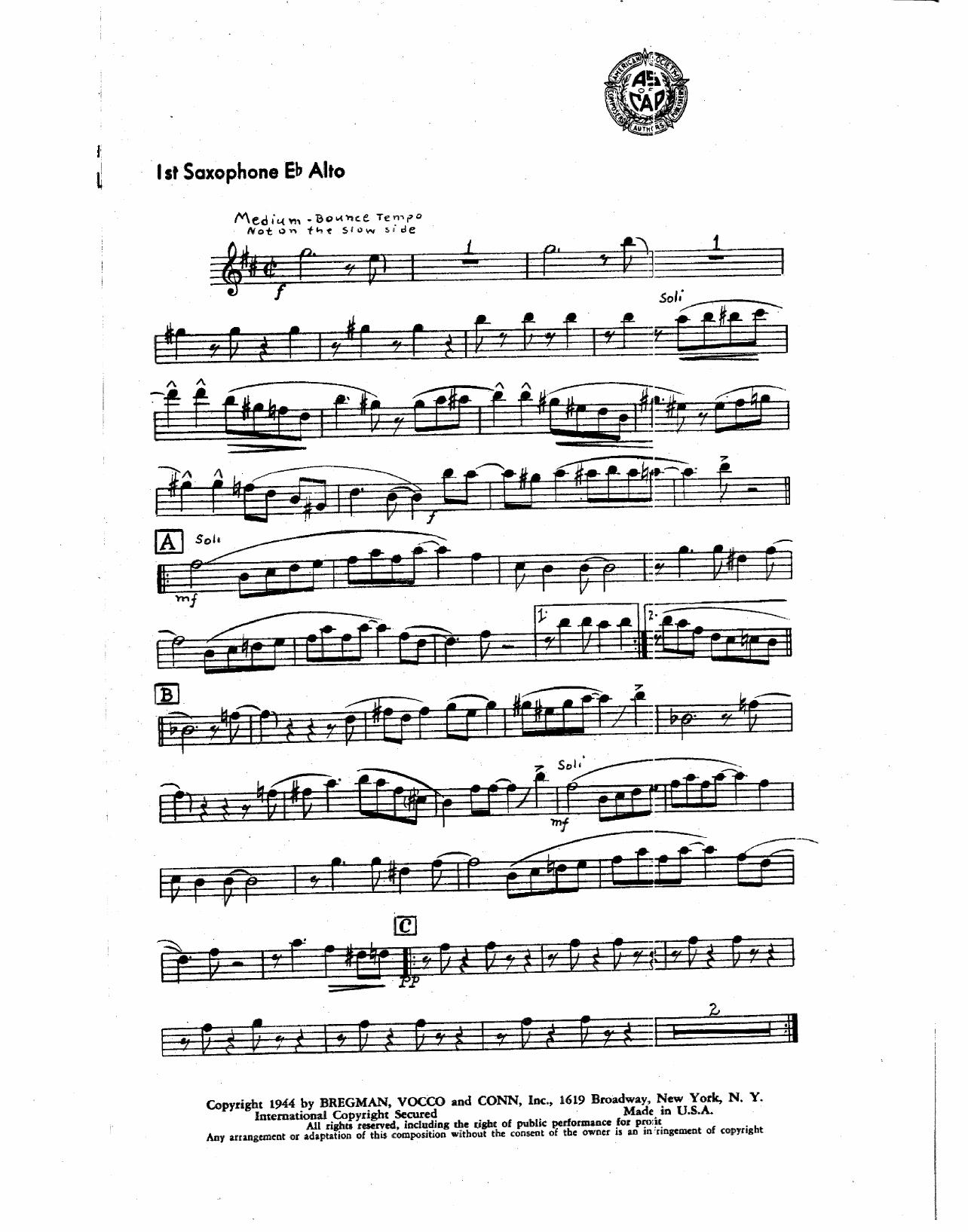
Swing Shift (B.Clayton) sheet music preview

Swing Shift (B.Clayton)

Composed by Buck Clayton

Arranged by Buck Clayton

  • Ensemble: Big Band
  • Pages: 42
  • Instruments (16): 1st Saxophone Eb Alto, 2nd Saxophone Bb Tenor, 3rd Saxophone Eb Alto, 4th Saxophone Bb Tenor, 5th Eb Baritone Saxophone, 1st Trumpet in Bb, 2nd Trumpet in Bb, 3rd Trumpet in Bb, 1st Trombone, 2nd Trombone, 3rd Trombone, Bass, Guitar, Drums, 1st Violins (Conductor), Piano
  • Difficulty: medium
  • Content: Individual Parts
  • Format: PDF Download (Instant)
  • Price: $24.99

Master architect of the Kansas City swing tradition and Count Basie alumnus Buck Clayton brings his unmistakable elegance and blues-drenched sophistication to "Swing Shift," a quintessential mid-century big band chart that encapsulates the spontaneous joy and driving momentum of the classic swing era. Originally conceived during the height of the post-war small-group and medium-ensemble sessions that defined Clayton’s globetrotting career as a bandleader and arranger, this composition bridges the gap between relaxed, after-hours jam session vibes and precision big band execution. Clayton, renowned for his lyrical trumpet phrasing and innate understanding of dynamic pacing, infuses the work with a polished, laid-back intensity that honors the foundational tenets of Southwestern swing while offering a masterclass in economic and tasteful orchestration. Anchored by an infectious, medium-tempo 4/4 swing groove, "Swing Shift" radiates a cool, confident energy characterized by buoyant walking basslines and crisp, conversational horn voicings. The harmonic landscape is rooted in traditional blues and American popular song forms, utilizing rich extended major and minor extensions, clever chromatic passing tones, and classic Kansas City riff-based development. The mood shifts effortlessly from sultry and understated to high-spirited and swinging, evoking late-night smoke-filled lounges and high-energy dance halls alike. Clayton’s writing avoids clutter, instead prioritizing transparency, space, and rhythmic interplay between sections, allowing the underlying groove to breathe organically while maintaining a relentless forward momentum. In this intimate yet punchy layout tailored for a flexible 7-instrument ensemble (comprising Alto Saxophone, Tenor Saxophone, Trumpet, Trombone, Piano, and rhythm section support), Clayton showcases his genius for making a smaller horn section sound like a full, roaring twelve-piece band. The arrangement relies heavily on tight, harmonized horn solis where the alto and tenor saxophones weave fluid countermelodies against brass stabs, while the piano anchors the harmonic framework with characteristic stride-informed comping and rhythmic urgency. Melody statements are traded cleanly between the trumpet and saxophone voices, building toward a cohesive, hard-swinging shout chorus that distills the essence of a classic Basie-style climax into an accessible, high-impact format across the 42 pages of comprehensive score and parts. Advanced high school, collegiate, and professional chamber jazz ensembles will find this chart an exceptional vehicle for developing stylistic authenticity, internal time, and section blending. Because the ensemble size is streamlined to 7 instruments, individual players cannot hide; every musician must possess a strong grasp of swing articulation, eighth-note phrasing, and dynamic control. The technical challenges lie less in breakneck finger-busters and more in the subtle nuances of ensemble phrasing—matching vibrato, executing sharp staccato accents, and swinging hard at a moderate tempo. For directors seeking to instill genuine jazz phrasing and historical awareness without the logistical weight of a full 17-piece big band, this arrangement delivers an authentic, deeply rewarding educational and performance experience. Success with "Swing Shift" hinges on achieving an authentic, relaxed medium-swing feel (approx. quarter note = 116–124 BPM) that never drags nor rushes. Conductors should emphasize that the eighth notes must be swung loosely, following the traditional Kansas City late-placement feel rather than a rigid triplet subdivision. Horn players must pay strict attention to articulation markings: treat all unaccented notes with a smooth, connected airflow, and give short, crisp accents to off-beat staccato figures. The rhythm section is the engine of this chart; the pianist should avoid over-comping, leaving plenty of room for the horns while providing sharp, rhythmic jabs on the backend of beats. Brass players should utilize subtle cup or bucket mutes if a darker, vintage timbre is desired during the head statements, though open horns are preferred for maximum projection during the ensemble shout choruses. Rehearsals should initially focus on isolated section work for the saxophone and brass counterlines, ensuring dynamic balance before integrating the rhythm section's groove. Q: What instruments and parts are included in this arrangement? A: This 42-page publication includes written parts and score for a 7-instrument ensemble featuring Alto Saxophone, Tenor Saxophone, Trumpet, Trombone, Piano, and integrated rhythm section support. Q: What is the difficulty level of this chart? A: This arrangement is well-suited for advanced high school, collegiate, and professional small jazz ensembles, requiring a strong grasp of medium-swing phrasing and individual part independence. Q: What is the historical style and background of "Swing Shift"? A: Written by jazz luminary Buck Clayton, the piece embodies the sophisticated, blues-infused Kansas City swing tradition popularized by Count Basie and post-war small-group swing innovators. Q: What makes this specific Buck Clayton arrangement unique? A: It condenses the power, dynamic range, and rich harmonic interplay of a full swing big band into a tight 7-instrument format without sacrificing punch, transparency, or authentic shout-chorus energy. Q: What is the recommended performance tempo and duration? A: The chart is designed for a medium swing tempo of approximately 116 to 124 BPM, resulting in a standard performance duration of around 3 to 4 minutes depending on solo rotations.

Questions and answers

What is included in the Swing Shift (B.Clayton) PDF?
The verified current file contains a conductor score and individual parts across 42 pages.
How many instruments or parts are listed for Swing Shift (B.Clayton)?
The verified instrumentation list contains 16 entries for this Big Band arrangement.
Who is credited for Swing Shift (B.Clayton)?
Composer: Buck Clayton. Arranger: Buck Clayton.
What difficulty is listed for Swing Shift (B.Clayton)?
The verified difficulty level is medium.
Can I preview Swing Shift (B.Clayton) before buying?
Yes. The product page provides a preview generated from the current PDF file.
How is Swing Shift (B.Clayton) delivered?
After successful payment, the digital PDF is made available for download. The displayed price is $24.99.

Musicians Also Search For

Swing Shift Buck Clayton PDFSwing Shift Buck Clayton sheet musicSwing Shift arranged by Buck ClaytonBuck Clayton big band chartsBuck Clayton jazz arrangements PDFSwing Shift Buck Clayton big band arrangementsSwing Shift big band arrangementsSwing Shift big band PDF downloadSwing Shift jazz sheet musicbig band sheet music downloadSwing Shift conductor score PDFSwing Shift individual parts downloadSwing Shift sheet music PDFbuy Swing Shift sheet musicdownload Swing Shift PDFSwing Shift jazz chartsbest Buck Clayton big band arrangementsSwing Shift printable sheet musicbig band repertoire PDF

All arrangements by Buck Clayton All Buck Clayton sheet music