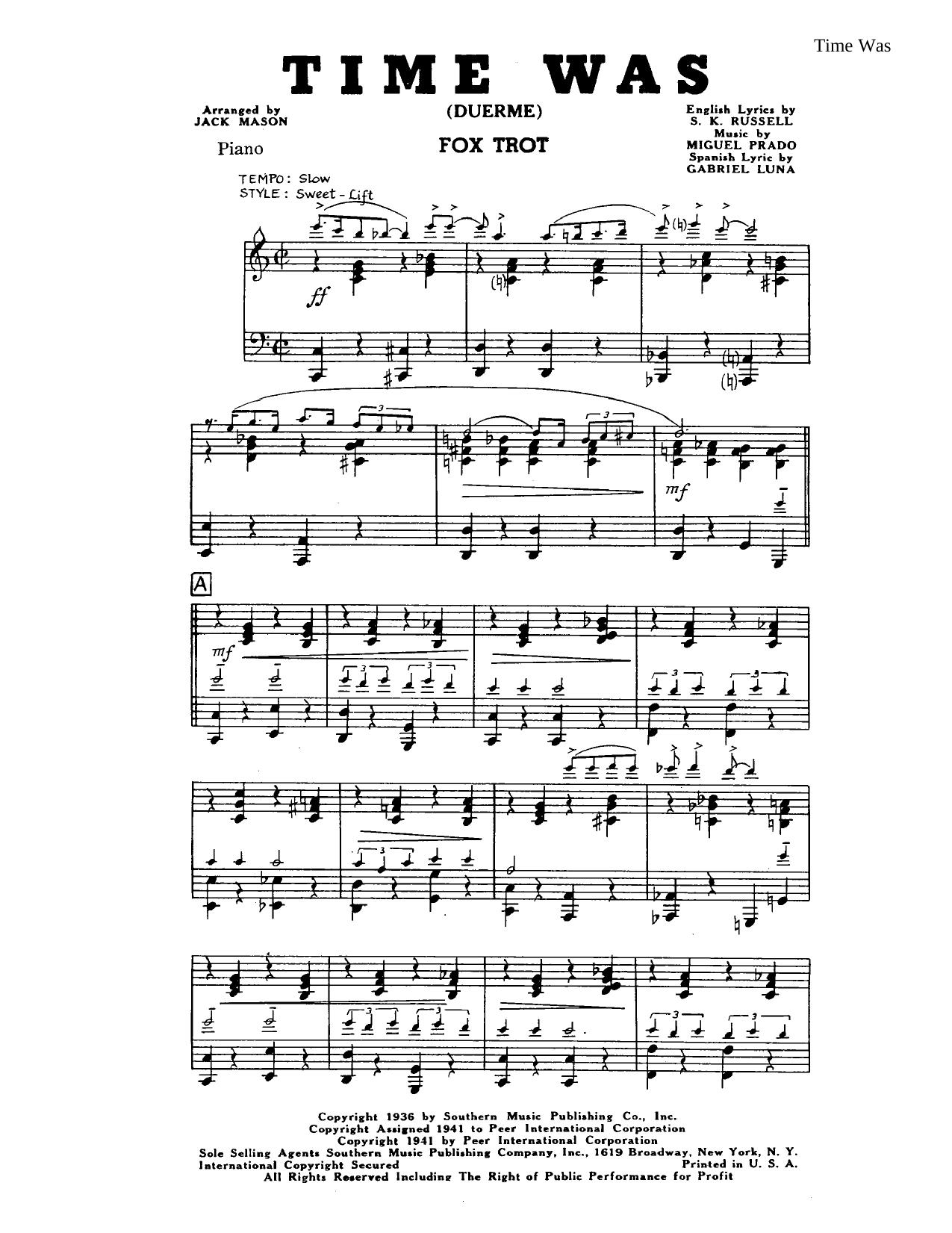
Time Was (J.Mason) sheet music preview

Time Was (J.Mason)

Composed by Miguel Prado

Arranged by Jack Mason

  • Ensemble: Big Band
  • Pages: 26
  • Instruments (13): Piano, 1st Trumpet, 1st Sax. Eb Alto, 2nd Sax. Bb Tenor, 3rd Sax. Eb Alto, 4th Sax. Bb Tenor, 2nd Bb Trumpet, 3rd Bb Trumpet, 1st Trombone, 2nd Trombone, Bass, Drums, Guitar
  • Difficulty: medium
  • Content: Individual Parts
  • Format: PDF Download (Instant)
  • Price: $24.99

Originating from the mid-1930s creation "Duerme" by Mexican composer Miguel Prado, this timeless melody crossed over into the American jazz and pop canon as "Time Was" following English lyrics by S.K. Russell. Embraced by seminal big bands and vocalists of the swing era—including Jimmy Dorsey and Xavier Cugat—the composition bridges lush Latin-infused romanticism with sophisticated mid-century jazz harmony. Jack Mason’s masterwork big band adaptation captures the inherent nostalgia and lyrical grace of the original theme while translating it seamlessly into a modern jazz ensemble framework, making it a sophisticated addition to any serious repertoire library. Built upon a flowing, medium-tempo swing and Latin-infused groove, the arrangement establishes an evocative, bittersweet mood characterized by rich chord extensions and warm, shimmering textures. The harmonic landscape shifts gracefully between minor-mode melancholy and lush major-seventh resolutions, evoking the classic late-night sophistication of 1940s supper clubs. Mason expertly balances transparent, breathing ensemble passages with thick, harmonically dense block-voicing structures, creating a dynamic emotional arc that moves seamlessly from introspective reflection to swelling, passionate climaxes. Jack Mason’s distinctive arranging style shines through the meticulous voice-leading and clever sectional interplay. Rather than relying on constant heavy tutti writing, Mason deploys sophisticated woodwind-style saxophone solis and muted brass counterlines that weave organically around the core thematic material. The brass writing utilizes subtle plunger effects and warm cup-mute timbres to pay homage to the tune’s Latin roots while maintaining a robust, contemporary big band swing vocabulary. A carefully constructed shout chorus serves as the emotional peak, cleanly modulating textures and building rhythmic intensity before resolving gracefully back into the recapitulation of the main melody. The melodic burden is shared thoughtfully across the ensemble, featuring prominent lines carried by the lead alto saxophone and first trumpet, supported by lush, harmonized trombone pads. Improvisational opportunities are provided via structured solo space, allowing featured performers to stretch out over accessible, jazz-standard changes. Technically, the chart demands precise breath control, crisp articulation in the saxophone section, and a mature, controlled approach to dynamic contrast from the brass. Performers and audiences alike will find immense satisfaction in the intricate inner voices and the clever harmonic turnarounds that pepper the chart from top to bottom. Tailored ideally for advanced high school, collegiate, and professional community big bands, this 26-page chart offers an exceptional vehicle for developing stylistic versatility. Directors will appreciate how the arrangement rewards meticulous sectional tuning, balanced voicing, and stylistic adherence to a hybrid swing-bolero feel. It stands as an evergreen concert piece that balances audience accessibility with profound artistic depth. Achieving the authentic character of this arrangement requires strict attention to the hybrid tempo feel: a relaxed, pulsing medium groove that marries traditional swing subdivision with subtle Latin warmth. Avoid rushing the quarter-note pulse; let the rhythm section anchor an unhurried, magnetic pocket. Technically, the brass section must navigate subtle dynamic shifts and precise articulation, particularly during muted passages. Trumpet 1 and Trombone 1 should ensure their lead lines project smoothly over the dense inner voicings without forcing tone quality. Cup mutes and optional plunger technique should be clean and unified within sections to preserve color balance. Rehearsal strategy should initially isolate the rhythm section to lock in the foundational groove before layering in the saxophones and brass. Pay close attention to the exposed inner-voice harmonies in the lower reeds and bones to ensure the complex chordal extensions speak clearly. Balance the shout chorus carefully so that the ensemble peaks dynamically without burying the lead melodic statements. Q: What instruments and parts are included in this arrangement? A: The 26-page set includes full instrumentation for 13 instruments, featuring Piano, Trumpet 1, Trombone 1, Alto Saxophone 1, Alto Saxophone 2, and accompanying big band sections. Q: What is the difficulty level of this chart? A: This arrangement is tailored for advanced high school, collegiate, and professional community big bands, requiring strong sectional blend, dynamic control, and stylistic versatility. Q: What is the historical style and background of the piece? A: The piece is based on Miguel Prado's classic 1930s Latin standard "Duerme", adapted into the American jazz canon as "Time Was" and arranged here in a sophisticated mid-century swing idiom. Q: What makes Jack Mason’s arrangement unique? A: Mason uniquely blends lush, Latin-inflected harmonic extensions with traditional big band voicings, incorporating transparent woodwind solis, warm muted brass effects, and a dynamic shout chorus. Q: What is the recommended performance tempo and duration? A: The chart is designed for a relaxed, medium-tempo swing feel that comfortably highlights the melodic narrative, typically running between three and a half to four minutes in performance.

Questions and answers

What is included in the Time Was (J.Mason) PDF?
The verified current file contains individual parts across 26 pages.
How many instruments or parts are listed for Time Was (J.Mason)?
The verified instrumentation list contains 13 entries for this Big Band arrangement.
Who is credited for Time Was (J.Mason)?
Composer: Miguel Prado. Arranger: Jack Mason.
What difficulty is listed for Time Was (J.Mason)?
The verified difficulty level is medium.
Can I preview Time Was (J.Mason) before buying?
Yes. The product page provides a preview generated from the current PDF file.
How is Time Was (J.Mason) delivered?
After successful payment, the digital PDF is made available for download. The displayed price is $24.99.

Musicians Also Search For

Time Was Jack Mason PDFTime Was Jack Mason sheet musicTime Was arranged by Jack MasonJack Mason big band chartsJack Mason jazz arrangements PDFTime Was Miguel Prado sheet musicTime Was Miguel Prado big band arrangementsMiguel Prado big band chartsTime Was big band arrangementsTime Was big band PDF downloadTime Was jazz sheet musicbig band sheet music downloadTime Was individual parts downloadTime Was sheet music PDFbuy Time Was sheet musicdownload Time Was PDFTime Was jazz chartsbest Jack Mason big band arrangementsMiguel Prado arranged by Jack MasonTime Was printable sheet musicbig band repertoire PDF

All arrangements by Jack Mason All Miguel Prado sheet music