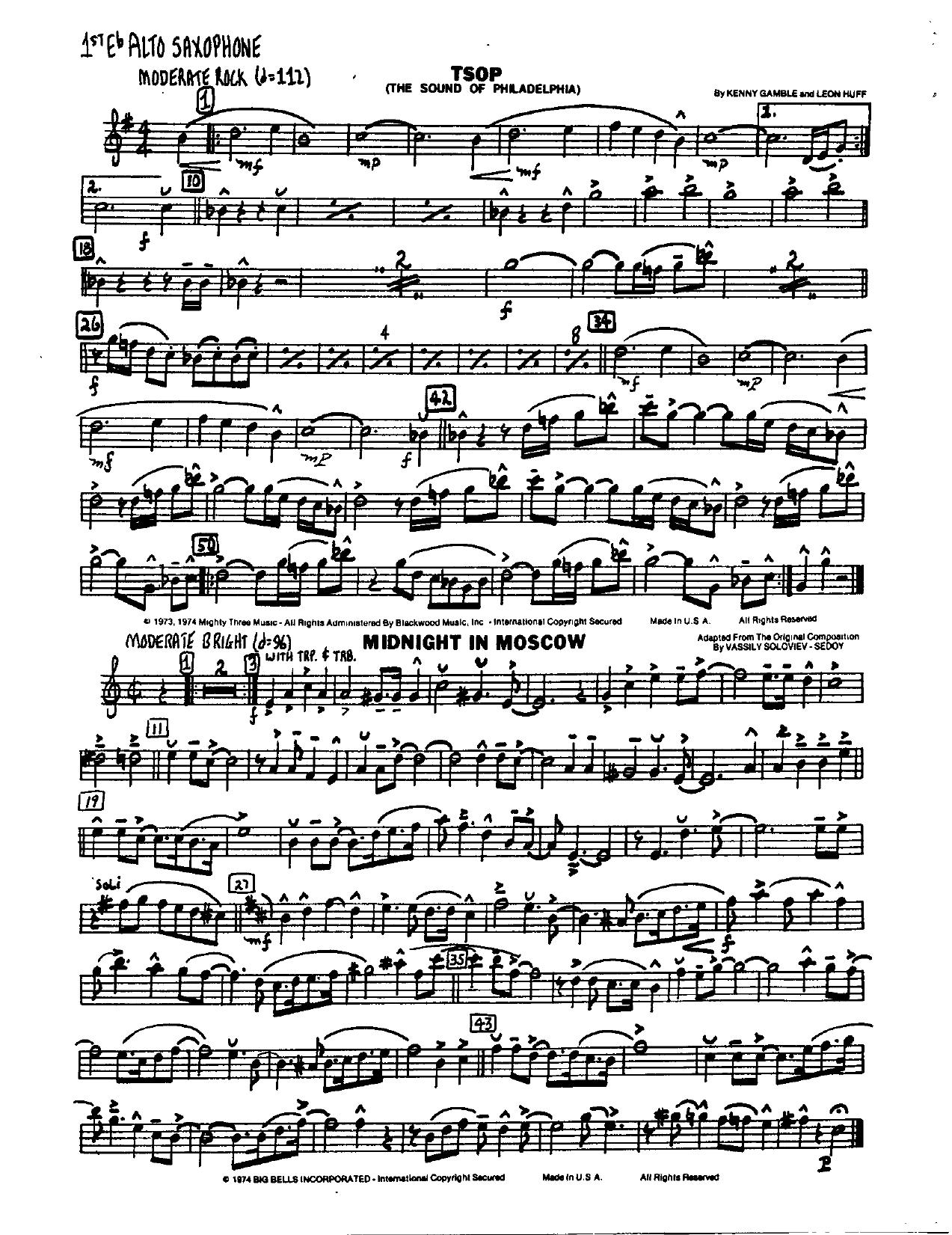
Midnight In Moscow (V.P.Sedov) sheet music preview

Midnight In Moscow (V.P.Sedov)

Composed by Vasily Solovyov-Sedoy

Arranged by V.P.Sedov

  • Ensemble: Big Band
  • Style: Jazz Standard
  • Pages: 18
  • Instruments (18): 1st Eb Alto Saxophone, 2nd Eb Alto Saxophone, 1st Bb Tenor Saxophone, 2nd Bb Tenor Saxophone, 3rd Bb Tenor Saxophone (Optional), Eb Baritone Saxophone, 1st Bb Trumpet, 2nd Bb Trumpet, 3rd Bb Trumpet (Optional), 4th Bb Trumpet (Optional), 1st Trombone, 2nd Trombone (Optional), 3rd Trombone (Optional), 4th Trombone (Optional), Piano, Drums, Guitar, Bass
  • Difficulty: easy
  • Content: Individual Parts
  • Format: PDF Download (Instant)
  • Price: $24.99

Originally composed in 1956 by Vasily Solovyov-Sedoy with lyrics by Mikhail Matusovsky as "Moscow Nights" (*Podmoskovnye Vechera*), this timeless melody achieved unprecedented global acclaim during the Cold War era, eventually becoming one of the most widely performed and recognized Russian songs in international music history. Its gentle, melancholic yearning easily bridged the gap between traditional European folk sensibilities and mid-century popular song forms. Over subsequent decades, the tune migrated naturally into the jazz idiom, embraced by jazz instrumentalists worldwide who found rich harmonic potential beneath its deceptively simple, minor-mode phrasing. V.P.Sedov’s sophisticated big band interpretation transforms the iconic lyrical theme into a refined jazz standard, casting the arrangement in a evocative, medium-tempo swing feel that highlights the inherent nostalgic warmth of the original composition. Set in a minor key that alternates gracefully with relative major interludes, the mood shifts seamlessly from introspective late-night contemplation to soaring, brass-heavy expansiveness. The energy builds with calculated precision, evoking the quiet, atmospheric charm of an urban landscape in the small hours of the morning, yet maintaining a steady, rhythmic pulse that drives the arrangement forward without ever losing its sophisticated composure. The arranger’s signature approach relies heavily on lush, extended post-bop chord voicings in the saxophone section, juxtaposed against muted trumpet counter-melodies that evoke classic modal jazz textures. Sedov builds structural momentum through a transparent texture at the outset, gradually expanding the harmonic density before culminating in a tightly orchestrated, harmonically rich shout chorus. This section avoids heavy-handed bombast, opting instead for sophisticated chordal shifts and subtle dynamic swells that reward an ensemble capable of nuanced blend and balance. Melodic responsibility is shared democratically across the ensemble, opening with a smoky tenor saxophone and muted trumpet dialogue before handing the main theme to a full, harmonized sax soli. Solo opportunities are provided for lead trumpet and piano, allowing featured improvisers to stretch out over a modal-inflected minor blues progression. Technically, the 18-page chart demands confident intonation in tight upper-structure voicings and precise rhythmic articulation on swung eighth-note figures. Advanced high school, collegiate, and professional community big bands will find this arrangement an ideal centerpiece for a concert program, offering sophisticated musicality that challenges the section players while providing an immediate, captivating connection with the audience. Achieving the authentic atmosphere of V.P.Sedov’s "Midnight In Moscow" hinges on maintaining a relaxed, unhurried medium-swing tempo (approx. Quarter Note = 112–116 BPM). The primary technical challenge lies in the execution of the sustained, lyrical lines; players must avoid clipping the ends of phrases and ensure a smooth, vocal-like connection between notes. Conductors should pay close attention to the dynamic contrast between the muted brass and open saxophones in the opening choruses. Muted passages—utilizing harmon or cup mutes where indicated—must blend without sounding harsh or piercing. The rhythm section should drive the swing feel without over-playing; the drummer should favor a light ride-cymbal sizzle and understated hi-hat on beats two and four, keeping the bass line walking with an acoustic, woody tone. In the shout chorus, ensure the brass articulations (accented staccatos contrasting with smooth legato lines) are sharply defined across all three trumpet and two trombone parts. Rehearsals should initially focus on sectional tuning, particularly on the altered dominant chords that underpin the arrangement's signature modulations. Q: What instruments and parts are included in this big band arrangement? A: The arrangement is scored for a standard 18-instrument big band lineup spanning 18 pages of music, including Alto Saxophone 1 & 2, Tenor Saxophone 1 & 2, Tenor Saxophone 3 (Optional), Baritone Saxophone, 4 Trumpets, 4 Trombones, Piano, Guitar, Bass, and Drums. Q: What is the difficulty level of this chart? A: This arrangement is graded as medium-advanced, making it best suited for accomplished high school ensembles, university jazz bands, and professional community big bands with strong section players and confident lead soloists. Q: What is the musical style and historical background of the piece? A: It is styled as a sophisticated jazz standard adaptation of Vasily Solovyov-Sedoy’s famous 1956 mid-century European melody, blending traditional melancholic minor-key phrasing with a polished, contemporary medium-swing big band aesthetic. Q: What makes V.P.Sedov’s arrangement unique? A: Sedov distinctively blends lush, extended post-bop saxophone voicings with modal-inflected minor harmonies and a dynamically restrained shout chorus, creating a moody, cinematic atmosphere that elevates a classic folk melody into a high-art jazz chart. Q: What is the performance duration and recommended tempo? A: The arrangement runs approximately 4 to 5 minutes in duration when performed at the recommended medium-swing tempo of quarter note equals 112 to 116 BPM.

Questions and answers

What is included in the Midnight In Moscow (V.P.Sedov) PDF?
The verified current file contains individual parts across 18 pages.
How many instruments or parts are listed for Midnight In Moscow (V.P.Sedov)?
The verified instrumentation list contains 18 entries for this Big Band arrangement.
Who is credited for Midnight In Moscow (V.P.Sedov)?
Composer: Vasily Solovyov-Sedoy. Arranger: V.P.Sedov.
What difficulty is listed for Midnight In Moscow (V.P.Sedov)?
The verified difficulty level is easy.
What style is listed for Midnight In Moscow (V.P.Sedov)?
The catalog lists the style as Jazz Standard.
Can I preview Midnight In Moscow (V.P.Sedov) before buying?
Yes. The product page provides a preview generated from the current PDF file.
How is Midnight In Moscow (V.P.Sedov) delivered?
After successful payment, the digital PDF is made available for download. The displayed price is $24.99.

Musicians Also Search For

Midnight In Moscow V.P.Sedov PDFMidnight In Moscow V.P.Sedov sheet musicMidnight In Moscow arranged by V.P.SedovV.P.Sedov big band chartsV.P.Sedov jazz arrangements PDFMidnight In Moscow Vasily Solovyov-Sedoy sheet musicMidnight In Moscow Vasily Solovyov-Sedoy big band arrangementsVasily Solovyov-Sedoy big band chartsMidnight In Moscow big band arrangementsMidnight In Moscow big band PDF downloadMidnight In Moscow jazz sheet musicbig band sheet music downloadMidnight In Moscow individual parts downloadMidnight In Moscow sheet music PDFMidnight In Moscow Jazz Standard chartsJazz Standard big band arrangementsbuy Midnight In Moscow sheet musicdownload Midnight In Moscow PDFMidnight In Moscow jazz chartsbest V.P.Sedov big band arrangementsVasily Solovyov-Sedoy arranged by V.P.SedovMidnight In Moscow printable sheet musicbig band repertoire PDF

All arrangements by V.P.Sedov All Vasily Solovyov-Sedoy sheet music