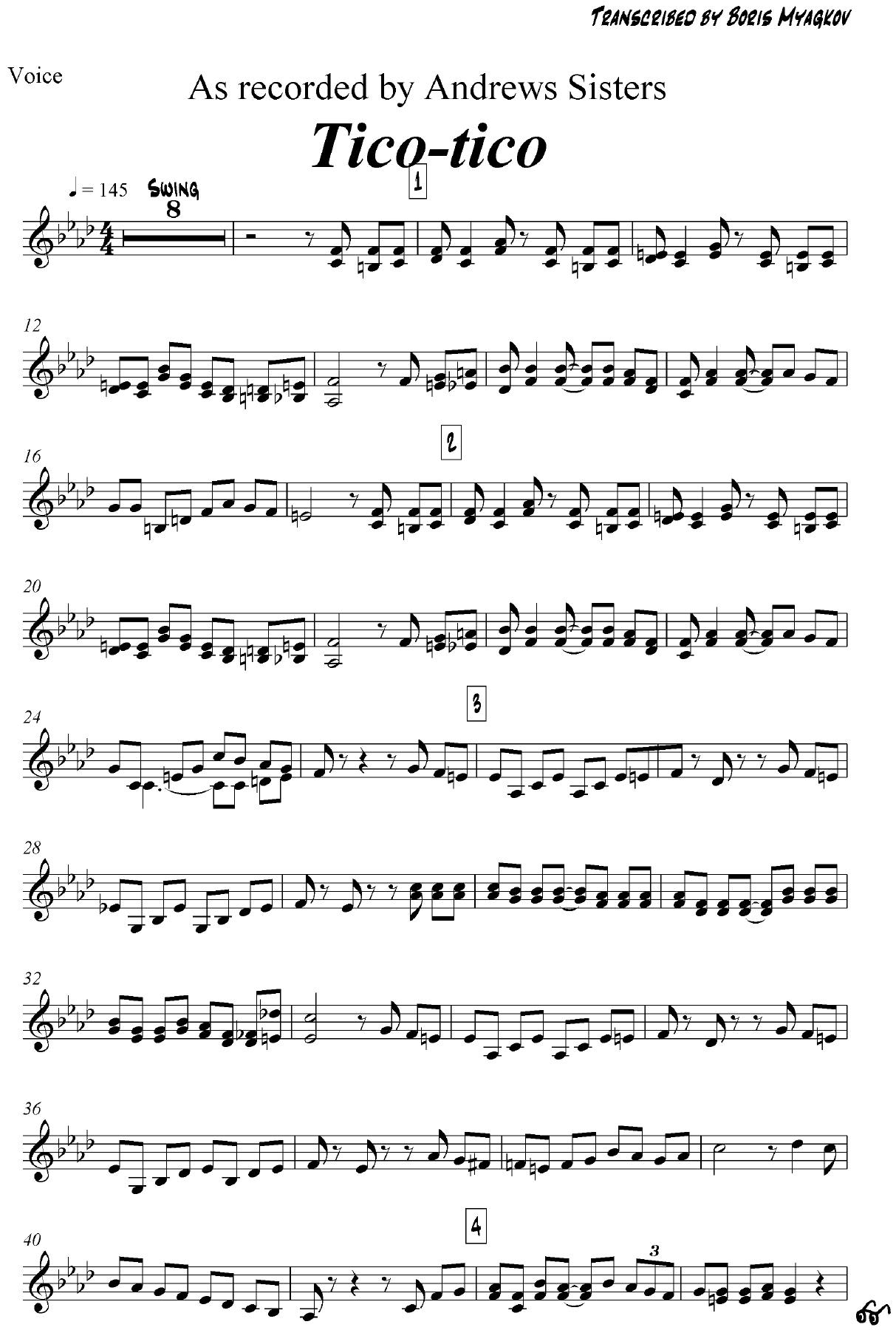
Tico Tico (B.Myagkow)
Composed by Zequinha de Abreu
Arranged by Boris Myagkov
- Ensemble: Big Band
- Style: Jazz Standard
- Pages: 26
- Instruments (17): Voice, Clarinet, Alto sax 1, Alto sax 2, Tenor sax, Baritone Sax, Trumpet 1, Trumpet 2, Trumpet 3, Trumpet 4, Trumpet 5, Trombone 1, Trombone 2, Trombone 3, Bass Trombone, Acoustic Bass, Drums
- Difficulty: medium
- Content: Individual Parts
- Format: PDF Download (Instant)
- Price: $24.99
"Tico Tico no Fubá," originally penned by Brazilian composer Zequinha de Abreu in 1917, stands as a cornerstone of the *choro* genre, a vibrant and often virtuosic instrumental music style that emerged in Rio de Janeiro during the 1870s. While *choro* translates to "lament," the music itself is frequently characterized by its upbeat, rhythmic energy, a quality perfectly embodied by "Tico Tico." The piece gained international renown and cemented its status as a jazz standard through its adoption by American popular culture, most notably by Carmen Miranda in the 1947 film *Copacabana* and via recordings by artists like Ethel Smith and The Andrews Sisters. Its infectious melody and intricate rhythmic structure have made it a perennial favorite, transcending its Brazilian roots to become a global symbol of lively, Latin-infused musicality. This Boris Myagkov arrangement transforms the spirited choro into a high-energy, up-tempo swing big band chart, typically performed around a brisk quarter note of 145 BPM. The primary key signature is likely to be bright and engaging, fostering an exuberant and celebratory mood throughout. Myagkov's signature approach to big band arranging often involves meticulous transcriptions and adaptations of popular tunes, emphasizing clear voicings, dynamic contrasts, and the inherent swing feel of the big band idiom. His arrangements are known for their precision and ability to capture the essence of the original while imbuing it with a powerful, driving jazz sensibility. The arrangement features a prominent vocal part, carrying the iconic melody, which is expertly woven into the rich tapestry of the full big band. Beyond the vocalist, the arrangement highlights the distinctive sound of a clarinet, often taking on melodic duties or engaging in intricate counterpoint. Expect vibrant soli sections from the saxophone and brass choirs, showcasing the ensemble's precision and blend. Myagkov's charts frequently include well-crafted shout choruses that build excitement and provide climactic moments. While specific solo sections are not explicitly detailed, the nature of a jazz standard arrangement of this caliber often implies opportunities for improvised solos, likely over the form, providing a platform for individual expression within the ensemble. The technical challenges lie in maintaining the relentless up-tempo swing feel, navigating intricate rhythmic figures, and achieving a tight, unified ensemble sound across the full 17-instrument orchestration. The rewarding aspects include the sheer joy of performing such an iconic and energetic piece, the interplay between the vocal and instrumental lines, and the powerful impact of a well-executed big band swing chart. Given its comprehensive instrumentation and the demands of an up-tempo swing chart, this arrangement is ideally suited for college-level jazz ensembles, advanced community big bands, and professional groups. High school bands with exceptional talent and dedicated rehearsal time may also find it a challenging yet highly rewarding endeavor. The arrangement's detailed scoring across 31 pages, including a full conductor score, ensures that all musical nuances are captured, allowing for a polished and impactful performance. The inclusion of a clarinet part, alongside the standard saxophone section, adds a unique textural color that harks back to classic big band sounds while providing additional melodic interest. Conductors should emphasize a consistent, driving up-tempo swing feel, ensuring that the rhythm section establishes a solid foundation from the outset. Pay close attention to articulation, particularly in the brass and saxophone soli sections, aiming for crisp, unified attacks and releases to maintain clarity at speed. The vocal part requires strong projection and rhythmic accuracy to cut through the full ensemble, while the clarinet feature demands a player with excellent technical facility and a bright, focused tone. Rehearsal time should be dedicated to sectional work on intricate rhythmic passages and ensuring precise ensemble entrances and cut-offs. Dynamic contrasts are crucial; encourage players to lean into the shout choruses with full energy while maintaining control. No special techniques like plunger mutes or falls are explicitly indicated, suggesting a focus on clean, traditional big band execution. **Q: What instruments are included in this arrangement?** A: This arrangement is scored for a full big band, including Voice, Clarinet, Alto Saxophone 1, Alto Saxophone 2, Tenor Saxophone (likely two parts), Baritone Saxophone, Trumpet (likely four parts), Trombone (likely four parts), Guitar, Piano, Bass, and Drums, totaling 17 instruments. **Q: What is the difficulty level of this arrangement?** A: This arrangement is considered to be of medium to advanced difficulty, suitable for college-level jazz ensembles, advanced community big bands, and professional groups due to its up-tempo swing feel and intricate scoring. **Q: What is the musical style and historical context of "Tico Tico no Fubá"?** A: "Tico Tico no Fubá" is a Brazilian *choro* piece composed by Zequinha de Abreu in 1917. It became a popular jazz standard, particularly in the 1940s, known for its lively, rhythmic character and Latin-infused melodies. **Q: What makes Boris Myagkov's arrangement of "Tico Tico" unique?** A: Boris Myagkov's arrangement transforms the original *choro* into a high-energy, up-tempo swing big band chart, featuring a vocal part, a prominent clarinet, vibrant soli sections, and powerful shout choruses, all characteristic of his meticulous and dynamic arranging style. **Q: What is the typical performance tempo for this arrangement?** A: This arrangement is designed for an up-tempo swing feel, typically performed around a brisk quarter note of 145 beats per minute, contributing to its energetic and celebratory mood.
Questions and answers
- What is included in the Tico Tico (B.Myagkow) PDF?
- The verified current file contains a conductor score and individual parts across 26 pages.
- How many instruments or parts are listed for Tico Tico (B.Myagkow)?
- The verified instrumentation list contains 17 entries for this Big Band arrangement.
- Who is credited for Tico Tico (B.Myagkow)?
- Composer: Zequinha de Abreu. Arranger: Boris Myagkov.
- What difficulty is listed for Tico Tico (B.Myagkow)?
- The verified difficulty level is medium.
- What style is listed for Tico Tico (B.Myagkow)?
- The catalog lists the style as Jazz Standard.
- Can I preview Tico Tico (B.Myagkow) before buying?
- Yes. The product page provides a preview generated from the current PDF file.
- How is Tico Tico (B.Myagkow) delivered?
- After successful payment, the digital PDF is made available for download. The displayed price is $24.99.
Musicians Also Search For
Tico Tico Boris Myagkov PDF • Tico Tico Boris Myagkov sheet music • Tico Tico arranged by Boris Myagkov • Boris Myagkov big band charts • Boris Myagkov jazz arrangements PDF • Tico Tico Zequinha de Abreu sheet music • Tico Tico Zequinha de Abreu big band arrangements • Zequinha de Abreu big band charts • Tico Tico big band arrangements • Tico Tico big band PDF download • Tico Tico jazz sheet music • big band sheet music download • Tico Tico conductor score PDF • Tico Tico individual parts download • Tico Tico sheet music PDF • Tico Tico Jazz Standard charts • Jazz Standard big band arrangements • buy Tico Tico sheet music • download Tico Tico PDF • Tico Tico jazz charts • best Boris Myagkov big band arrangements • Zequinha de Abreu arranged by Boris Myagkov • Tico Tico printable sheet music • big band repertoire PDF