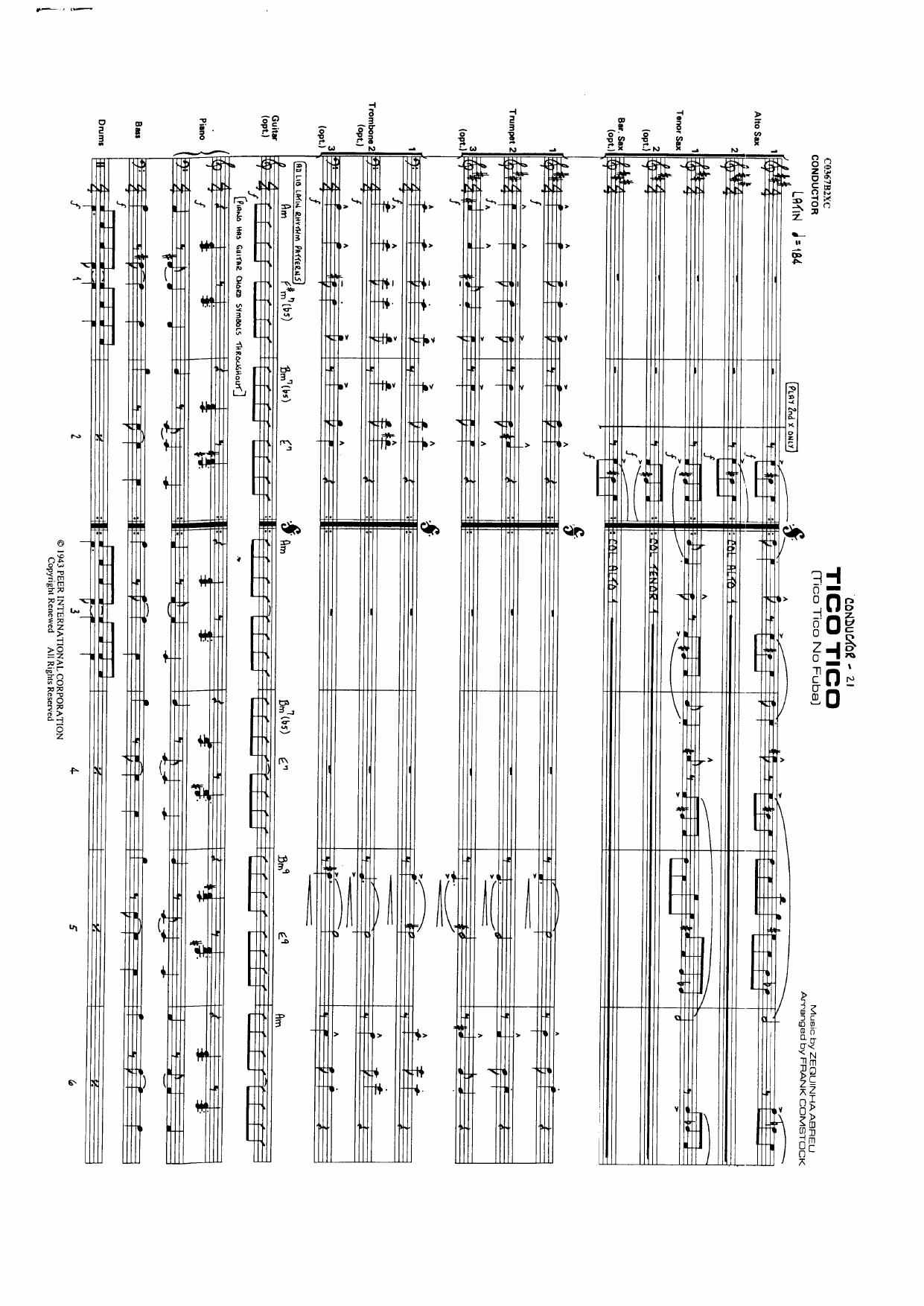
Tico Tico (F.Comstock)
Composed by Zequinha de Abreu
Arranged by Frank Comstock
- Ensemble: Big Band
- Pages: 22
- Instruments (15): 1st Eb Alto Saxophone, 2nd Eb Alto Saxophone, 1st Bb Tenor Saxophone, 2nd Bb Tenor Saxophone, Eb Baritone Saxophone, 1st Bb Trumpet, 2nd Bb Trumpet, 3rd Bb Trumpet, 1st Trombone, 2nd Trombone, 3rd Trombone, Piano, Guitar, Bass, Drums
- Difficulty: medium
- Content: Individual Parts
- Format: PDF Download (Instant)
- Price: $24.99
Zequinha de Abreu’s immortal choro masterpiece "Tico-Tico no Fubá" has traversed boundaries from Brazilian street music to global prominence, most notably cemented in American consciousness through wildfire recordings and cinematic appearances during the mid-20th century. Originally penned in 1917, the tune became an international sensation, celebrated for its breakneck speed, infectious syncopation, and irrepressible joy. When translated into the jazz idiom, it offers a brilliant collision between traditional Brazilian choro and mid-century American big band arranging. This repertoire staple transforms a classic melody into a high-octane showcase, embodying the vibrant cross-cultural exchange that defined the golden age of big band jazz. Driven by an exhilarating, high-velocity Latin-swing groove in 4/4 time, this chart radiates non-stop kinetic energy and festive brilliance. The harmonic language sparkles with bright, optimistic major-mode tonalities juxtaposed against crisp chromatic descents and playful counter-melodies. From the opening statement to the final explosive chord, the mood is relentlessly exuberant, evoking a sense of festive carnival celebration and dizzying virtuosic display. The arrangement demands absolute rhythmic precision, as the groove relies heavily on tight, punctuated syncopations that must lock seamlessly between the rhythm section and the horn tiers. Arranger Frank Comstock, renowned for his sophisticated west coast polish and masterful command of large-jazz-ensemble textures, approaches "Tico Tico" with a brilliant blend of transparency and driving momentum. Rather than relying solely on brute volume, Comstock utilizes sparkling woodwind doublings, intricate cross-section voicings, and clever harmonic turnarounds to keep the texture light, agile, and continually surprising. The saxes and brass engage in rapid-fire conversational call-and-response patterns, leading into tightly knit soli sections that showcase section cohesion. Comstock’s signature writing shines in the dynamic contouring, building structural tension through cascading scalar passages and rhythmic displacement before releasing into exhilarating shout choruses. The melodic weight is shared dynamically across the entire ensemble, with woodwinds and brass frequently trading lightning-fast scalar runs. Featured solo spaces allow standout improvisers to stretch out over driving Latin-swing changes, while the rhythm section—particularly the percussion and drum kit—must maintain an authentic, unyielding groove underneath complex horn lines. Technical challenges center primarily on articulation clarity at high tempos and navigating accidental-heavy key centers across the saxophone and trumpet registers. For advanced high school, collegiate, and professional big bands, the reward lies in the sheer visceral thrill of executing Comstock’s intricate counterpoint and watching an audience respond to the breathtaking momentum of the performance. Conductors must approach Frank Comstock’s setting of "Tico Tico" with a primary focus on rhythmic crispness and ultra-controlled tempo management. Because the chart naturally begs to be pushed, establishing a stable, resilient tempo right from the downbeat is essential to prevent the ensemble from rushing through intricate scalar passages. The primary technical challenge rests in the articulation of fast, syncopated sixteenth-note figures. Brass players should utilize clean, light tonguing to ensure lines remain nimble rather than heavy or sluggish, while saxophonists must practice finger dexterity slowly with a metronome before attempting performance velocity. The rhythm section should lean into a buoyant, light-footed Latin-jazz feel, avoiding a heavy rock or stiff swing straight-eighth interpretation. Rehearsals should initially isolate the woodwind and brass soli sections at half-tempo, ensuring that dynamic balances between inner and outer voices are clearly established before integrating the full ensemble. Pay close attention to sudden dynamic shifts and accent placements, as Comstock uses these accents to define the structural architecture of the arrangement. Q: What specific instruments and parts are included in this big band arrangement? A: The instrumentation comprises a standard 15-instrument big band lineup including Alto Saxophone 1, Alto Saxophone 2, Tenor Saxophone 1, Tenor Saxophone 2, Baritone Saxophone, plus full brass and rhythm sections, accompanied by a comprehensive 22-page conductor score. Q: What is the difficulty level of this Frank Comstock arrangement? A: This arrangement is graded as advanced, making it best suited for collegiate, advanced high school, community, and professional big bands capable of handling rapid tempos and intricate section interplay. Q: What is the style and historical context of this piece? A: This piece adapts Zequinha de Abreu’s 1917 Brazilian choro standard into an energetic mid-century American big band jazz arrangement, blending Latin groove mechanics with classic swing-era orchestration. Q: What makes Frank Comstock’s treatment of "Tico Tico" unique? A: Comstock distinguishes his arrangement through transparent, West Coast-influenced voicings, sparkling woodwind integration, and rapid-fire call-and-response patterns that maintain clarity even at breakneck speeds. Q: What is the expected performance duration and tempo feel of the chart? A: The arrangement is set at a blistering, up-tempo Latin-swing groove designed to run approximately 3 to 4 minutes, depending on the chosen tempo and the inclusion of improvised solo choruses.
Questions and answers
- What is included in the Tico Tico (F.Comstock) PDF?
- The verified current file contains a conductor score and individual parts across 22 pages.
- How many instruments or parts are listed for Tico Tico (F.Comstock)?
- The verified instrumentation list contains 15 entries for this Big Band arrangement.
- Who is credited for Tico Tico (F.Comstock)?
- Composer: Zequinha de Abreu. Arranger: Frank Comstock.
- What difficulty is listed for Tico Tico (F.Comstock)?
- The verified difficulty level is medium.
- Can I preview Tico Tico (F.Comstock) before buying?
- Yes. The product page provides a preview generated from the current PDF file.
- How is Tico Tico (F.Comstock) delivered?
- After successful payment, the digital PDF is made available for download. The displayed price is $24.99.
Musicians Also Search For
Tico Tico Frank Comstock PDF • Tico Tico Frank Comstock sheet music • Tico Tico arranged by Frank Comstock • Frank Comstock big band charts • Frank Comstock jazz arrangements PDF • Tico Tico Zequinha de Abreu sheet music • Tico Tico Zequinha de Abreu big band arrangements • Zequinha de Abreu big band charts • Tico Tico big band arrangements • Tico Tico big band PDF download • Tico Tico jazz sheet music • big band sheet music download • Tico Tico conductor score PDF • Tico Tico individual parts download • Tico Tico sheet music PDF • buy Tico Tico sheet music • download Tico Tico PDF • Tico Tico jazz charts • best Frank Comstock big band arrangements • Zequinha de Abreu arranged by Frank Comstock • Tico Tico printable sheet music • big band repertoire PDF