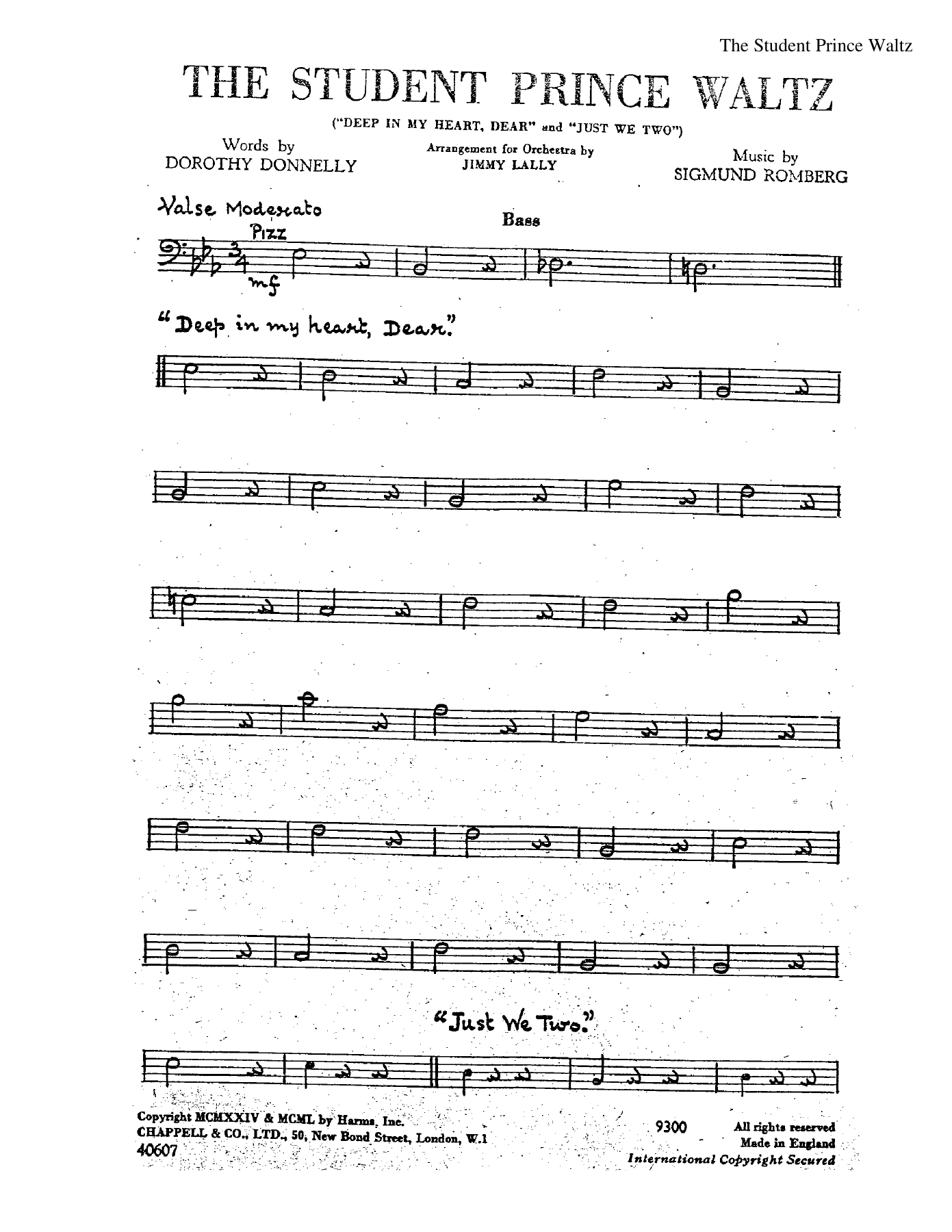
The Student Prince Waltz (J.Lally) sheet music preview

The Student Prince Waltz (J.Lally)

Composed by Sigmund Romberg

Arranged by J. Lally

  • Ensemble: Big Band
  • Style: Waltz
  • Pages: 22
  • Instruments (17): Alto Saxophone 1, Alto Saxophone 2, Tenor Saxophone 1, Tenor Saxophone 2, Baritone Saxophone, Trumpet 1, Trumpet 2, Trumpet 3, Trumpet 4, Trombone 1, Trombone 2, Trombone 3, Bass Trombone, Piano, Bass, Drums, Guitar
  • Difficulty: medium
  • Content: Individual Parts
  • Format: PDF Download (Instant)
  • Price: $24.99

Sigmund Romberg's "The Student Prince Waltz" emerges from the golden age of operetta, a genre that captivated audiences in the early 20th century with its romantic melodies and lush orchestrations. Originally premiered in 1924, this iconic waltz quickly became a signature piece from the operetta, known for its sweeping, memorable theme. While not a jazz standard in its original form, its enduring popularity and melodic strength made it ripe for reinterpretation by jazz arrangers seeking to infuse classic repertoire with the improvisational spirit and harmonic richness of the big band idiom. This piece represents a bridge between the grand romanticism of the operetta stage and the sophisticated, swinging sound of the jazz orchestra. J. Lally's arrangement transforms Romberg's classic into a captivating big band waltz, maintaining the original's elegant 3/4 meter while imbuing it with a distinctly jazz-inflected character. The piece opens with a stately, almost regal introduction, setting a sophisticated tone before transitioning into the familiar waltz theme. Lally masterfully employs rich, close voicings throughout the saxophone and brass sections, creating a full, resonant sound that evokes both the grandeur of the original and the harmonic depth of modern jazz. The overall mood is one of nostalgic elegance and graceful swing, with a medium waltz tempo that allows for expressive phrasing and a comfortable, flowing feel. The arrangement features dynamic contrasts, moving from tender, lyrical passages to powerful, full-ensemble statements, building to a satisfying climax. Lally's distinctive approach to this arrangement is evident in several key areas. The melody is artfully distributed, initially presented by the saxophone section in a warm, blended soli, then passed to the brass, often with counter-melodic lines weaving through the ensemble. There are no extended improvised solos, focusing instead on the ensemble's collective interpretation and the arranger's harmonic re-imagining. This choice emphasizes the beauty of Romberg's original melody within a fresh, big band context. The arrangement showcases Lally's penchant for sophisticated harmonic substitutions and reharmonizations, which subtly enrich the waltz without obscuring its inherent charm. A notable feature is the use of a powerful shout chorus that brings the entire band together in a majestic, swinging declaration, providing a thrilling contrast to the more lyrical sections. The arrangement concludes with a grand, sustained chord, leaving a lasting impression of refined power. This arrangement is ideally suited for college, community, and advanced high school jazz ensembles seeking a piece that offers both musical depth and audience appeal. Its technical demands are moderate, focusing more on ensemble blend, dynamic control, and accurate articulation within the waltz feel rather than extreme ranges or rapid-fire technical passages. The rewarding aspects include the opportunity to explore expressive phrasing, achieve a cohesive ensemble sound, and present a beloved melody in a fresh, engaging style. It serves as an excellent vehicle for developing a sophisticated ensemble sound and exploring the nuances of a jazz waltz. Conductors should emphasize a consistent, flowing 3/4 waltz feel from the outset, avoiding any tendency to rush or drag. The primary technical challenge lies in achieving precise articulation and blend within the rich, often close voicings, particularly in the saxophone and brass soli sections. Encourage players to listen across sections for balance and intonation. Dynamic contrasts are crucial; ensure crescendos build gradually and diminuendos are controlled and expressive. There are no special techniques like mutes or falls required, focusing instead on pure tone and ensemble precision. Rehearsal time should be dedicated to shaping phrases, especially the lyrical melody lines, and ensuring the rhythmic clarity of the underlying accompaniment figures. Pay close attention to the transitions between sections to maintain a seamless narrative. Q: What instruments and parts are included in "The Student Prince Waltz (J.Lally)" arrangement? A: This big band arrangement includes parts for 17 instruments: Alto Saxophone 1, Alto Saxophone 2, Tenor Saxophone 1, Tenor Saxophone 2, Baritone Saxophone, Trumpet 1, Trumpet 2, Trumpet 3, Trumpet 4, Trombone 1, Trombone 2, Trombone 3, Trombone 4, Piano, Bass, Drums, and Guitar. Q: What is the difficulty level of this arrangement, and for which ensembles is it most appropriate? A: This arrangement is rated as moderate difficulty, making it suitable for college, community, and advanced high school jazz ensembles. It focuses on ensemble blend, dynamic control, and expressive phrasing within a waltz feel rather than extreme technical demands. Q: What is the musical style and historical context of "The Student Prince Waltz (J.Lally)"? A: This is a big band jazz waltz arrangement of Sigmund Romberg's classic operetta melody from 1924. It blends the romanticism of the original with sophisticated jazz harmonies and voicings, maintaining a graceful 3/4 meter. Q: What makes J. Lally's arrangement of "The Student Prince Waltz" unique? A: Lally's arrangement is distinguished by its rich, close voicings, sophisticated reharmonizations, and the artful distribution of the melody across the ensemble. It emphasizes collective interpretation and ensemble power, culminating in a majestic shout chorus, rather than featuring extended improvised solos. Q: What is the typical performance duration and tempo for this arrangement? A: While exact duration can vary with interpretation, this arrangement typically performs at a medium waltz tempo, resulting in a performance time of approximately 3-4 minutes, allowing for expressive melodic development and dynamic shaping.

Musicians Also Search For

The Student Prince Waltz J. Lally PDFThe Student Prince Waltz J. Lally sheet musicThe Student Prince Waltz arranged by J. LallyJ. Lally big band chartsJ. Lally jazz arrangements PDFThe Student Prince Waltz Sigmund Romberg sheet musicThe Student Prince Waltz Sigmund Romberg big band arrangementSigmund Romberg big band chartsThe Student Prince Waltz big band arrangementThe Student Prince Waltz big band PDF downloadThe Student Prince Waltz jazz ensemble sheet musicbig band sheet music instant downloadThe Student Prince Waltz individual parts downloadThe Student Prince Waltz sheet music with partsThe Student Prince Waltz Waltz chartWaltz big band arrangementsbuy The Student Prince Waltz sheet music onlinedownload The Student Prince Waltz PDFThe Student Prince Waltz jazz chartbest J. Lally big band arrangementsSigmund Romberg songs arranged by J. LallyThe Student Prince Waltz printable sheet musicbig band repertoire PDF

All arrangements by J. Lally All Sigmund Romberg sheet music