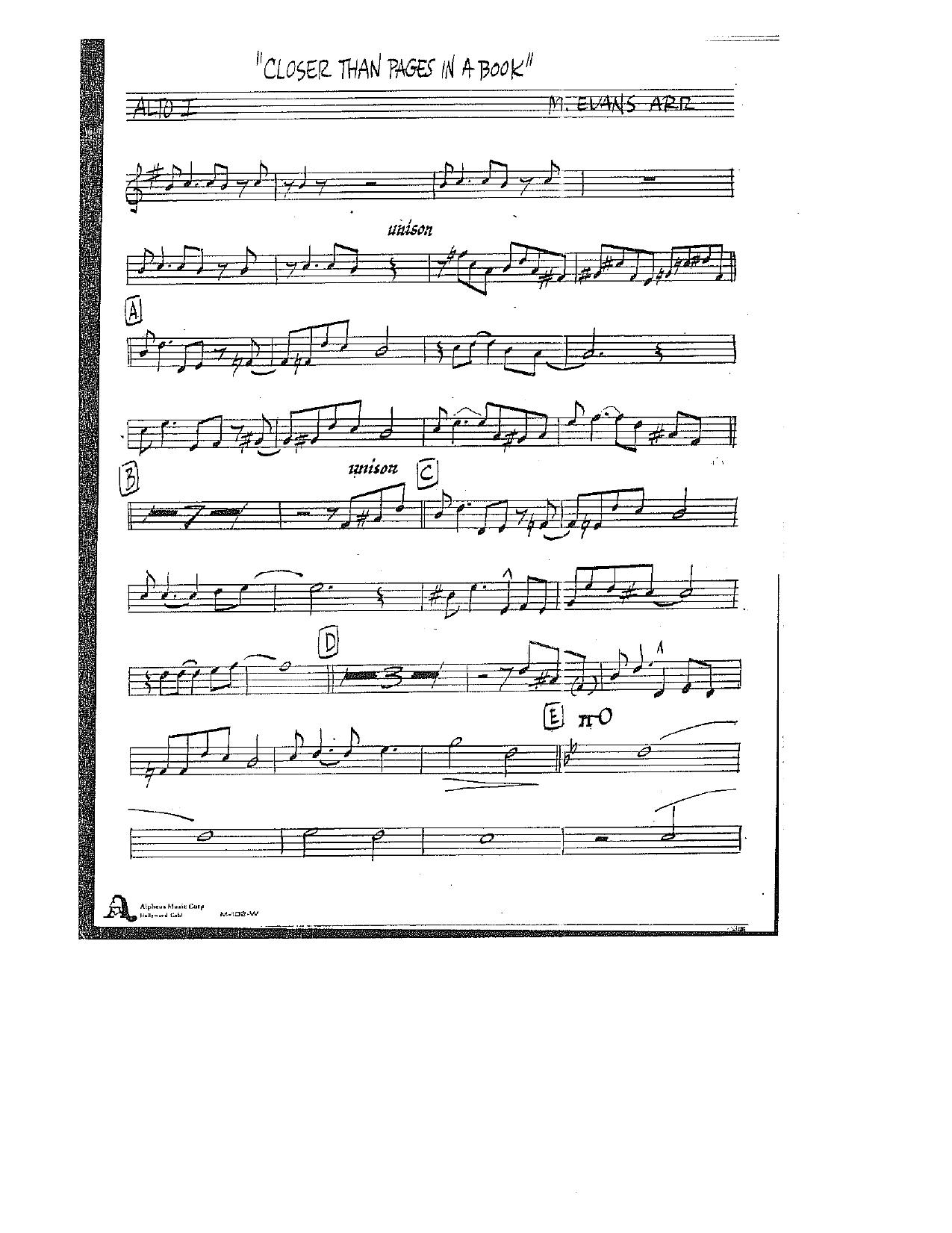
Close As Pages In A Book (M.Evans) sheet music preview

Close As Pages In A Book (M.Evans)

Composed by Sigmund Romberg

Arranged by Marion Evans

  • Ensemble: Big Band
  • Pages: 34
  • Instruments (16): Alto Saxophone I, Alto Saxophone II, Tenor Saxophone I, Tenor Saxophone II, Baritone Saxophone, Trumpet I, Trumpet II, Trumpet III, Trumpet IV, Trombone I, Trombone II, Trombone III, Trombone IV, Piano, Bass, Drums
  • Difficulty: medium
  • Content: Individual Parts
  • Format: PDF Download (Instant)
  • Price: $24.99

Sigmund Romberg’s timeless melody "Close As Pages In A Book," originally introduced in the 1944 Broadway musical *Sing Out, Sweet Land* with lyrics by Dorothy Fields, found a natural second home in the jazz idiom through sophisticated vocal and instrumental interpretations. While rooted in the rich, romantic tradition of the Great American Songbook, this material readily lends itself to the lush harmonic language of mid-century jazz. The composition captures a bittersweet, reflective nostalgia, balancing traditional Broadway sentiment with a sophisticated harmonic framework that rewards sensitive ensemble playing. Marion Evans, a master craftsman of the big band arranging tradition whose legendary charts for Peggy Lee, Count Basie, and Quincy Jones defined an era of vocal and instrumental elegance, brings his signature sophistication to this chart. Evans approaches the composition with a luxurious, cinematic sensibility, utilizing expansive extended chord voicings, cascading woodwind embellishments, and rich brass buffering that evoke the opulent soundscapes of 1950s and 60s studio orchestras. Rather than relying on aggressive, high-energy shout choruses, Evans crafts a dynamic narrative arc defined by lush, interwoven countermelodies, gorgeous saxophone solis, and subtle harmonic modulations that gently elevate the emotional intensity of the performance. The arrangement opens with a captivating, atmospheric introduction that immediately establishes a relaxed, flowing medium-tempo swing feel. The saxophones and muted brass carry the primary thematic material, requiring precise intonation, seamless blend, and meticulous attention to dynamic shading. Solos are thoughtfully integrated into the structural fabric, allowing featured improvisers space to stretch out over tasteful, evolving backgrounds. Technically, the chart demands a mature sense of swing subdivision and disciplined breath support, particularly for the brass section who must navigate sustained, high-register chordal pads with a warm, round tone. The rhythm section plays a pivotal role in maintaining an unhurried, buoyant pulse, with the piano and guitar employing light, comping voicings that respect the transparent textures of Evans's scoring. Advanced high school ensembles with strong section leaders, collegiate jazz orchestras, and professional community big bands will find this arrangement an ideal vehicle for developing stylistic refinement, dynamic control, and harmonic awareness. Because it relies far more on balance, blend, and lyrical phrasing than sheer velocity or volume, it serves as an exceptional masterclass in big band ballad and medium-swing interpretation. Performing this Marion Evans chart provides audiences and musicians alike with a masterclass in elegance, offering a masterwork of mid-century arranging art that elevates any concert program. Balancing the ensemble is the primary challenge of this chart, as Marion Evans utilizes dense, rich voicings that require absolute dynamic discipline. The conductor must ensure that the rhythm section—particularly the piano and guitar—abstains from over-comping, keeping voicings clean and transparent to let the horn harmonies speak clearly. The tempo should maintain a relaxed, flowing medium-swing feel (around quarter note = 112–120 BPM); rushing will strip the arrangement of its sophisticated, late-night atmosphere. Brass players should utilize subtle cup or harmon mutes where indicated, prioritizing a warm, vocal quality over cutting brightness. Pay close attention to the dynamic markings in the saxophone soli; the inner voices must project equally to execute the intricate chromatic leading tones without distortion. Rehearsals should focus initially on sectional blend and intonation during the sustained chordal passages before integrating the rhythm section's groove. Q: What instruments and parts are included in this big band arrangement? A: The arrangement is scored for a standard 16-instrument big band instrumentation, featuring Alto Saxophone 1, Alto Saxophone 2, Tenor Saxophone 1, Tenor Saxophone 2, Baritone Saxophone, 4 Trumpets, 4 Trombones, and a full rhythm section comprising piano, guitar, bass, and drums, spread across a 34-page conductor and instrumental part set. Q: What is the difficulty level of this arrangement? A: This chart is best suited for advanced high school, collegiate, and professional big bands. While it does not feature extreme technical velocity, it demands high-level musicianship, sophisticated intonation, precise dynamic control, and a mature grasp of medium-swing phrasing. Q: What is the historical and stylistic background of this piece? A: Based on Sigmund Romberg's 1944 composition from *Sing Out, Sweet Land*, this arrangement transforms a classic Broadway standard into a sophisticated jazz orchestra vehicle, reflecting the lush, cinematic arranging style popularized by Marion Evans during the golden era of studio jazz. Q: What makes Marion Evans's treatment of this composition unique? A: Evans eschews a traditional high-octane shout chorus in favor of rich, cascading woodwind textures, lush brass buffers, and subtle harmonic modulations that create a deeply expressive, vocal-like instrumental narrative. Q: What is the recommended performance tempo and duration for this piece? A: The arrangement is designed for a relaxed, buoyant medium swing feel at approximately 116 BPM, resulting in a performance duration of roughly 3.5 to 4.5 minutes depending on the length of the improvised solo sections.

Questions and answers

What is included in the Close As Pages In A Book (M.Evans) PDF?
The verified current file contains individual parts across 34 pages.
How many instruments or parts are listed for Close As Pages In A Book (M.Evans)?
The verified instrumentation list contains 16 entries for this Big Band arrangement.
Who is credited for Close As Pages In A Book (M.Evans)?
Composer: Sigmund Romberg. Arranger: Marion Evans.
What difficulty is listed for Close As Pages In A Book (M.Evans)?
The verified difficulty level is medium.
Can I preview Close As Pages In A Book (M.Evans) before buying?
Yes. The product page provides a preview generated from the current PDF file.
How is Close As Pages In A Book (M.Evans) delivered?
After successful payment, the digital PDF is made available for download. The displayed price is $24.99.

Musicians Also Search For

Close As Pages In A Book Marion Evans PDFClose As Pages In A Book Marion Evans sheet musicClose As Pages In A Book arranged by Marion EvansMarion Evans big band chartsMarion Evans jazz arrangements PDFClose As Pages In A Book Sigmund Romberg sheet musicClose As Pages In A Book Sigmund Romberg big band arrangementsSigmund Romberg big band chartsClose As Pages In A Book big band arrangementsClose As Pages In A Book big band PDF downloadClose As Pages In A Book jazz sheet musicbig band sheet music downloadClose As Pages In A Book individual parts downloadClose As Pages In A Book sheet music PDFbuy Close As Pages In A Book sheet musicdownload Close As Pages In A Book PDFClose As Pages In A Book jazz chartsbest Marion Evans big band arrangementsSigmund Romberg arranged by Marion EvansClose As Pages In A Book printable sheet musicbig band repertoire PDF

All arrangements by Marion Evans All Sigmund Romberg sheet music