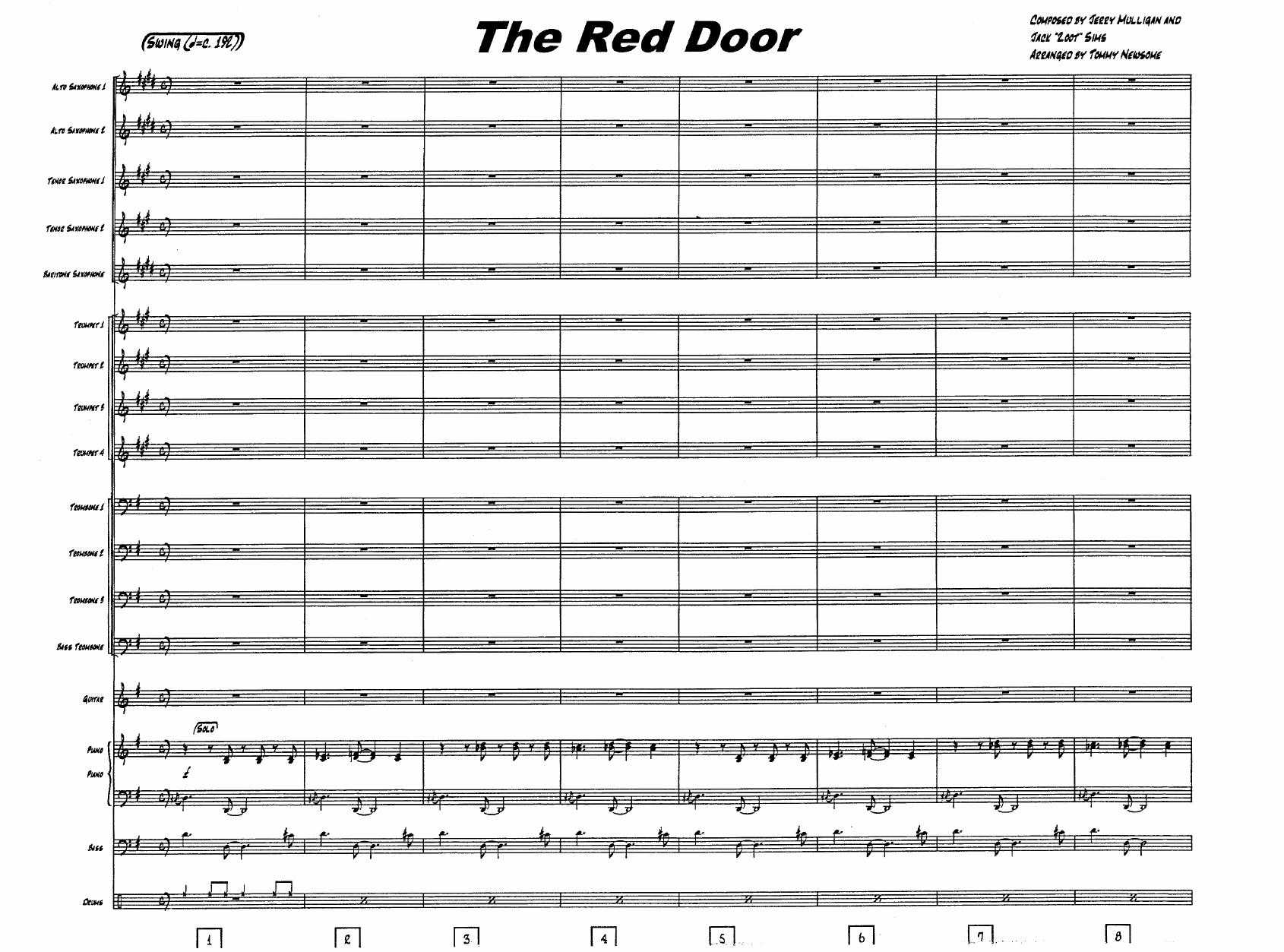
The Red Door (T.Newsom)
Composed by Gerry Mulligan
Arranged by Gerry Mulligan
- Ensemble: Big Band
- Pages: 91
- Instruments (17): Alto Saxophone 1, Alto Saxophone 2, Tenor Saxophone 1, Tenor Saxophone 2, Baritone Saxophone, Trumpet 1, Trumpet 2, Trumpet 3, Trumpet 4, Trombone 1, Trombone 2, Trombone 3, Bass Trombone, Guitar, Piano, Bass, Drums
- Difficulty: advanced
- Content: Individual Parts
- Format: PDF Download (Instant)
- Price: $24.99
"The Red Door," originally co-written by baritone saxophone titan Gerry Mulligan and trombonist Zoot Sims (though often associated with Mulligan's stellar collaborations with fellow baritone great Pepper Adams or his legendary Concert Jazz Band), stands as a quintessential pillar of West Coast cool jazz and modern big band writing. Conceived during an era when Mulligan was redefining the role of the baritone saxophone in modern jazz through his pianoless quartet and expansive orchestration experiments, the composition captures the sophisticated harmonic interplay, driving counterpoint, and effortless swing that defined the 1950s modernist movement. Mulligan’s writing bridges the gap between the intricate bebop vocabulary of the East Coast and the more relaxed, spacious orchestration favored by California modernists. Driven by an infectious, medium-up swing groove in 4/4 time, the arrangement projects a cool yet high-energy atmosphere characterized by tight, interlocking horn lines and an urbane swagger. The harmonic language relies on clever chromatic voice-leading, extended tertian harmonies, and modal shifts typical of Mulligan’s writing style. Rather than relying on standard block-chord writing, Mulligan treats the ensemble with a polyphonic sensibility, allowing individual sections to weave independent countermelodies that create a rich, transparent texture. The emotional landscape shifts dynamically from playful, blues-infused mischief to roaring, brass-heavy intensity during the climactic ensemble passages. Mulligan’s distinctive arranging approach shines through the clever deployment of the 8-instrument ensemble, maximizing the tonal weight of the sax section—featuring Alto, Tenor, and Baritone Saxophones—alongside Trumpet and Trombone. The baritone sax naturally commands a foundational, authoritative role, often anchoring the low end or engaging in witty call-and-response figures with the upper voices. Soli sections showcase crisp articulation and demanding rhythmic unisons, while the shout chorus builds organically, utilizing dynamic contrast rather than mere brute force to achieve maximum impact. The chart rewards precision, demanding a light, articulate swing eighth-note feel that avoids heavy-handed accents in favor of horizontal momentum. Advanced high school, collegiate, and professional jazz ensembles will find this 91-page publication exceptionally rewarding. The technical challenges lie primarily in maintaining rhythmic exactness across complex sectional unisons and executing clean, linear phrasing at a brisk tempo. Featured solo changes offer ample opportunity for capable improvisers in the saxophone and brass sections to stretch out over standard changes. Ultimately, performing this chart provides a masterclass in ensemble breathing, section blending, and stylistic authenticity, making it a standout selection for festival performance or advanced concert programming. Success with this arrangement hinges on establishing a relaxed yet forward-driving medium-up swing feel (quarter note $\approx$ 180–192 BPM). Avoid dragging; the momentum must feel effortless, characteristic of the West Coast cool aesthetic. The primary technical challenge for the horn section is executing lightweight, articulate eighth-note lines without over-blowing or distorting the chordal balance. Articulation markings—particularly subtle tenutos and staccatos—must be rigorously observed to maintain the transparent, linear textures Mulligan intended. Conductors should pay close attention to the dynamic contrast between the counterpunthal background figures and the primary melody. Ensure the baritone saxophone and trombone parts are heard clearly when anchoring the harmonic foundation, as they drive the movement beneath the upper woodwinds and brass. Rehearsals should begin section by section, isolating the intricate interplay between the alto, tenor, and baritone saxophones before integrating the full ensemble. No specialized plunger mutes or unconventional extended techniques are required, allowing the ensemble to focus entirely on intonation, time-feel, and stylistic unity. Q: What specific instruments and parts are included in this publication? A: This arrangement is scored for an 8-instrument ensemble comprising Alto Saxophone, Tenor Saxophone, Baritone Saxophone, Trumpet, Trombone, and a complete rhythm section framework spanning 91 total pages of fully engraved parts and score. Q: What is the difficulty level of this arrangement? A: This chart is best suited for advanced high school, collegiate, and professional jazz ensembles due to its demanding sectional unisons, linear phrasing requirements, and fast-moving harmonic improvisational spaces. Q: What is the historical background and musical style of "The Red Door"? A: Originally composed by Gerry Mulligan, this piece is a textbook representation of 1950s West Coast cool jazz, combining sophisticated counterpoint, bebop-influenced harmonic structures, and a relaxed yet driving swing feel. Q: What makes this specific arrangement by Gerry Mulligan unique? A: Mulligan eschews standard dense block-chord writing in favor of a transparent, polyphonic orchestration style that highlights the unique tonal capabilities of the baritone, tenor, and alto saxophone sections working in tandem with the brass. Q: What is the performance duration and recommended tempo for this piece? A: The arrangement typically runs around 4 to 5 minutes in performance length when executed at the recommended medium-up swing tempo of approximately quarter note = 180–192 BPM.
Questions and answers
- What is included in the The Red Door (T.Newsom) PDF?
- The verified current file contains a conductor score and individual parts across 91 pages.
- How many instruments or parts are listed for The Red Door (T.Newsom)?
- The verified instrumentation list contains 17 entries for this Big Band arrangement.
- Who is credited for The Red Door (T.Newsom)?
- Composer: Gerry Mulligan. Arranger: Gerry Mulligan.
- What difficulty is listed for The Red Door (T.Newsom)?
- The verified difficulty level is advanced.
- Can I preview The Red Door (T.Newsom) before buying?
- Yes. The product page provides a preview generated from the current PDF file.
- How is The Red Door (T.Newsom) delivered?
- After successful payment, the digital PDF is made available for download. The displayed price is $24.99.
Musicians Also Search For
The Red Door Gerry Mulligan PDF • The Red Door Gerry Mulligan sheet music • The Red Door arranged by Gerry Mulligan • Gerry Mulligan big band charts • Gerry Mulligan jazz arrangements PDF • The Red Door Gerry Mulligan big band arrangements • The Red Door big band arrangements • The Red Door big band PDF download • The Red Door jazz sheet music • big band sheet music download • The Red Door conductor score PDF • The Red Door individual parts download • The Red Door sheet music PDF • buy The Red Door sheet music • download The Red Door PDF • The Red Door jazz charts • best Gerry Mulligan big band arrangements • The Red Door printable sheet music • big band repertoire PDF