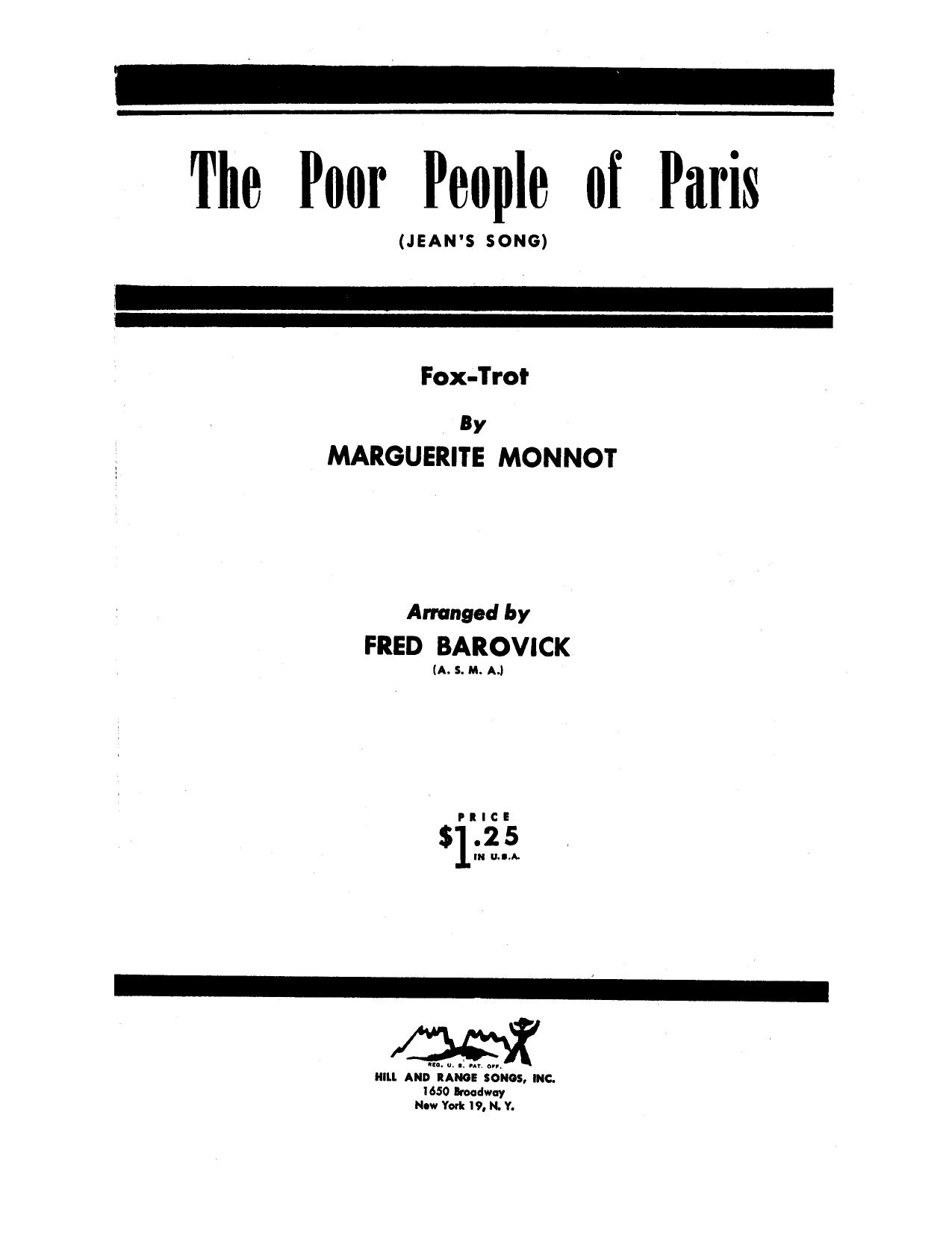
The Poor People Of Paris (F.Barovick) sheet music preview

The Poor People Of Paris (F.Barovick)

Composed by Marguerite Monnot

Arranged by Fred Barovick

  • Ensemble: Big Band
  • Pages: 32
  • Instruments (16): 1st Sax. Eb Alto, 3rd Sax. Eb Alto, 2nd Sax. Bb Tenor, 4th Sax. Bb Tenor, 5th Sax. Eb Baritone, 1st Bb Trumpet, 2nd Bb Trumpet, 3rd Bb Trumpet, 1st Trombone, 2nd Trombone, 3rd Trombone, Piano, Bass, Drums, Guitar, Violins A-B C
  • Difficulty: medium
  • Content: Individual Parts
  • Format: PDF Download (Instant)
  • Price: $24.99

Marguerite Monnot’s timeless melody "The Poor People of Paris"—originally known in France as "La Goualante du pauvre jean"—captures the romantic, accordion-driven atmosphere of mid-century Montmartre. While initially popularized in France by Édith Piaf in 1954, the tune crossed the Atlantic to become an American pop and jazz sensation in 1956 thanks to Les Baxter’s driving instrumental cover, which famously claimed the number-one spot on the Billboard charts. This infectious, street-corner-waltz-turned-swing-tune occupies a unique intersection between European cabaret and American mid-century big band jazz, offering ensembles a chance to explore a lighter, highly melodic side of the idiom without sacrificing traditional section interplay. Brimming with buoyant energy and a cheerful, optimistic cadence, Fred Barovick’s big band interpretation infuses Monnot’s Parisian motif with a crisp, swinging 4/4 feel. The arrangement opens with an inviting, jaunty introduction before launching into a bright, rhythmic pulse that evokes a bustling afternoon on the Left Bank. Throughout the chart, Barovick balances whimsical, nostalgic charm with driving brass stabs and rich reed countermelodies. The mood shifts effortlessly between playful, conversational interplay among the woodwinds and soaring, full-ensemble climaxes that showcase the unmistakable warmth of the mid-1950s light-jazz aesthetic. Barovick’s scoring methodology relies on clever sectional distribution, utilizing tight saxophone solis and sparkling brass counter-lines to keep the texture transparent yet punchy. The melody is shared democratically across the ensemble, giving the alto and tenor saxophones ample opportunity to drive the thematic material, while the lower reeds provide a rhythmic anchor. The arrangement features smart dynamic contrasting, building toward a vibrant shout chorus that expands the harmonic vocabulary just enough to keep sophisticated listeners engaged. Harmonic shifts are smooth yet unexpected, avoiding cliché resolution paths to give the classic tune a fresh, sophisticated coat of paint. Advanced high school, collegiate, and community jazz orchestras will find this chart to be an absolute crowd-pleaser that rewards clean articulation and stylistic versatility. While the technical demands are moderate—avoiding hyper-fast tempos or ultra-complex altered-scale improvisations—success relies entirely on pristine ensemble tightness, crisp swing phrasing, and an accurate handling of dynamic nuances. Featured solo sections provide a welcoming platform for developing improvisers to stretch out over accessible changes, making it an ideal repertoire choice for spring concerts, festival performances, or vintage-themed jazz sets. Achieving the authentic charm of "The Poor People of Paris" requires strict attention to a bright, buoyant medium-swing tempo—avoid rushing the feel, as the groove relies heavily on a relaxed yet driving quarter-note pulse. The primary technical challenge lies in the articulation of the recurring eighth-note figures; brass players should employ a crisp, defined tongue without over-accentuating, ensuring the playful character remains intact rather than sounding heavy-handed. Reeds must focus on blend during the integrated soli sections, matching the vibrato width of the lead alto. Conductors should pay close attention to the dynamic transitions leading into the shout chorus, ensuring the rhythm section maintains an even, unforced momentum. Encourage the drummer to utilize a feather bass drum technique and a crisp ride cymbal pattern that mirrors the traditional light-swing propulsion of the 1950s studio jazz era, keeping rimshots sharp and interactive during the transitional vamp sections. Q: What specific instruments and parts are included in this 32-page big band arrangement? A: The arrangement is scored for a 16-instrument big band ensemble, explicitly featuring Alto Saxophone 1, Alto Saxophone 3, Tenor Saxophone 2, Tenor Saxophone 4, Baritone Saxophone 5, alongside standard corresponding brass and rhythm section parts across 32 pages of fully realized scores. Q: What is the overall difficulty level of Fred Barovick’s arrangement? A: This chart is graded at a medium difficulty level, making it exceptionally well-suited for advanced high school, collegiate, and proficient community big bands seeking a balance of accessibility and stylistic depth. Q: What is the historical background and musical style of this piece? A: Based on Marguerite Monnot’s 1954 French composition famously popularized in the US by Les Baxter, this arrangement translates a classic European cabaret melody into a bright, swinging 4/4 mid-century jazz big band idiom. Q: What makes this specific arrangement by Fred Barovick unique? A: Barovick uniquely balances nostalgic Parisian charm with sophisticated big band voicings, incorporating clever sectional interplay, tight reed solis, and tasteful harmonic expansions that elevate a traditional pop-jazz crossover tune. Q: What is the recommended performance tempo and duration for this chart? A: The arrangement is designed to be played at a bright, swinging medium tempo (approximately 120-132 BPM) with a total performance duration of roughly 3 to 4 minutes, fitting ideally into standard concert or festival program slots.

Questions and answers

What is included in the The Poor People Of Paris (F.Barovick) PDF?
The verified current file contains individual parts across 32 pages.
How many instruments or parts are listed for The Poor People Of Paris (F.Barovick)?
The verified instrumentation list contains 16 entries for this Big Band arrangement.
Who is credited for The Poor People Of Paris (F.Barovick)?
Composer: Marguerite Monnot. Arranger: Fred Barovick.
What difficulty is listed for The Poor People Of Paris (F.Barovick)?
The verified difficulty level is medium.
Can I preview The Poor People Of Paris (F.Barovick) before buying?
Yes. The product page provides a preview generated from the current PDF file.
How is The Poor People Of Paris (F.Barovick) delivered?
After successful payment, the digital PDF is made available for download. The displayed price is $24.99.

Musicians Also Search For

The Poor People Of Paris Fred Barovick PDFThe Poor People Of Paris Fred Barovick sheet musicThe Poor People Of Paris arranged by Fred BarovickFred Barovick big band chartsFred Barovick jazz arrangements PDFThe Poor People Of Paris Marguerite Monnot sheet musicThe Poor People Of Paris Marguerite Monnot big band arrangementsMarguerite Monnot big band chartsThe Poor People Of Paris big band arrangementsThe Poor People Of Paris big band PDF downloadThe Poor People Of Paris jazz sheet musicbig band sheet music downloadThe Poor People Of Paris individual parts downloadThe Poor People Of Paris sheet music PDFbuy The Poor People Of Paris sheet musicdownload The Poor People Of Paris PDFThe Poor People Of Paris jazz chartsbest Fred Barovick big band arrangementsMarguerite Monnot arranged by Fred BarovickThe Poor People Of Paris printable sheet musicbig band repertoire PDF

All arrangements by Fred Barovick All Marguerite Monnot sheet music