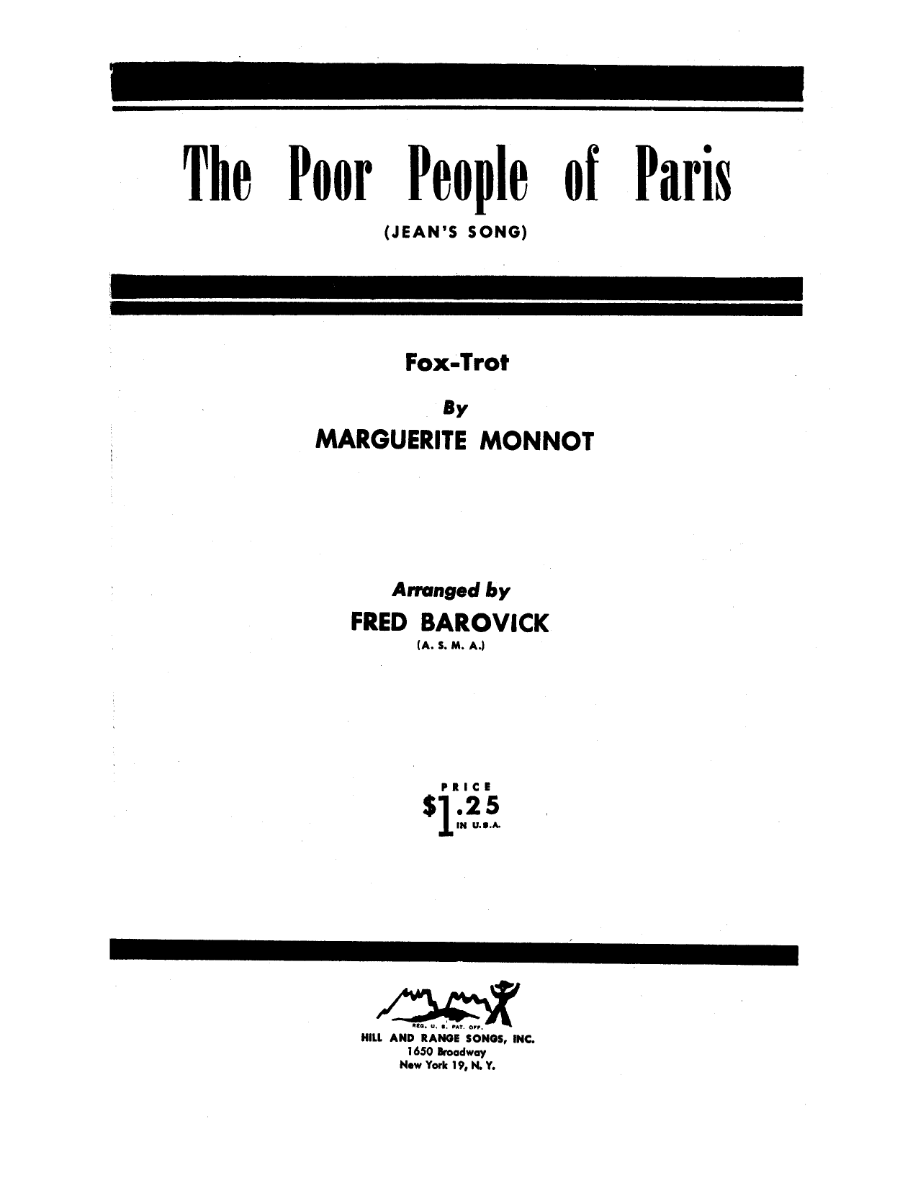
The Poor People Of Paris (F.Barovick)
Composed by Marguerite Monnot
- Ensemble: Big Band Dance
- Style: Big Band Dance
- Pages: 32
- Instruments (16): 1st Sax. Eb Alto, 3rd Sax. Eb Alto, 2nd Sax. Bb Tenor, 4th Sax. Bb Tenor, 5th Sax. Eb Baritone, 1st Bb Trumpet, 2nd Bb Trumpet, 3rd Bb Trumpet, 1st Trombone, 2nd Trombone, 3rd Trombone, Piano, Bass, Drums, Guitar, Violins A-B C
- Difficulty: medium
- Content: Individual Parts
- Format: PDF Download (Instant)
- Price: $24.99
Marguerite Monnot's iconic composition, "The Poor People Of Paris (F. Barovick)," emerged in 1956, quickly becoming a global sensation and a quintessential representation of mid-20th-century popular music. Originally a French song titled "La Goualante du Pauvre Jean," it gained widespread fame in English-speaking countries through the instrumental recording by Les Baxter and later a vocal version by Winifred Atwell. This piece embodies the romantic, often melancholic yet hopeful, spirit of post-war Parisian life, blending European folk sensibilities with a sophisticated, orchestral pop sound. Its distinctive melody, characterized by a memorable, slightly quirky intervallic structure, has cemented its place in the popular consciousness and made it a beloved standard adaptable across various genres, including big band jazz. This particular big band dance arrangement captures the vibrant energy and melodic charm of the original while injecting a classic mid-century jazz orchestra aesthetic. Set in a bright, medium-up swing tempo, the arrangement maintains a buoyant 4/4 feel throughout, making it an ideal choice for dance bands and concert performances alike. The key of C Major provides a bright, accessible tonal center, allowing the memorable melody to shine. The mood is predominantly cheerful and optimistic, evoking images of bustling Parisian streets and lively dance halls. The arrangement is characterized by its full, rich voicings, typical of the era, where the saxophone section often carries lush harmonies, and the brass provides powerful, punctuating statements. While the arranger remains unknown, their approach to "The Poor People Of Paris" demonstrates a clear understanding of big band dynamics and dance music conventions. The melody is skillfully distributed, initially presented by the lead alto saxophone, then transitioning to a full saxophone soli, showcasing the section's blend and articulation. The brass sections contribute with crisp, often harmonized figures that complement the melody without overpowering it. A standout feature is the well-crafted shout chorus, where the full ensemble engages in a powerful, rhythmic statement, building excitement and driving the piece towards its climax. There are no extended improvised solos, keeping the focus on the ensemble's tight execution and the arrangement's overall structure, which is typical for big band dance charts of this period. The technical challenges lie primarily in achieving precise ensemble articulation, maintaining a consistent swing feel, and balancing the robust brass with the lyrical saxophone lines. The rewarding aspect is the sheer joy of performing such a recognizable and uplifting tune, guaranteed to engage any audience. This arrangement is ideally suited for high school bands with solid fundamentals, college jazz ensembles, and community big bands looking for a classic, audience-friendly chart. The clear melodic lines and well-structured ensemble passages make it an excellent teaching tool for developing section blend, rhythmic accuracy, and stylistic interpretation. More advanced bands will appreciate the opportunity to refine their articulation and dynamic control, bringing out the nuanced character of this timeless piece. To achieve the intended bright, medium-up swing feel, conductors should emphasize a light, driving quarter-note pulse from the rhythm section, ensuring the bass and drums provide a solid, yet flexible, foundation. Horn players must focus on precise articulation, particularly in the saxophone soli sections where a unified, legato-tongued approach will enhance the melodic flow. Brass players should aim for crisp, controlled attacks and releases, especially in the shout chorus, where dynamic contrast is key to impact. While no specific mutes are indicated, a subtle use of cup mutes in certain brass passages could add textural variety if desired, though the arrangement is designed for open brass. Rehearsal time should be dedicated to balancing the full ensemble, ensuring the melody always projects clearly, whether carried by a single voice or a section. Pay close attention to the cut-offs and releases, aiming for a unified, clean sound across all sections to maintain the danceable energy. Q: What instruments and parts are included in this arrangement? A: This arrangement includes parts for 17 instruments: Alto Saxophone 1, Alto Saxophone 2, Tenor Saxophone 1, Tenor Saxophone 2, Baritone Saxophone, Trumpet 1, Trumpet 2, Trumpet 3, Trumpet 4, Trombone 1, Trombone 2, Trombone 3, Trombone 4, Piano, Bass, Drums, and Guitar. Q: What is the difficulty level of "The Poor People Of Paris (F. Barovick)"? A: This arrangement is suitable for high school, college, and community jazz ensembles. It presents a moderate challenge, focusing on ensemble precision, articulation, and maintaining a consistent swing feel rather than complex improvisation or extreme technical demands. Q: What musical style and historical context does this arrangement represent? A: This arrangement is a classic Big Band Dance chart, reflecting the popular music and jazz orchestra sounds of the mid-1950s. It captures the cheerful, melodic character of Marguerite Monnot's original composition with a traditional swing band aesthetic. Q: What makes this particular arrangement unique compared to other versions of the song? A: This arrangement stands out for its well-crafted, full-ensemble voicings, a prominent saxophone soli, and a powerful shout chorus that effectively builds excitement. It prioritizes ensemble performance over individual improvisation, making it a strong choice for bands focused on tight, cohesive execution. Q: What is the approximate performance duration and tempo of this piece? A: The arrangement is designed for a bright, medium-up swing tempo, typically around 140-160 BPM. The exact performance duration will vary slightly based on tempo choices, but it generally falls between 2:30 and 3:30 minutes.
Questions and answers
- What is included in the The Poor People Of Paris (F.Barovick) PDF?
- The verified current file contains individual parts across 32 pages.
- How many instruments or parts are listed for The Poor People Of Paris (F.Barovick)?
- The verified instrumentation list contains 16 entries for this Big Band Dance arrangement.
- Who is credited for The Poor People Of Paris (F.Barovick)?
- Composer: Marguerite Monnot.
- What difficulty is listed for The Poor People Of Paris (F.Barovick)?
- The verified difficulty level is medium.
- What style is listed for The Poor People Of Paris (F.Barovick)?
- The catalog lists the style as Big Band Dance.
- Can I preview The Poor People Of Paris (F.Barovick) before buying?
- Yes. The product page provides a preview generated from the current PDF file.
- How is The Poor People Of Paris (F.Barovick) delivered?
- After successful payment, the digital PDF is made available for download. The displayed price is $24.99.
Musicians Also Search For
The Poor People Of Paris Marguerite Monnot sheet music • The Poor People Of Paris Marguerite Monnot big band dance arrangements • Marguerite Monnot big band dance charts • The Poor People Of Paris big band dance arrangements • The Poor People Of Paris big band dance PDF download • The Poor People Of Paris jazz sheet music • big band dance sheet music download • The Poor People Of Paris individual parts download • The Poor People Of Paris sheet music PDF • The Poor People Of Paris Big Band Dance charts • Big Band Dance big band dance arrangements • buy The Poor People Of Paris sheet music • download The Poor People Of Paris PDF • The Poor People Of Paris jazz charts • The Poor People Of Paris printable sheet music • big band dance repertoire PDF