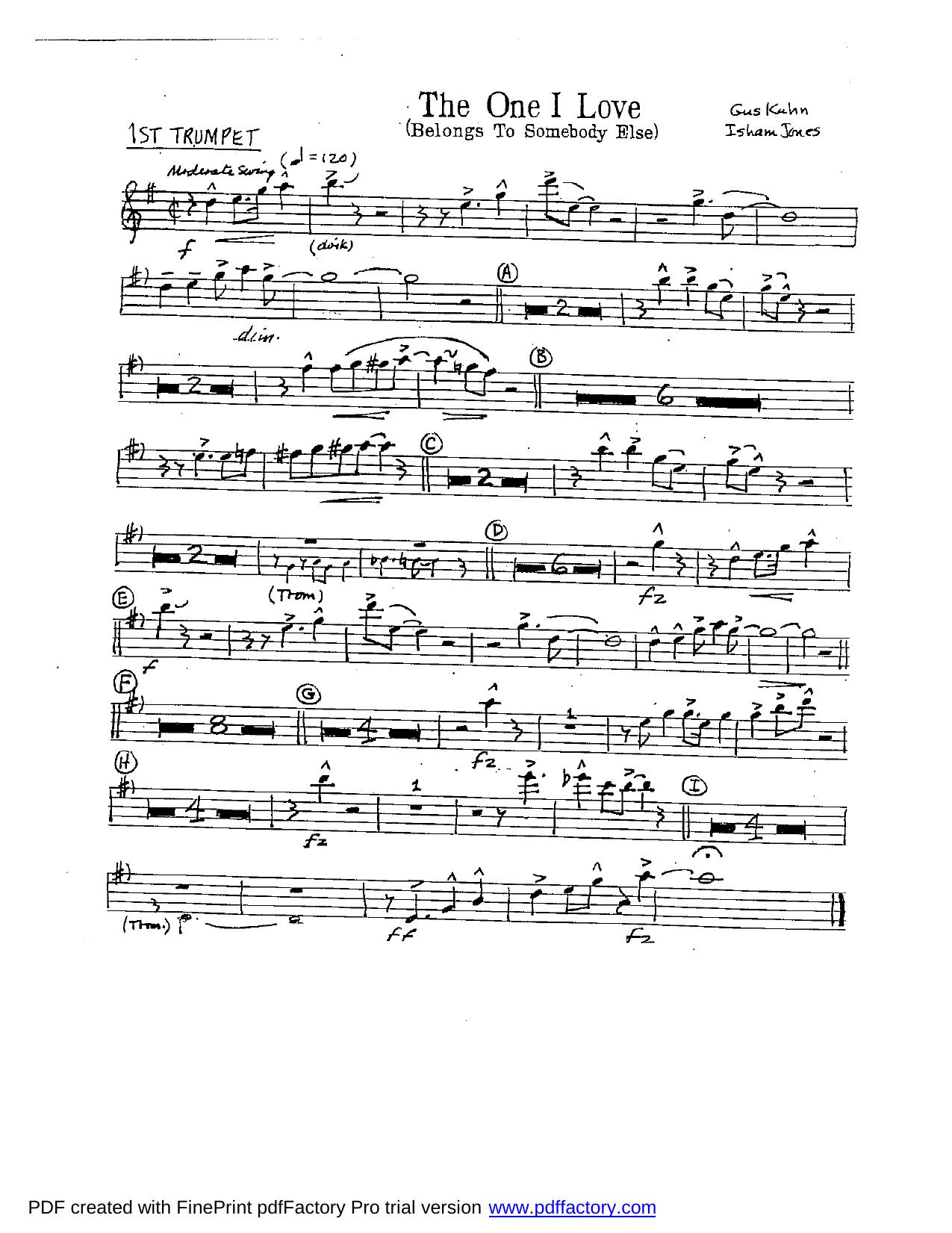
The One I Love (S.Oliver)
Composed by Gus Kahn
Arranged by Frank Sinatra & Nelson Riddle
- Ensemble: Big Band
- Pages: 19
- Instruments (17): 1st Trumpet, 2nd Trumpet, 3rd Trumpet, 4th Trumpet, 1st Trombone, 2nd Trombone, 3rd Trombone, 4th Trombone, 1st Alto Sax, 2nd Alto Sax, 1st Tenor Sax, 2nd Tenor Sax, Baritone Sax, Bass, Piano/Guitar, Drums, Vocal
- Difficulty: easy
- Content: Individual Parts
- Format: PDF Download (Instant)
- Price: $24.99
Written originally by Burton Lane and Gus Kahn in 1924, "The One I Love (Belongs to Somebody Else)" evolved from a popular Tin Pan Alley tune into an indispensable vehicle for jazz vocalists and instrumental interpreters alike. Its enduring legacy was permanently cemented during the mid-20th century golden age of American popular song, when it became a staple of the vocal jazz canon. The quintessential blueprint for this arrangement, however, stems from the legendary creative partnership between vocalist Frank Sinatra and master arranger Nelson Riddle. Riddle’s sophisticated, cinematic approach transformed standard swing-era orchestration into lush, high-definition musical storytelling, blending West Coast cool with rich, traditional big band textures that defined the sophisticated sound of Capitol Records in the 1950s. Brimming with an infectious, driving medium-up swing feel in 4/4 time, this chart radiates an energetic yet effortlessly suave persona. The mood shifts masterfully between punchy, brass-led swagger and velvety, harmonic sophistication, capturing the bittersweet romantic irony of Kahn's lyricism through bright, major-mode reframing and clever chromatic movement. Riddle’s signature scoring techniques are immediately recognizable throughout the chart, characterized by cascading woodwind counterlines, warm trombone block voicings, and economically placed brass stabs that leave ample sonic space for the ensemble and featured soloist. The dynamic architecture builds organically, utilizing rhythmic displacement and clever harmonic tension to propel the momentum forward without ever sacrificing the underlying dance groove. The arrangement opens with an iconic, instantly engaging hook before transitioning into a swinging thematic presentation where the saxes and muted brass trade crisp, articulation-driven melodic fragments. While designed to support a charismatic vocal lead or featured instrumental soloist, the ensemble writing itself functions as an active participant in the dialogue, featuring tight soli passages that demand absolute precision in phrasing and swing eighth-note subdivision. A blistering, tightly wound shout chorus serves as the emotional and sonic climax of the chart, forcing every section to lock in with unified articulation, dynamic contrast, and impeccable intonation before winding down to a clever, tongue-in-cheek final cadence. Tailored specifically for an agile 10-instrument ensemble (featuring a robust horn section of Alto Sax, Tenor Sax, Baritone Sax, Trumpet, and Trombone alongside rhythm), this chart strikes an ideal balance between chamber jazz transparency and full big-band power. Advanced high school ensembles with strong section leaders, collegiate jazz bands, and professional repertory groups will find this arrangement profoundly rewarding. Because the texture is leaner than a traditional 17-piece big band, every player's part is exposed and vital, making it an exceptional pedagogical tool for developing section independence, stylistic authenticity, and sophisticated swing articulation. Executing this Nelson Riddle-style chart successfully requires a meticulous approach to stylistic unity and dynamic control. The foundation rests on a crisp, forward-moving medium swing feel where eighth notes are played with an authentic, triplet-based subdivision, particularly in the moderate tempos. Conductor and bandleaders should pay close attention to the dynamic markings; Riddle's arrangements rely heavily on sudden sub-ito pianos and explosive brass accents for their dramatic effect. Key technical challenges involve the articulation of fast, swinging bebop-inflected lines in the woodwinds and the execution of clean, unforced plunger or cup mutes in the brass sections where indicated. Ensure that the rhythm section maintains a feather-light, driving pulse—the drummer should favor a bouncing ride cymbal pattern with crisp hi-hat chicks on beats 2 and 4, avoiding any heavy-handed backbeats. Rehearsal should begin slowly, locking in the inner-voice countermelodies within the saxophone section before integrating the brass punches. Emphasize that short notes must be clipped cleanly without losing their acoustic core, and long notes should bloom with subtle vibrato appropriate to the 1950s Capitol studio style. Q: What instruments and parts are included in this 10-instrument arrangement? A: The chart is scored for a 10-piece ensemble featuring Alto Saxophone, Tenor Saxophone, Baritone Saxophone, Trumpet, and Trombone, alongside a full rhythm section, spread across a comprehensive 19-page score and parts set. Q: What is the difficulty level of this arrangement? A: This arrangement is rated as advanced-intermediate to advanced, making it best suited for college jazz ensembles, professional groups, and top-tier high school bands with strong sight-reading and sectional discipline. Q: What is the historical style and context of this piece? A: It reflects the classic 1950s vocal jazz style pioneered by Frank Sinatra and arranger Nelson Riddle, transforming a 1924 Tin Pan Alley standard into a sophisticated, swinging masterclass in cinematic big band arranging. Q: What makes this specific Nelson Riddle-style arrangement unique? A: It utilizes Riddle's signature scoring techniques—such as cascading woodwind counterlines, warm block-voiced trombones, and clever harmonic shifts—giving a leaner 10-piece ensemble the rich, expansive sound of a full studio orchestra. Q: What is the performance duration and tempo feel of this arrangement? A: The arrangement is set at an energetic medium-up swing tempo (approximately 132-140 BPM) in 4/4 time, with a total performance duration of roughly 3 to 4 minutes depending on solo extensions.
Questions and answers
- What is included in the The One I Love (S.Oliver) PDF?
- The verified current file contains individual parts across 19 pages.
- How many instruments or parts are listed for The One I Love (S.Oliver)?
- The verified instrumentation list contains 17 entries for this Big Band arrangement.
- Who is credited for The One I Love (S.Oliver)?
- Composer: Gus Kahn. Arranger: Frank Sinatra & Nelson Riddle.
- What difficulty is listed for The One I Love (S.Oliver)?
- The verified difficulty level is easy.
- Can I preview The One I Love (S.Oliver) before buying?
- Yes. The product page provides a preview generated from the current PDF file.
- How is The One I Love (S.Oliver) delivered?
- After successful payment, the digital PDF is made available for download. The displayed price is $24.99.
Musicians Also Search For
The One I Love Frank Sinatra & Nelson Riddle PDF • The One I Love Frank Sinatra & Nelson Riddle sheet music • The One I Love arranged by Frank Sinatra & Nelson Riddle • Frank Sinatra & Nelson Riddle big band charts • Frank Sinatra & Nelson Riddle jazz arrangements PDF • The One I Love Gus Kahn sheet music • The One I Love Gus Kahn big band arrangements • Gus Kahn big band charts • The One I Love big band arrangements • The One I Love big band PDF download • The One I Love jazz sheet music • big band sheet music download • The One I Love individual parts download • The One I Love sheet music PDF • buy The One I Love sheet music • download The One I Love PDF • The One I Love jazz charts • best Frank Sinatra & Nelson Riddle big band arrangements • Gus Kahn arranged by Frank Sinatra & Nelson Riddle • The One I Love printable sheet music • big band repertoire PDF