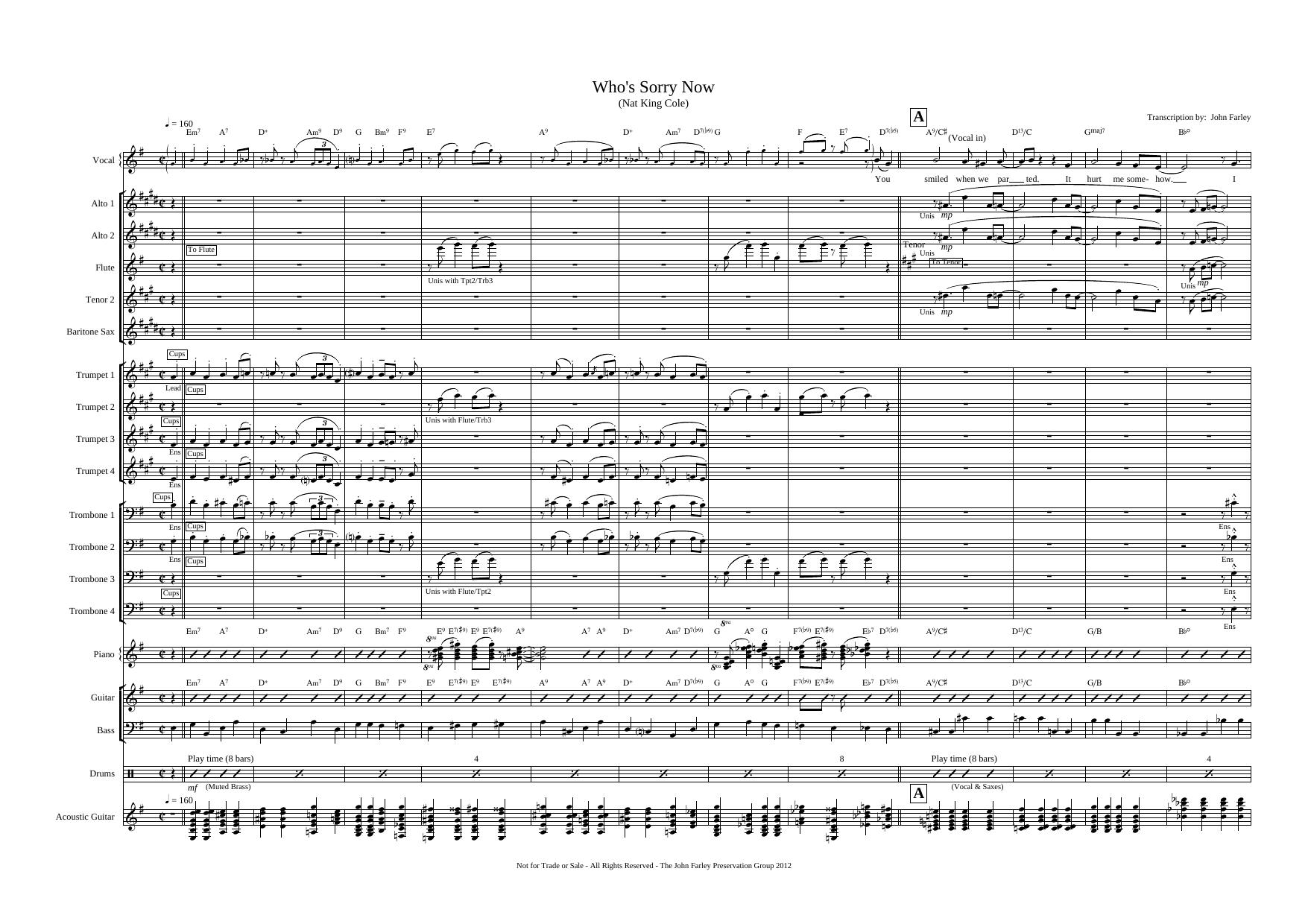
Who's Sorry Now (J.Farley)
Composed by Gus Kahn
Arranged by John Farley
- Ensemble: Big Band
- Pages: 48
- Instruments (20): Vocal, Alto Saxophone 1, Alto Saxophone 2, Flute, Tenor Saxophone 1, Tenor Saxophone 2, Baritone Saxophone, Trumpet 1, Trumpet 2, Trumpet 3, Trumpet 4, Trombone 1, Trombone 2, Trombone 3, Trombone 4, Piano, Guitar, Acoustic Guitar, Bass, Drums
- Difficulty: medium
- Content: Individual Parts
- Format: PDF Download (Instant)
- Price: $24.99
Originally penned in 1923 by lyricist Gus Kahn alongside composers Ted Snyder and Harry Ruby, "Who’s Sorry Now?" stands as a quintessential artifact of the Tin Pan Alley era that successfully transitioned into a cornerstone of the traditional jazz and swing repertoires. While initially introduced as a standard popular song, its melancholy yet resilient melodic contour invited early jazz interpreters to bend its phrasing and explore its harmonic potential. The tune achieved its most iconic status when Connie Francis revived it as a crossover smash in the late 1950s, cementing its melody in the global consciousness, but its sturdy 32-bar form has long made it a favorite canvas for jazz arrangers seeking a vehicle for expressive swing and dynamic contrast. John Farley’s sophisticated big band interpretation reimagines the classic tune as a driving, mid-tempo swing chart that balances nostalgic charm with modern harmonic color. Floating effortlessly at a comfortable medium-swing tempo (around 120–126 BPM), the arrangement opens with a sultry, subdued introduction before unfolding into a rich tapestry of lush brass voicings and interlocking sax solis. Farley employs contemporary extended chord extensions—incorporating major ninths, altered dominants, and subtle chromatic passing tones—without ever obscuring the instantly recognizable vocal line. The emotional trajectory shifts seamlessly from introspective, smoky verses to an exuberant, high-energy shout chorus that showcases the full dynamic range of a standard 19-piece jazz orchestra. Throughout the chart, the instrumental distribution is meticulously balanced to highlight both ensemble unity and individual expression. The vocal lead serves as the emotional anchor, framed expertly by tasteful countermelodies in the reed section and punchy, conversational background figures from the brass. An improvised solo section provides an ideal spotlight for a featured tenor saxophone or trumpet player, built over changes that encourage fluid, linear phrasing. Technical demands are moderate yet engaging, requiring clean articulation, precise control of dynamic shading, and a deep, unified internal clock to nail the infectious triplet feel of the swing rhythm section. Advanced high school ensembles, collegiate jazz orchestras, and professional community big bands will find this arrangement to be an exceptionally rewarding addition to their libraries. It offers enough harmonic sophistication and stylistic nuance to challenge developing musicians—particularly in section blend and stylistic consistency—while delivering the crowd-pleasing accessibility expected of a timeless vocal feature. Farley’s expert pacing ensures that the chart builds naturally from start to finish, leaving audiences captivated by its timeless melody and refreshed big band vitality. Conductors should approach John Farley’s arrangement of "Who’s Sorry Now?" with an emphasis on relaxed, forward-moving swing momentum rather than aggressive rushing. The rhythm section is the engine here: the drummer should maintain a crisp, buoyant ride cymbal pattern with a feathered bass drum feel, while the bassist walks a steady, quarter-note line that locks tightly with the piano’s comping. Brass players should utilize warm, harmonically blended tones, keeping vibrato controlled during the quieter ballad-esque segments. Mutes (such as cup or harmon) can be tastefully integrated during the opening verses if a more intimate, smoky club atmosphere is desired, though open horns are equally effective. Pay close attention to the dynamic markings leading into the shout chorus; the transition from subdued accompaniment to full ensemble roar must be gradual and controlled to maximize impact. Saxophones should focus on seamless intonation during the harmonized soli passages, ensuring that every articulation—from accented staccatos to smooth slurs—is matched across the section. Q: What instruments and parts are included in this big band arrangement? A: The 48-page score and parts package is scored for a standard 19-instrument big band lineup, featuring a vocal lead, two alto saxophones, a tenor saxophone, a flute, and a complete rhythm and brass section. Q: What is the difficulty level of this arrangement? A: This arrangement is rated at an intermediate-to-advanced difficulty level, making it ideal for proficient high school jazz bands, collegiate ensembles, and professional community big bands. Q: What style and historical era does this arrangement draw from? A: It draws from the traditional jazz and swing eras, transforming a classic 1923 Tin Pan Alley standard into a sophisticated, mid-tempo swing chart with modern harmonic coloration. Q: What makes John Farley’s arrangement unique? A: Farley blends nostalgic vocal delivery with contemporary extended harmonies, clever countermelodies, and a dynamic shout chorus that revitalizes a familiar standard without losing its vintage appeal. Q: What is the performance duration and recommended tempo for this piece? A: The arrangement runs approximately 3.5 to 4 minutes in duration and is best performed at a medium-swing tempo of around 120 to 126 beats per minute.
Questions and answers
- What is included in the Who's Sorry Now (J.Farley) PDF?
- The verified current file contains a conductor score and individual parts across 48 pages.
- How many instruments or parts are listed for Who's Sorry Now (J.Farley)?
- The verified instrumentation list contains 20 entries for this Big Band arrangement.
- Who is credited for Who's Sorry Now (J.Farley)?
- Composer: Gus Kahn. Arranger: John Farley.
- What difficulty is listed for Who's Sorry Now (J.Farley)?
- The verified difficulty level is medium.
- Can I preview Who's Sorry Now (J.Farley) before buying?
- Yes. The product page provides a preview generated from the current PDF file.
- How is Who's Sorry Now (J.Farley) delivered?
- After successful payment, the digital PDF is made available for download. The displayed price is $24.99.
Musicians Also Search For
Who's Sorry Now John Farley PDF • Who's Sorry Now John Farley sheet music • Who's Sorry Now arranged by John Farley • John Farley big band charts • John Farley jazz arrangements PDF • Who's Sorry Now Gus Kahn sheet music • Who's Sorry Now Gus Kahn big band arrangements • Gus Kahn big band charts • Who's Sorry Now big band arrangements • Who's Sorry Now big band PDF download • Who's Sorry Now jazz sheet music • big band sheet music download • Who's Sorry Now conductor score PDF • Who's Sorry Now individual parts download • Who's Sorry Now sheet music PDF • buy Who's Sorry Now sheet music • download Who's Sorry Now PDF • Who's Sorry Now jazz charts • best John Farley big band arrangements • Gus Kahn arranged by John Farley • Who's Sorry Now printable sheet music • big band repertoire PDF