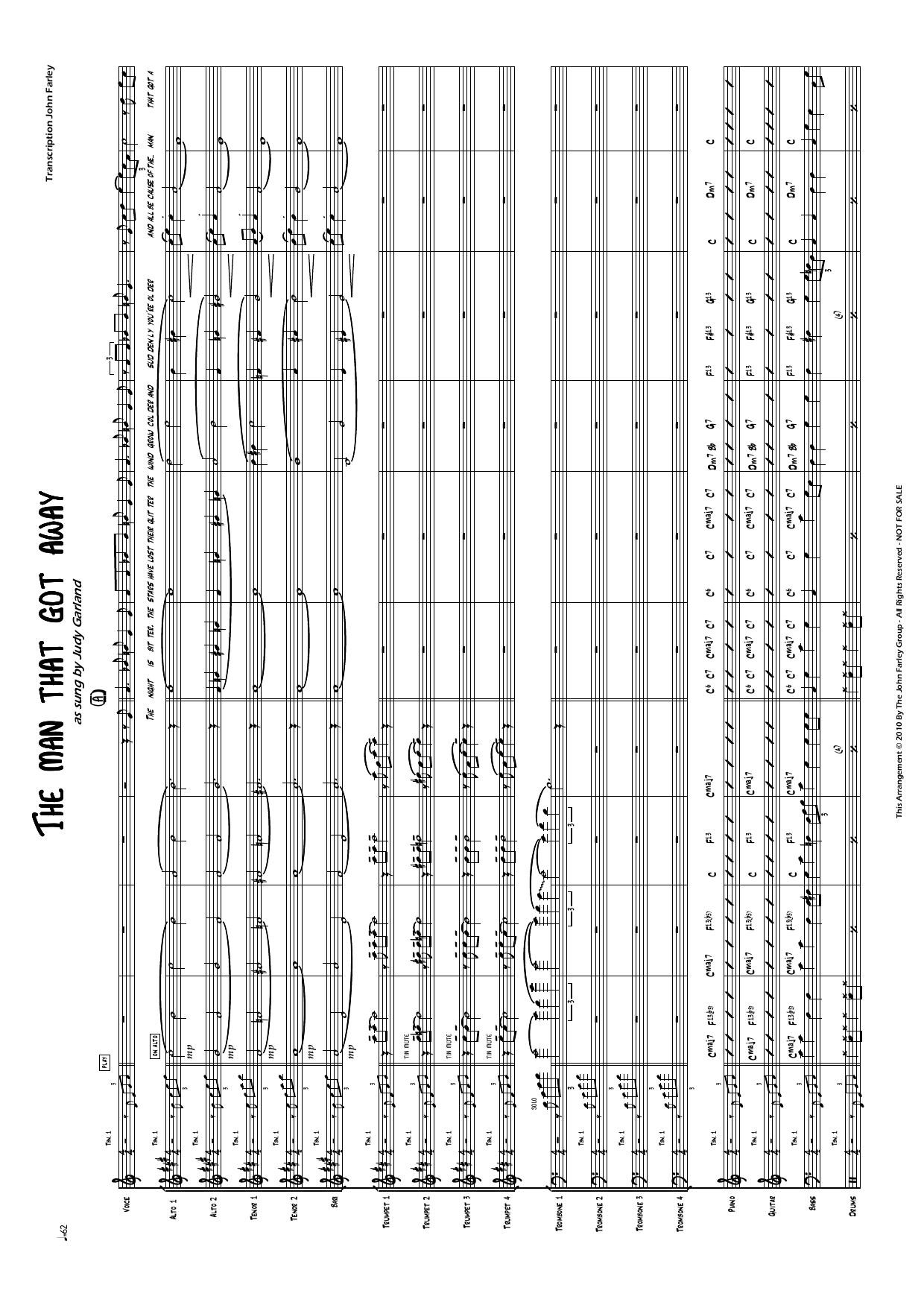
The Man That Got Away (J.Farley)
Composed by Harold Arlen
Arranged by John Farley
- Ensemble: Big Band
- Pages: 31
- Instruments (19): Voice, Alto Saxophone 1, Alto Saxophone 2, Tenor Saxophone 1, Tenor Saxophone 2, Baritone Saxophone, Trumpet 1, Trumpet 2, Trumpet 3, Trumpet 4, Trombone 1, Trombone 2, Trombone 3, Trombone 4, Piano, Guitar, Bass, Drums, Clarinet in Bb
- Difficulty: medium
- Content: Individual Parts
- Format: PDF Download (Instant)
- Price: $24.99
Harold Arlen and Ira Gershwin originally forged "The Man That Got Away" for Judy Garland in the 1954 cinematic milestone *A Star Is Born*, cementing its status as one of the most dramatically potent torch songs of the twentieth century. While born on the silver screen, the composition quickly transitioned into the permanent jazz and cabaret canon, revered for its sweeping minor-mode architecture, bruised harmonic progression, and uncommon theatrical gravity. Unlike standard AABA show tunes, the composition follows a sprawling, narrative-driven form that invites deep expressive interpretation, making it a natural vehicle for jazz arrangers seeking to bridge the gap between intimate vocal delivery and expansive big band orchestration. John Farley’s sophisticated big band treatment transforms this classic into a smoldering, dramatic minor-key masterpiece. Rooted in a smoldering, slow-to-medium swing feel anchored by a smoky jazz-waltz or brooding 12/8 and straight-into-swing contrast, the chart opens with an atmospheric, tension-building intro that highlights sultry muted brass and sparse, cascading piano voicings. The emotional arc scales steadily from introspective melancholy to explosive despair. Farley utilizes rich, extended chord voicings in the saxophones and dark, lush lower-register harmonies in the trombones to evoke a late-night, cinematic atmosphere. A striking dynamic shift occurs midway through the chart, where a dense, interlocking horn soli leads directly into a towering, brass-heavy shout chorus that lays bare the inherent tragedy and power of the melody before subsiding into a haunting, lingering decrescendo. The vocal soloist carries the narrative weight of the arrangement, enjoying ample rhythmic flexibility and rubato freedom within tightly controlled ensemble backgrounds. Instrumental spotlights are woven organically into the texture, featuring a soaring alto saxophone obbligato that weaves around the vocal line, and a poignant, blues-infused tenor saxophone or muted trumpet solo that captures the aching essence of the post-bop harmonic language. Technically, the chart demands exceptional dynamic control, immaculate intonation on complex minor-seventh and altered dominant sonorities, and a mature sense of theatrical pacing. The rhythm section is tasked with maintaining an unyielding, subtle propulsion, utilizing a felt bass line and nuanced cymbal work rather than heavy-handed timekeeping. Advanced high school ensembles with strong mature soloists, as well as collegiate, community, and professional jazz orchestras, will find this arrangement an ideal centerpiece for festival programs or concert sets. It provides a rare opportunity to showcase a powerhouse vocalist while stretching the ensemble’s collective maturity, demanding deep listening, stylistic cohesion, and an appreciation for dramatic storytelling through jazz harmony. Conducting John Farley’s arrangement of "The Man That Got Away" requires a deft balance of rigid structural control and expressive rubato freedom, particularly when supporting the vocal soloist. The tempo should hover around a brooding medium groove, but the conductor must breathe with the singer, allowing natural accelerandos and ritardandos during transitional phrases without letting the underlying pulse drag. Key technical challenges center around intonation within the dense, extended minor harmonies; saxophones and trombones must spend dedicated rehearsal time locking in their inner voices on altered chords. Brass players will need to execute subtle, warm cup and harmon mutes with precise pitch alignment during the opening statements, transitioning smoothly to open bell sections without sacrificing core tone quality. Rehearsal should prioritize the dynamic contour of the chart. Ensure the rhythm section maintains an ultra-subtle, conversational accompaniment during the verses so the vocal line never has to force projection. Pay meticulous attention to the balance of the mid-chart soli; the saxophones must project their intricate lines with a unified, dark tone color while remaining transparent enough for the underlying counter-melodies to pierce through. Finally, approach the shout chorus not as a test of raw volume, but as an exercise in sheer sonic weight and controlled intensity, utilizing crisp articulation to maximize the emotional payoff. Q: What instruments and parts are included in this big band arrangement? A: This arrangement is scored for a standard 19-instrument jazz big band lineup, consisting of a vocal soloist, 2 alto saxophones, 2 tenor saxophones, baritone saxophone, 4 trumpets, 4 trombones, guitar, piano, bass, and drums, and includes a comprehensive conductor score across its 31 pages. Q: What is the difficulty level of this chart? A: This arrangement is graded as advanced, suited for collegiate, professional, and advanced high school jazz ensembles that possess strong reading skills, a mature sense of minor-key swing phrasing, and a capable featured vocal soloist. Q: What is the musical style and historical context of this piece? A: Written in a dramatic jazz style, this arrangement reinterprets Harold Arlen and Ira Gershwin’s iconic 1954 torch song, transforming a classic cinematic vocal standard into a moody, harmonically rich big band showcase rooted in the jazz tradition. Q: What makes John Farley’s arrangement unique? A: Farley’s treatment stands out through its cinematic use of dark, extended minor voicings, a sophisticated saxophone soli, a towering brass-heavy shout chorus, and an intricate balance between intimate vocal storytelling and explosive ensemble power. Q: What is the performance duration and tempo feel of this arrangement? A: The piece functions as a substantial concert work, typically clocking in around 4 to 5 minutes depending on the vocal soloist's rubato interpretation, anchored by a smoldering, flexible medium swing and ballad-esque feel.
Questions and answers
- What is included in the The Man That Got Away (J.Farley) PDF?
- The verified current file contains a conductor score and individual parts across 31 pages.
- How many instruments or parts are listed for The Man That Got Away (J.Farley)?
- The verified instrumentation list contains 19 entries for this Big Band arrangement.
- Who is credited for The Man That Got Away (J.Farley)?
- Composer: Harold Arlen. Arranger: John Farley.
- What difficulty is listed for The Man That Got Away (J.Farley)?
- The verified difficulty level is medium.
- Can I preview The Man That Got Away (J.Farley) before buying?
- Yes. The product page provides a preview generated from the current PDF file.
- How is The Man That Got Away (J.Farley) delivered?
- After successful payment, the digital PDF is made available for download. The displayed price is $24.99.
Musicians Also Search For
The Man That Got Away John Farley PDF • The Man That Got Away John Farley sheet music • The Man That Got Away arranged by John Farley • John Farley big band charts • John Farley jazz arrangements PDF • The Man That Got Away Harold Arlen sheet music • The Man That Got Away Harold Arlen big band arrangements • Harold Arlen big band charts • The Man That Got Away big band arrangements • The Man That Got Away big band PDF download • The Man That Got Away jazz sheet music • big band sheet music download • The Man That Got Away conductor score PDF • The Man That Got Away individual parts download • The Man That Got Away sheet music PDF • buy The Man That Got Away sheet music • download The Man That Got Away PDF • The Man That Got Away jazz charts • best John Farley big band arrangements • Harold Arlen arranged by John Farley • The Man That Got Away printable sheet music • big band repertoire PDF