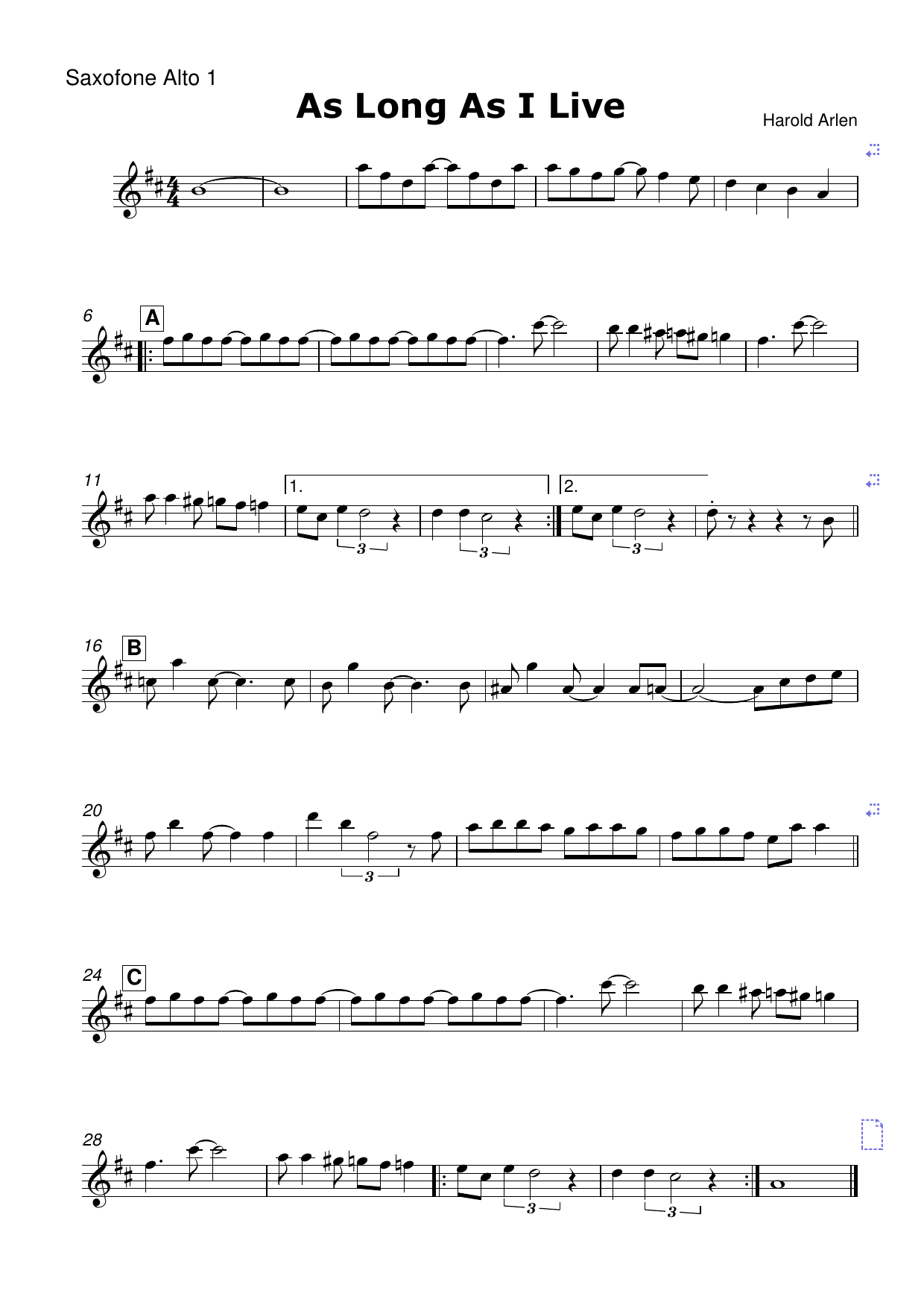
As Long As I Live (H.Arlen)
Composed by Harold Arlen
Arranged by H.Arlen
- Ensemble: Big Band
- Pages: 11
- Instruments (11): Saxofone Alto 1, Saxofone Alto 2, Baixo, Piano, Trombone 1, Trombone 2, Saxofone Tenor 1, Saxofone Tenor 2, Trompete 1, Trompete 2, Trompete 3
- Difficulty: easy
- Content: individual parts only
- Format: PDF Download (Instant)
- Price: $24.99
Harold Arlen and Ted Koehler’s timeless standard "As Long As I Live," introduced in the 1934 Broadway revue *Say When* and subsequently immortalized by legends like Lena Horne and Benny Goodman, stands as a cornerstone of the Great American Songbook. This swinging gem represents the golden age of 1930s swing and theater composition, renowned for its infectious optimism, sophisticated harmonic architecture, and uplifting, driving melody. Over the decades, it has evolved from a sophisticated show tune into an essential vehicle for jazz improvisation, celebrated for its buoyant bridge and harmonically rich A sections that invite creative interpretation from vocalists and instrumentalists alike. Bouncing forward with a bright, luminous medium-up swing feel in 4/4 time, this chart radiates an effervescent, vintage optimism. The mood is relentlessly joyful and sophisticated, evoking the vibrant atmosphere of Harlem's historic supper clubs and mid-century big band ballrooms. The arrangement opens with a crisp, inviting brass-and-reed preamble that immediately establishes a buoyant groove, driven by an insistent walking bassline and crisp ride-cymbal pulsations from the rhythm section. The underlying emotional current is one of unbridled exuberance, shifting seamlessly between punchy ensemble hits and flowing, conversational counter-melodies that keep the energy perpetually airborne. Conceived with a brilliant economy of texture, this 11-page manuscript is uniquely tailored for a compact 7-instrument instrumentation (featuring Alto Saxophone, Tenor Saxophone, Trumpet, Trombone, Piano, and rhythm section components). Rather than relying on a massive wall of sound, the scoring achieves a remarkably full, authentic big band transparency through ingenious counterpoint and rich, transparent three- and four-part horn voicings. The arrangement cleverly distributes thematic material between the woodwinds and brass, creating sparkling dynamic contrasts. Solos are seamlessly integrated into the form, allowing the alto and tenor saxophones to stretch out over changes that closely mirror classic small-group swing recordings while maintaining crisp, idiomatic ensemble punctuation behind the soloists. Advanced high school ensembles, collegiate jazz combos with horn sections, and professional freelance groups will find this chart to be an exceptionally rewarding addition to their repertoire. The primary technical challenges lie not in extreme technical pyrotechnics, but in achieving a unified, lightweight articulation across the seven voices and maintaining a relaxed, driving swing feel at a brisk tempo. The interplay between the rhythm section and horns demands crisp stylistic precision, particularly during the syncopated shout chorus that builds organically toward a triumphant, high-spirited final cadence. It offers a masterclass in classic arranging economy, proving that a lean ensemble, when voiced with brilliance and stylistic authenticity, can project all the power and elegance of a full-scale seventeen-piece jazz orchestra. Success with this arrangement hinges on achieving a lightweight, buoyant swing feel rather than a heavy, aggressive modern stomp. The tempo should be kept bright and nimble, allowing the rhythm section to propel the 7-piece ensemble with an effortless, conversational groove. Conductors should pay close attention to articulation markings: eighth notes must be cleanly swung with natural horn accents on beats two and four, avoiding over-articulation. The saxophone and brass sections must balance carefully against the piano, ensuring that inner-voice harmonies in the voicings are transparent rather than muddy. For the ensemble passages, utilize subtle dynamic shading—subito piano contrasts following brass shouts will heighten the excitement. Horn players should incorporate natural, tasteful jazz inflections such as gentle terminal vibrato and subtle falls where indicated, while the rhythm section maintains an unyielding, steady pulse. Rehearsal should begin slowly with a metronome to lock in the unison syncopated figures before opening up the tempo to performance speed. Q: What specific instruments and parts are included in this 7-instrument arrangement? A: The chart is scored for a versatile 7-instrument lineup comprising Alto Saxophone, Tenor Saxophone, Trumpet, Trombone, Piano, and rhythm section support, ensuring a full big-band texture with lean instrumentation. Q: What is the difficulty level of this arrangement? A: This arrangement is graded as intermediate to advanced, making it ideal for skilled high school musicians, collegiate small jazz ensembles, and professional freelance groups looking for authentic swing styling. Q: What is the historical style and musical context of this piece? A: Originally composed by Harold Arlen in 1934 for the Broadway stage and later adopted as a staple of the swing era, this arrangement captures the bright, optimistic, and sophisticated spirit of 1930s jazz standards. Q: What makes this particular 7-piece arrangement unique? A: It brilliantly condenses the rich harmonic density and dynamic power of a full 17-piece big band into a nimble 7-part texture using clever counterpoint, transparent voicings, and crisp ensemble interplay across its 11 pages. Q: What is the recommended performance duration and tempo for this chart? A: The arrangement is set at a bright, medium-up swing tempo (approximately quarter note = 160–172 BPM) and typically runs for about 3.5 to 4 minutes depending on solo choruses.
Questions and answers
- What is included in the As Long As I Live (H.Arlen) PDF?
- The verified current file contains individual parts across 11 pages.
- How many instruments or parts are listed for As Long As I Live (H.Arlen)?
- The verified instrumentation list contains 11 entries for this Big Band arrangement.
- Who is credited for As Long As I Live (H.Arlen)?
- Composer: Harold Arlen. Arranger: H.Arlen.
- What difficulty is listed for As Long As I Live (H.Arlen)?
- The verified difficulty level is easy.
- Can I preview As Long As I Live (H.Arlen) before buying?
- Yes. The product page provides a preview generated from the current PDF file.
- How is As Long As I Live (H.Arlen) delivered?
- After successful payment, the digital PDF is made available for download. The displayed price is $24.99.
Musicians Also Search For
As Long As I Live H.Arlen PDF • As Long As I Live H.Arlen sheet music • As Long As I Live arranged by H.Arlen • H.Arlen big band charts • H.Arlen jazz arrangements PDF • As Long As I Live Harold Arlen sheet music • As Long As I Live Harold Arlen big band arrangements • Harold Arlen big band charts • As Long As I Live big band arrangements • As Long As I Live big band PDF download • As Long As I Live jazz sheet music • big band sheet music download • As Long As I Live individual parts download • As Long As I Live sheet music PDF • buy As Long As I Live sheet music • download As Long As I Live PDF • As Long As I Live jazz charts • best H.Arlen big band arrangements • Harold Arlen arranged by H.Arlen • As Long As I Live printable sheet music • big band repertoire PDF