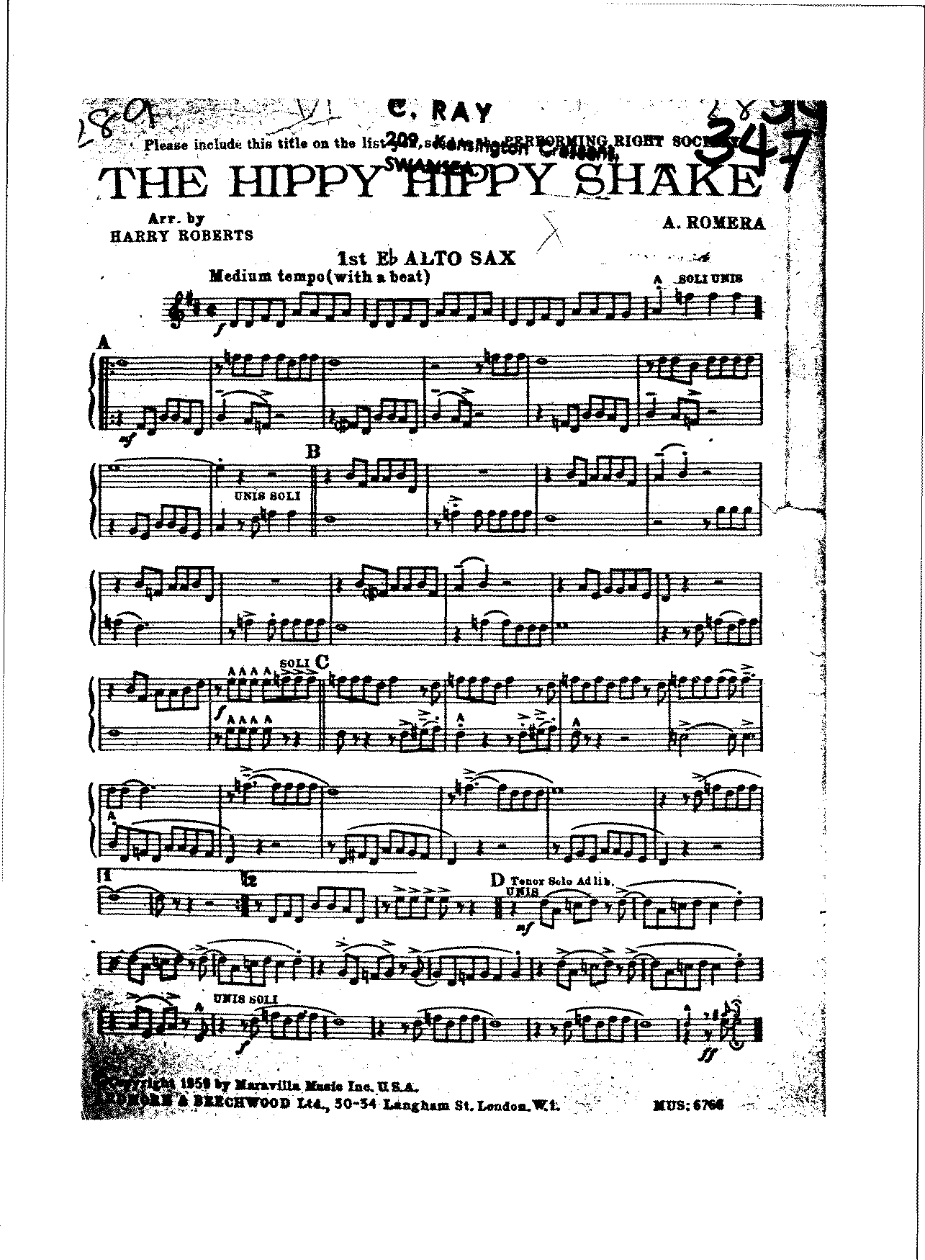
The Hippy Hippy Shake (H.Roberts)
Composed by Chan Romero
Arranged by H. Roberts
- Ensemble: Big Band
- Style: Jive
- Pages: 22
- Instruments (17): 1st Eb Alto Sax, 2nd Eb Alto Sax, Eb Baritone Sax, Bass, 1st Trombone, 2nd Trombone, 3rd Trombone, 4th Trombone, Drums, Rh. Guitar, Piano Conductor & Accordion Guide, 1st Bb Tenor Sax, 2nd Bb Tenor Sax, 1st Bb Trumpet, 2nd Bb Trumpet, 3rd Bb Trumpet, 4th Trumpet
- Difficulty: easy
- Content: Individual Parts
- Format: PDF Download (Instant)
- Price: $24.99
"The Hippy Hippy Shake," originally penned by Chan Romero in 1959, stands as an enduring anthem of early rock and roll, a vibrant sonic snapshot from an era defined by youthful exuberance and burgeoning musical innovation. Romero, a mere 17 years old at the time, crafted a tune that, while not an immediate chart-topper in the US, quickly found immense popularity in Australia, reaching number three the same year. Its raw energy and infectious rhythm resonated deeply, particularly with the burgeoning Merseybeat scene in the UK. The song gained legendary status through its frequent performance by The Beatles in their formative years at venues like the Cavern Club and Star-Club, with Paul McCartney often taking lead vocals, solidifying its place in rock history. Later, The Swinging Blue Jeans propelled it to number two on the UK Singles Chart in 1963, cementing its legacy as a quintessential 1960s jive and rock and roll staple. This big band arrangement by H. Roberts reimagines the electrifying spirit of "The Hippy Hippy Shake" through a sophisticated yet driving jive lens. Set in the original key of E major, the arrangement maintains the song's characteristic medium-fast tempo, typically around 140-150 BPM, ensuring its danceable and energetic core remains intact. The musical character is one of unbridled joy and rhythmic propulsion, evoking the lively atmosphere of a 1960s dance hall with a powerful, contemporary big band sound. The arrangement is designed to be bright and penetrating, with a clear focus on rhythmic precision and dynamic contrast, creating an exhilarating experience for both performers and audience. H. Roberts' distinctive approach to this arrangement is evident in the clever voicings and strategic use of the full ensemble. The melody is initially carried by the saxophone section, often in tight, punchy unison or harmonized lines, before being passed to the trumpets for a brighter, more assertive statement. Expect classic big band techniques such as call-and-response between sections, driving brass figures, and a powerful shout chorus that builds to an exhilarating climax. While H. Roberts is known for crafting arrangements that are both technically engaging and musically rewarding, this piece specifically highlights crisp articulation and rhythmic tightness. Featured solo sections provide opportunities for improvisation, likely for tenor saxophone or trumpet, allowing individual musicians to showcase their expressive capabilities within the jive framework. This arrangement is ideally suited for college-level jazz ensembles, advanced community big bands, or professional groups seeking a high-energy, historically significant, yet freshly interpreted chart. The technical challenges lie in maintaining the relentless rhythmic drive, executing precise ensemble hits, and navigating the often intricate brass and saxophone soli passages. However, the rewarding aspect comes from the sheer infectiousness of the music and the opportunity to perform a beloved classic with a powerful, full-bodied sound. The interplay between the piano and accordion adds a unique textural layer, providing a rich harmonic foundation and occasional counter-melodic interest that sets this arrangement apart. Conductors should emphasize a consistent, driving jive feel, maintaining a steady pulse around 140-150 BPM. Articulation is paramount; brass sections should aim for crisp, short notes in rhythmic figures, while saxophones should balance precision with a smooth, connected sound in melodic lines. Key technical challenges include the fast-paced ensemble soli sections, particularly in the brass, which require diligent practice for rhythmic accuracy and blend. Encourage musicians to listen across sections to ensure unified attacks and releases. The arrangement may call for specific brass techniques like short, accented falls at the end of phrases, adding to the authentic jive aesthetic. Rehearsal time should be dedicated to isolating these challenging ensemble passages and ensuring dynamic contrast is clearly defined, building energy towards the shout chorus. The unique inclusion of accordion requires careful balancing within the ensemble, ensuring its distinctive timbre enhances rather than overwhelms the overall sound. Q: What instruments are included in this arrangement? A: This big band arrangement includes parts for Piano, Accordion, Saxophones (likely Alto 1, Alto 2, Tenor 1, Tenor 2, Baritone), Trombone, and Trumpets (likely Trumpet 1, Trumpet 2, Trumpet 3, Trumpet 4). Q: What is the difficulty level of "The Hippy Hippy Shake (H.Roberts)"? A: This arrangement is considered advanced, suitable for college-level, advanced community, or professional big bands due to its demanding rhythmic precision, intricate soli sections, and dynamic requirements. Q: What musical style and historical context does this arrangement represent? A: This arrangement is in the Jive style, a lively and energetic form of swing dance music. It reimagines Chan Romero's original 1959 rock and roll hit, which gained further fame through The Beatles and The Swinging Blue Jeans in the early 1960s. Q: What makes this specific arrangement unique? A: H. Roberts' arrangement is unique for its sophisticated big band treatment of a classic rock and roll tune, featuring clever voicings, a powerful shout chorus, and the distinctive inclusion of an accordion part that adds a fresh textural dimension to the traditional big band sound. Q: What is the typical performance duration or tempo for this piece? A: "The Hippy Hippy Shake" is typically performed at a medium-fast jive tempo, ranging from approximately 140 to 150 BPM, ensuring its characteristic high energy and danceable feel.
Questions and answers
- What is included in the The Hippy Hippy Shake (H.Roberts) PDF?
- The verified current file contains a conductor score and individual parts across 22 pages.
- How many instruments or parts are listed for The Hippy Hippy Shake (H.Roberts)?
- The verified instrumentation list contains 17 entries for this Big Band arrangement.
- Who is credited for The Hippy Hippy Shake (H.Roberts)?
- Composer: Chan Romero. Arranger: H. Roberts.
- What difficulty is listed for The Hippy Hippy Shake (H.Roberts)?
- The verified difficulty level is easy.
- What style is listed for The Hippy Hippy Shake (H.Roberts)?
- The catalog lists the style as Jive.
- Can I preview The Hippy Hippy Shake (H.Roberts) before buying?
- Yes. The product page provides a preview generated from the current PDF file.
- How is The Hippy Hippy Shake (H.Roberts) delivered?
- After successful payment, the digital PDF is made available for download. The displayed price is $24.99.
Musicians Also Search For
The Hippy Hippy Shake H. Roberts PDF • The Hippy Hippy Shake H. Roberts sheet music • The Hippy Hippy Shake arranged by H. Roberts • H. Roberts big band charts • H. Roberts jazz arrangements PDF • The Hippy Hippy Shake Chan Romero sheet music • The Hippy Hippy Shake Chan Romero big band arrangements • Chan Romero big band charts • The Hippy Hippy Shake big band arrangements • The Hippy Hippy Shake big band PDF download • The Hippy Hippy Shake jazz sheet music • big band sheet music download • The Hippy Hippy Shake conductor score PDF • The Hippy Hippy Shake individual parts download • The Hippy Hippy Shake sheet music PDF • The Hippy Hippy Shake Jive charts • Jive big band arrangements • buy The Hippy Hippy Shake sheet music • download The Hippy Hippy Shake PDF • The Hippy Hippy Shake jazz charts • best H. Roberts big band arrangements • Chan Romero arranged by H. Roberts • The Hippy Hippy Shake printable sheet music • big band repertoire PDF