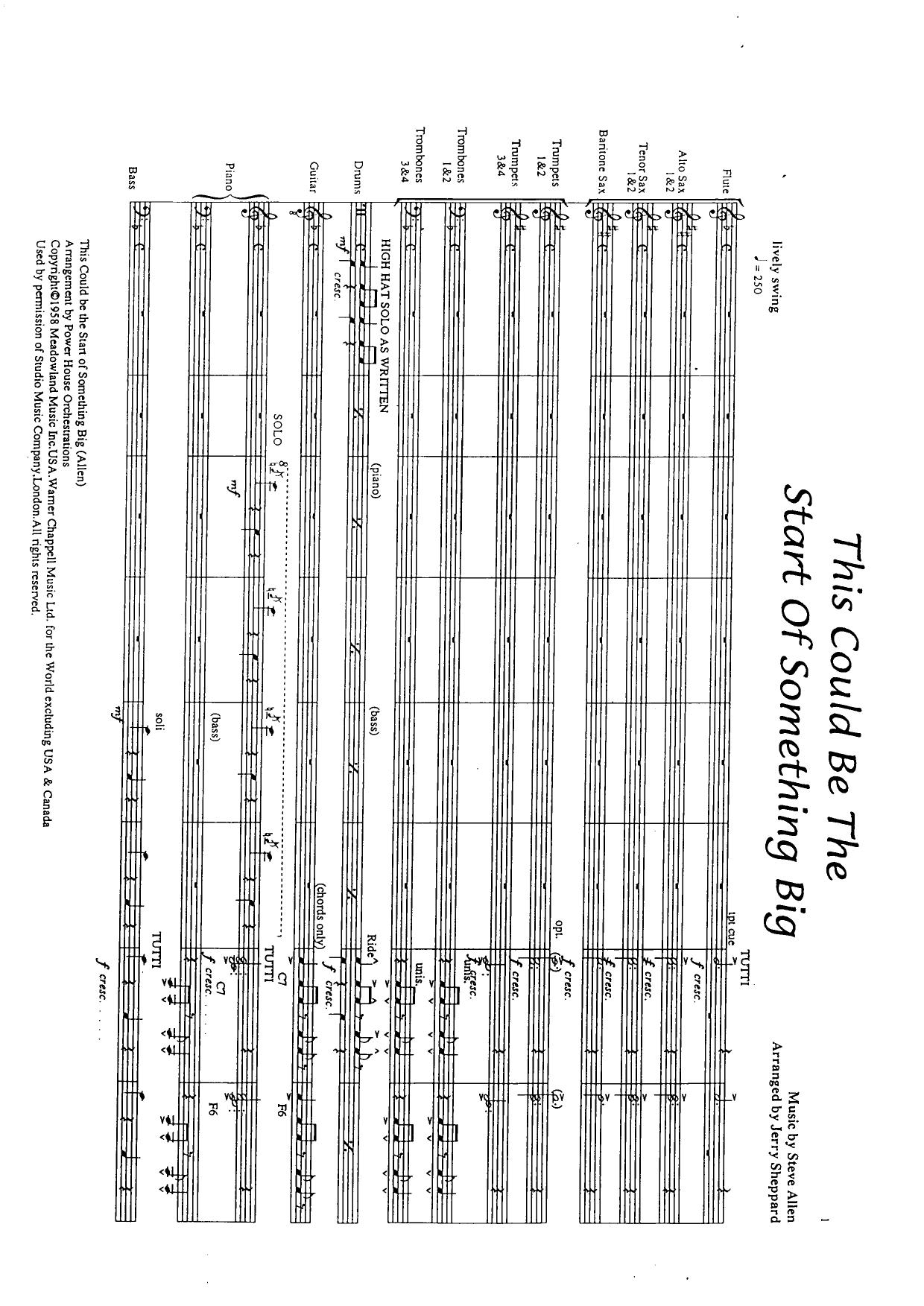
This Could Be The Start Of Something Big (J.Sheppard) sheet music preview

This Could Be The Start Of Something Big (J.Sheppard)

Composed by Steve Allen

Arranged by J.Sheppard

  • Ensemble: Big Band
  • Style: Jazz Standard
  • Pages: 25
  • Instruments (18): Flute, Alto Saxophone 1, Alto Saxophone 2, Tenor Saxophone 1, Tenor Saxophone 2, Baritone Saxophone, Trumpet 1, Trumpet 2, Trumpet 3, Trumpet 4, Trombone 1, Trombone 2, Trombone 3, Trombone 4, Drums, Guitar, Piano, Bass
  • Difficulty: medium
  • Content: Individual Parts
  • Format: PDF Download (Instant)
  • Price: $24.99

Steve Allen’s timeless composition "This Could Be The Start Of Something Big" stands as one of the quintessential vocal and instrumental vehicles of the mid-century American songbook, capturing the unbridled optimism and suave sophistication of the 1950s pop-jazz crossover era. Originally introduced by Allen and later cemented into jazz canon by artists like Count Basie, Ella Fitzgerald, and Stan Kenton, the tune thrives on an irrepressible forward momentum and an infectious, driving melody. It represents the pinnacle of upbeat, swinging optimism, effortlessly bridging mainstream appeal with sophisticated harmonic structures that allow jazz orchestras to showcase both individual flair and collective precision. J.Sheppard’s dynamic big band treatment infuses this classic standard with a vibrant, high-energy medium-up swing feel that radiates electricity from the downbeat. Set in a bright, brass-heavy, and rhythmically punchy framework, the chart opens with an inviting, sparkling intro before leaping into a full-ensemble statement. The emotional landscape is buoyant, triumphant, and relentlessly joyful, driven by crisp articulation and interlocking horn lines that evoke the golden age of Basie-style shout choruses while injecting modern, rich extended chord voicings. The mood is celebratory and sophisticated, demanding a high level of ensemble engagement and an unwavering sense of time from the rhythm section. In this masterful configuration, J.Sheppard utilizes classic big band architecture—featuring a powerful 18-instrument roster—to distribute melodic interest dynamically across the ensemble. The woodwinds, anchored by a nimble flute and dual alto and tenor saxophones, weave intricate bebop-influenced counterlines beneath soaring brass statements. The arrangement features designated solo spaces that invite improvisers to stretch out over accessible yet stimulating changes, while the brass section benefits from cleverly crafted dynamic contours, punchy accents, and strategic use of falls and doits. The crowning glory of the chart is a blistering shout chorus that builds tension through rhythmic displacement and syncopated figures before releasing into a roaring, high-octane final cadence. Advanced high school, collegiate, and professional community jazz orchestras will find this chart to be an exceptional centerpiece for festival repertoires and concert programs. While the rhythmic syncopation and brisk tempo require solid reading skills and precise section articulation, the idiomatic writing ensures that the hard work pays off immediately in audience response. Musicians will relish the clever interplay between the rhythm section and horns, making it a profoundly rewarding piece to rehearse and an unforgettable experience to perform live. Conductors should approach J.Sheppard’s chart with a crisp, driving medium-up swing tempo, maintaining a steady, buoyant pulse around 160–172 BPM without rushing. The primary technical challenge lies in the execution of precision syncopation between the brass and saxophones; short notes must be clipped and uniform, while sustained lines require a warm, supportive vibrato. Saxophones should focus on smooth, linear transitions during scalar soli passages, ensuring that internal voices balance cleanly against the lead alto. The rhythm section is the engine of this arrangement: the drummer should drive the ensemble with a crisp ride cymbal pattern and well-placed dynamic kicks that punctuate the horn ensemble's stop-time figures, while the bassist lays down a walking quarter-note line with strong emphasis on beats two and four. Utilize dynamic contrast wisely—underscoring the difference between the hushed, driving background figures and the explosive full-ensemble shout chorus—to maximize the theatrical impact of the arrangement. Q: What instrumentation and specific parts are included in this 18-instrument big band arrangement? A: The chart is scored for a standard 18-piece big band instrumentation, featuring parts for flute, two alto saxophones, two tenor saxophones, a full complement of brass (trumpets and trombones), and a complete rhythm section including piano, guitar, bass, and drums. Q: What is the overall difficulty level of J.Sheppard's arrangement? A: This arrangement is graded as advanced-intermediate to advanced, making it best suited for capable high school, collegiate, and professional community big bands that possess strong section reading abilities and solid swing feel. Q: What is the historical style and musical background of this piece? A: Originally composed by television personality and musician Steve Allen, the tune is a quintessential mid-century jazz standard that embodies the vibrant, swinging optimism of the 1950s jazz and pop crossover era. Q: What makes this particular version by J.Sheppard unique among big band charts of this standard? A: J.Sheppard's treatment stands out through its clever integration of a flute voice within the saxophone section, sophisticated extended harmonies, and a thrilling, high-energy shout chorus that revitalizes the classic melody. Q: What is the performance duration and recommended tempo for this arrangement? A: The arrangement runs approximately 3 to 4 minutes in length and is best performed at a bright, swinging tempo between 160 and 172 BPM to capture its intended energetic character.

Questions and answers

What is included in the This Could Be The Start Of Something Big (J.Sheppard) PDF?
The verified current file contains a conductor score across 25 pages.
How many instruments or parts are listed for This Could Be The Start Of Something Big (J.Sheppard)?
The verified instrumentation list contains 18 entries for this Big Band arrangement.
Who is credited for This Could Be The Start Of Something Big (J.Sheppard)?
Composer: Steve Allen. Arranger: J.Sheppard.
What difficulty is listed for This Could Be The Start Of Something Big (J.Sheppard)?
The verified difficulty level is medium.
What style is listed for This Could Be The Start Of Something Big (J.Sheppard)?
The catalog lists the style as Jazz Standard.
Can I preview This Could Be The Start Of Something Big (J.Sheppard) before buying?
Yes. The product page provides a preview generated from the current PDF file.
How is This Could Be The Start Of Something Big (J.Sheppard) delivered?
After successful payment, the digital PDF is made available for download. The displayed price is $24.99.

Musicians Also Search For

This Could Be The Start Of Something Big J.Sheppard PDFThis Could Be The Start Of Something Big J.Sheppard sheet musicThis Could Be The Start Of Something Big arranged by J.SheppardJ.Sheppard big band chartsJ.Sheppard jazz arrangements PDFThis Could Be The Start Of Something Big Steve Allen sheet musicThis Could Be The Start Of Something Big Steve Allen big band arrangementsSteve Allen big band chartsThis Could Be The Start Of Something Big big band arrangementsThis Could Be The Start Of Something Big big band PDF downloadThis Could Be The Start Of Something Big jazz sheet musicbig band sheet music downloadThis Could Be The Start Of Something Big conductor score PDFThis Could Be The Start Of Something Big sheet music PDFThis Could Be The Start Of Something Big Jazz Standard chartsJazz Standard big band arrangementsbuy This Could Be The Start Of Something Big sheet musicdownload This Could Be The Start Of Something Big PDFThis Could Be The Start Of Something Big jazz chartsbest J.Sheppard big band arrangementsSteve Allen arranged by J.SheppardThis Could Be The Start Of Something Big printable sheet musicbig band repertoire PDF

All arrangements by J.Sheppard All Steve Allen sheet music