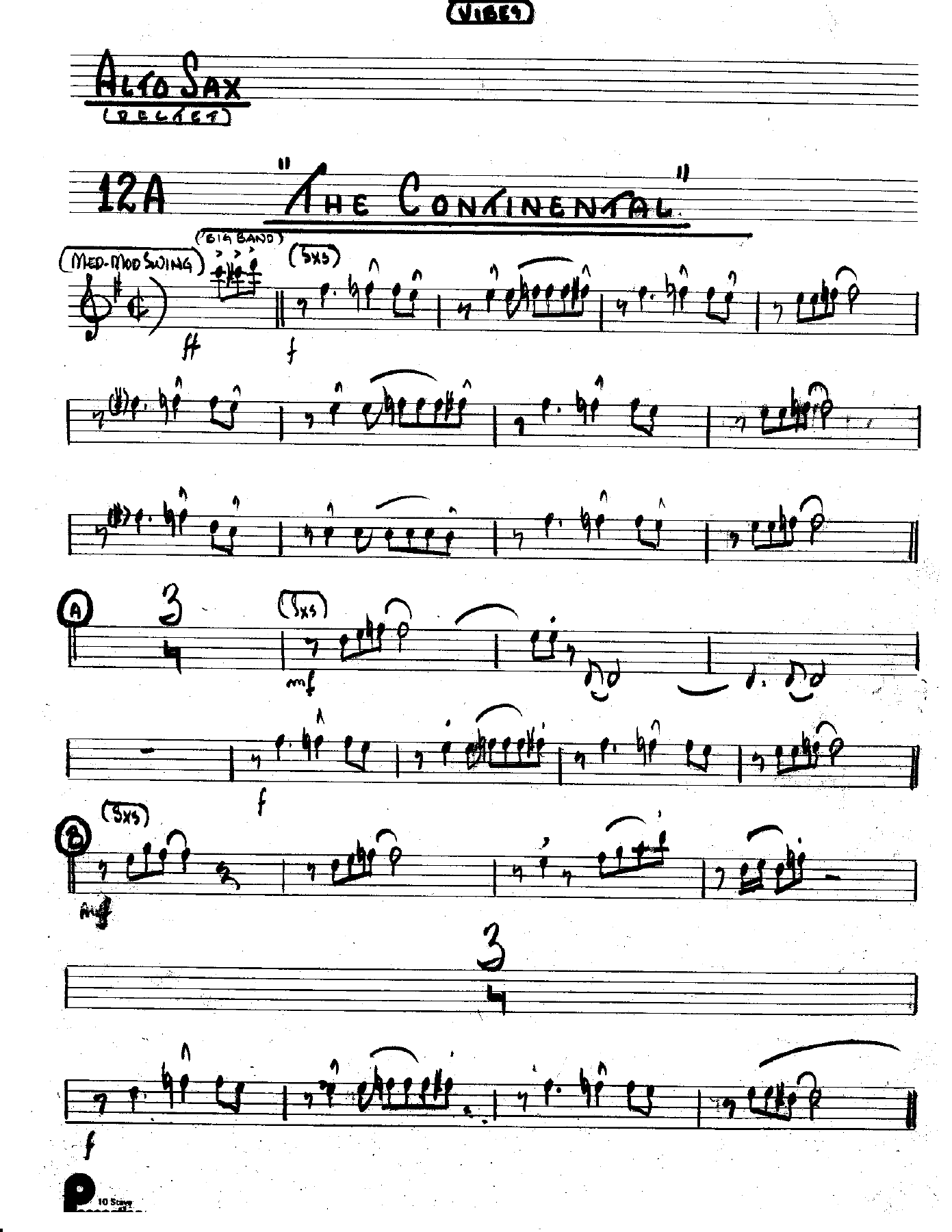
The Continental (Kenton Dectet #12A) sheet music preview

The Continental (Kenton Dectet #12A)

Composed by Con Conrad, Herb Magidson

Arranged by Kenton Dectet #12A

  • Ensemble: Small Ensemble
  • Style: Jazz Standard
  • Pages: 36
  • Difficulty: easy
  • Content: Sheet Music
  • Format: PDF Download (Instant)
  • Price: $12.99

"The Continental," originally composed by Con Conrad and Herb Magidson, emerged in 1934 as the first song to win an Academy Award for Best Original Song, featured in the film *The Gay Divorcee*. This iconic tune quickly became a cornerstone of the Great American Songbook, synonymous with the sophistication and romantic allure of the 1930s dance band era. While initially a ballroom standard, its infectious melody and elegant harmonic structure made it a natural fit for jazz interpretation, later embraced by swing orchestras and small combos alike, solidifying its status as a timeless jazz standard. Its enduring appeal lies in its graceful, flowing melodic lines and a harmonic progression that invites both faithful rendition and creative improvisation, making it a perennial favorite for dancers and listeners. Kenton Dectet #12A's arrangement of "The Continental" reimagines this classic with a medium swing feel, set in the key of F major, radiating a mood of sophisticated buoyancy and understated elegance. The piece opens with a refined, almost orchestral introduction that immediately establishes a sense of anticipation before settling into a relaxed yet propulsive groove. The overall energy is one of controlled dynamism, allowing the melody to shine while providing a rich harmonic tapestry. The arrangement evokes the golden age of jazz, blending traditional swing sensibilities with subtle modern harmonic extensions, creating a sound that is both familiar and fresh. It’s a piece that encourages a confident, expressive performance, inviting the audience to sway with its irresistible rhythm. The arranger, Kenton Dectet #12A, approaches "The Continental" with a distinctive blend of intricate voicings and thoughtful melodic development. The primary melody is initially carried by a unison or harmonized saxophone section, often featuring a lead alto or tenor, before being passed to the brass, creating textural variety. A signature element of this arrangement is the judicious use of soli sections, particularly for the saxophones and trombones, showcasing the ensemble's precision and blend. There are ample opportunities for featured solos, typically for trumpet, alto saxophone, or piano, over the standard form, allowing for individual expression within the structured framework. The arrangement culminates in a classic shout chorus, building dynamic intensity through layered brass and reeds, before a refined, conclusive coda. Technical challenges include maintaining a consistent, relaxed swing feel, executing precise articulations in the soli passages, and navigating the harmonic nuances of the Kenton Dectet #12A's signature voicings. The reward lies in performing a piece that is both historically significant and musically engaging, offering a satisfying challenge for a cohesive small ensemble. This arrangement is ideally suited for college-level jazz ensembles, advanced community bands, or professional small combos seeking a sophisticated yet accessible swing chart. Its balanced demands on ensemble precision, individual soloing, and stylistic interpretation make it an excellent vehicle for developing musicality and cohesion. The detailed voicings and thoughtful structure provide a rich learning experience, while the inherent charm of "The Continental" ensures it will be a crowd-pleaser, perfect for concerts, dances, or educational performances. "The Continental (Kenton Dectet #12A)" thrives on a consistent, relaxed medium swing feel, approximately quarter note = 120-130 BPM. Conductors should emphasize a light, driving rhythm section that supports the ensemble without overpowering. A key technical challenge lies in achieving precise articulation and blend within the saxophone and brass soli sections; encourage musicians to listen across sections and match phrasing. The brass section, particularly trumpets, should focus on a clear, warm tone, reserving brighter sounds for the shout chorus. Trombone players should ensure smooth legato in their soli lines. For the featured solos, encourage melodic improvisation that respects the harmonic structure while allowing for personal interpretation. Rehearsal time should be dedicated to balancing the intricate voicings, ensuring all inner voices are heard clearly, and practicing the dynamic build-up into the final shout chorus for maximum impact. No special mutes or extended techniques are explicitly required, though a tasteful use of plunger or cup mutes in the brass during certain sections can add stylistic authenticity if desired. Q: What instruments and parts are included in "The Continental (Kenton Dectet #12A)"? A: This small ensemble arrangement typically includes parts for lead alto saxophone, tenor saxophone, baritone saxophone, 2 trumpets, 1-2 trombones, piano, bass, and drums. Specific instrumentation may vary slightly, but it is designed for a standard jazz dectet or similar small big band configuration. Q: What is the difficulty level of this arrangement? A: This arrangement is rated as medium-advanced. It requires proficient instrumentalists capable of navigating intricate voicings, precise articulations, and comfortable improvisation over jazz standard changes. It is suitable for college-level ensembles, advanced community bands, and professional small jazz groups. Q: What is the musical style and historical context of "The Continental (Kenton Dectet #12A)"? A: This arrangement is a jazz standard in a medium swing style. The original song, composed in 1934, is a classic from the Great American Songbook, and this arrangement provides a sophisticated, swinging interpretation reminiscent of the golden age of jazz small ensembles. Q: What makes this particular arrangement unique compared to other versions of "The Continental"? A: Kenton Dectet #12A's arrangement is distinguished by its sophisticated voicings, prominent soli sections for both saxophones and brass, and a carefully crafted dynamic arc that builds to an exciting shout chorus. It blends traditional swing elements with subtle harmonic richness, offering a fresh yet authentic take on the classic. Q: What is the approximate performance duration and tempo for "The Continental (Kenton Dectet #12A)"? A: The typical performance duration for this arrangement is between 3:30 and 4:30 minutes, depending on the length of improvised solos. It is designed to be played at a medium swing tempo, generally around 120-130 beats per minute.

Musicians Also Search For

The Continental Kenton Dectet #12A PDFThe Continental Kenton Dectet #12A sheet musicThe Continental arranged by Kenton Dectet #12AKenton Dectet #12A small ensemble chartsKenton Dectet #12A jazz arrangements PDFThe Continental Con Conrad, Herb Magidson sheet musicThe Continental Con Conrad, Herb Magidson small ensemble arrangementCon Conrad, Herb Magidson small ensemble chartsThe Continental small ensemble arrangementThe Continental small ensemble PDF downloadThe Continental jazz ensemble sheet musicsmall ensemble sheet music instant downloadThe Continental sheet music with partsThe Continental Jazz Standard chartJazz Standard small ensemble arrangementsbuy The Continental sheet music onlinedownload The Continental PDFThe Continental jazz chartbest Kenton Dectet #12A small ensemble arrangementsCon Conrad, Herb Magidson songs arranged by Kenton Dectet #12AThe Continental printable sheet musicsmall ensemble repertoire PDF

All arrangements by Kenton Dectet #12A All Con Conrad, Herb Magidson sheet music