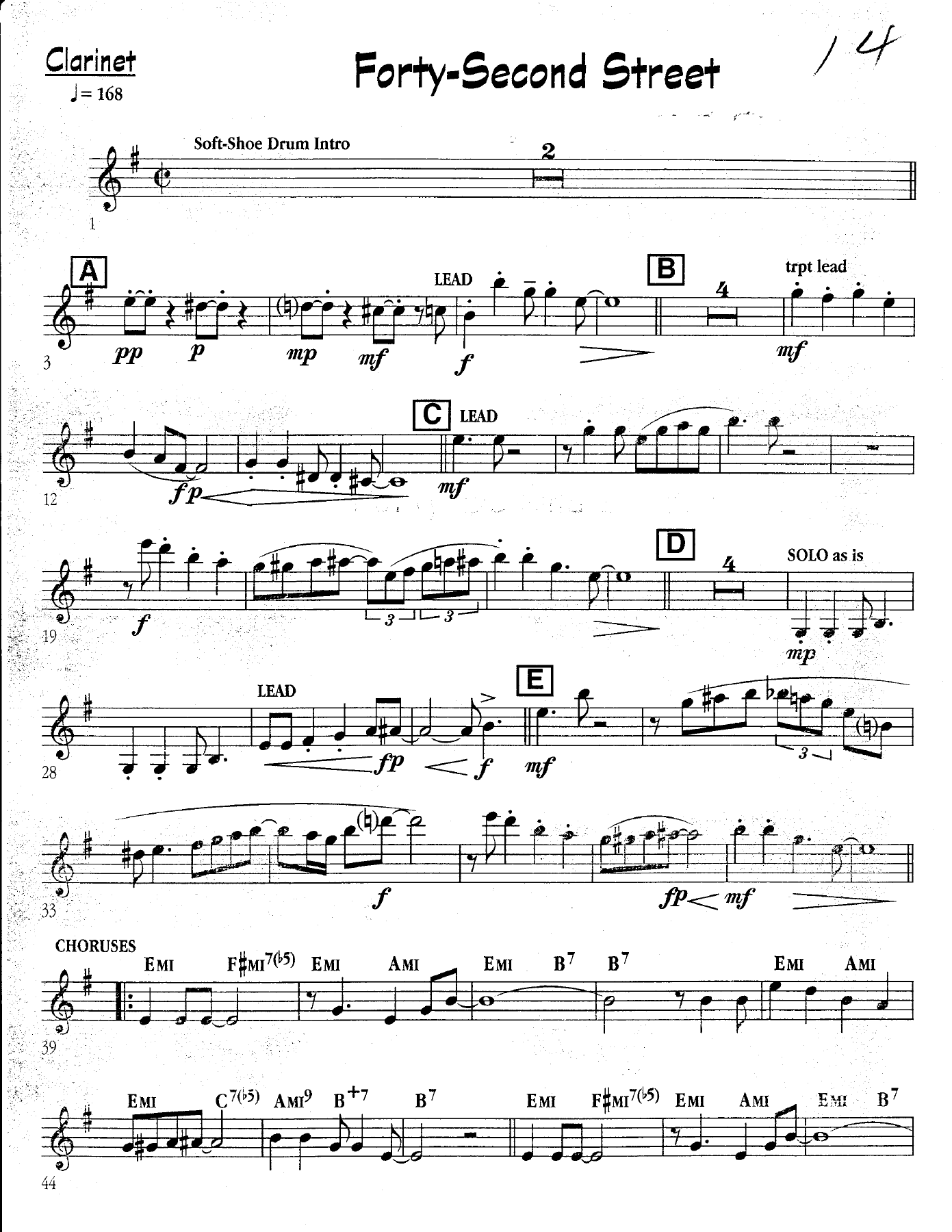
Forty-Second Street (comp. Harry Warren)
Composed by Harry Warren
Arranged by Paul Cook
- Ensemble: Small Ensemble
- Style: Musical Theatre
- Pages: 11
- Instruments (6): Clarinet, Trumpet, Trombone, Keyboard, Tuba, Drums
- Difficulty: easy
- Content: Individual Parts
- Format: PDF Download (Instant)
- Price: $12.99
The iconic tune "Forty-Second Street," composed by the prolific Harry Warren, stands as a quintessential anthem of the Great Depression era, forever etched into the American musical lexicon through the groundbreaking 1933 Warner Bros. film of the same name. This cinematic masterpiece, famous for its Busby Berkeley choreographed numbers, introduced the world to the vibrant energy and escapist fantasy of Broadway, with its title track embodying the bustling, hopeful spirit of New York City's theater district. While not a traditional jazz standard in the improvisational sense, its enduring melodic charm and harmonic simplicity have made it a favorite for big band and small ensemble interpretations, bridging the gap between musical theatre and the swing era's nascent sound. Its enduring popularity is a testament to Warren's gift for crafting memorable melodies that resonate with audiences across generations. This particular small ensemble arrangement captures the effervescent spirit of the original while infusing it with a medium-up swing feel, perfect for evoking a sense of classic Hollywood glamour. Set primarily in the bright key of E-flat major, the arrangement maintains an optimistic and energetic mood throughout. The musical character is defined by its driving rhythmic pulse and the interplay between the lead voices, creating a sound that is both sophisticated and accessible. The arrangement features a clear, articulate melody line, often presented in unison or tight harmonic voicings, ensuring the tune's inherent catchiness shines through. The overall energy is one of joyous celebration, making it an ideal piece for setting a lively and engaging atmosphere. While the arranger remains unknown, their approach to "Forty-Second Street" demonstrates a keen understanding of small ensemble dynamics and classic swing arranging techniques. The arrangement cleverly utilizes call-and-response figures, particularly in the A sections, creating a conversational texture between the instrumental voices. There are well-crafted soli sections that showcase the ensemble's blend and precision, often employing rich, yet not overly complex, extended harmonies that add depth without obscuring the melodic clarity. The arrangement builds effectively towards a dynamic shout chorus, providing a powerful climax before a tasteful, swinging coda. This treatment avoids overly complex improvisational sections, instead focusing on ensemble precision and a faithful, yet refreshed, interpretation of the original's charm. The melody is primarily carried by the lead instruments, often with supporting counter-melodies or rhythmic figures from other voices. While specific solo sections are not explicitly notated, ample space is provided for improvisation over the familiar chord changes, allowing for featured solos from a variety of instruments. Technical challenges lie in maintaining a consistent, driving swing feel at a medium-up tempo, achieving tight ensemble articulation, and executing the soli passages with precision and blend. The rewarding aspects include the sheer joy of performing such an iconic and uplifting tune, the opportunity for individual expression within the ensemble framework, and the audience's immediate recognition and appreciation of this timeless classic. This arrangement is ideally suited for college-level jazz ensembles, advanced high school groups, or community bands looking for a polished, engaging, and historically significant piece that offers both challenge and immense musical satisfaction. To achieve the intended medium-up swing feel, conductors should emphasize a buoyant, slightly pushed eighth-note rhythm, avoiding a heavy or plodding execution. The primary key is E-flat major, with a few judicious modulations that should be approached with careful attention to intonation, particularly in the soli sections. Articulation is key: ensure crisp short notes and sustained, vibrant long tones, especially in the melody and shout chorus. Rehearsal emphasis should be placed on rhythmic precision in the unison and soli passages, ensuring all voices articulate and release together. For soloists, encourage improvisation that respects the song's melodic integrity and harmonic structure. There are no special techniques like plunger mutes or falls required, making this a straightforward yet engaging performance piece focused on ensemble blend and swing feel. Q: What instruments/parts are included in this arrangement? A: This small ensemble arrangement includes parts for a flexible instrumentation, typically comprising a lead instrument (e.g., trumpet, alto sax), a harmony instrument (e.g., trombone, tenor sax), a rhythm section (piano, bass, drums), and optionally a guitar. The 11 pages usually indicate individual parts plus a conductor's score. Q: What is the difficulty level of this arrangement? A: This arrangement is rated as suitable for college-level jazz ensembles, advanced high school groups, and community bands. It requires solid instrumental technique, good sight-reading skills, and an understanding of swing rhythm and ensemble playing. Q: What musical style and historical context does "Forty-Second Street" represent? A: "Forty-Second Street" is a classic musical theatre piece from the 1933 film of the same name, composed by Harry Warren. This arrangement interprets it with a medium-up swing feel, bridging the gap between Broadway show tunes and early big band jazz, embodying the optimistic spirit of the Great Depression era. Q: What makes this specific arrangement unique compared to other versions of "Forty-Second Street"? A: This arrangement, by an unknown arranger, is notable for its focus on tight ensemble voicings, well-crafted soli sections, and a dynamic shout chorus, all within a small ensemble format. It prioritizes clarity and a classic swing feel, providing ample space for improvisation without over-complicating the core melody. Q: What is the typical performance duration and tempo for this arrangement? A: Given its medium-up swing feel, a typical performance of this arrangement would likely fall between 3:00 and 4:00 minutes, depending on the number and length of improvised solos. The tempo should be lively and driving, around 180-200 beats per minute, to capture the song's inherent energy.
Questions and answers
- What is included in the Forty-Second Street (comp. Harry Warren) PDF?
- The verified current file contains individual parts across 11 pages.
- How many instruments or parts are listed for Forty-Second Street (comp. Harry Warren)?
- The verified instrumentation list contains 6 entries for this Small Ensemble arrangement.
- Who is credited for Forty-Second Street (comp. Harry Warren)?
- Composer: Harry Warren. Arranger: Paul Cook.
- What difficulty is listed for Forty-Second Street (comp. Harry Warren)?
- The verified difficulty level is easy.
- What style is listed for Forty-Second Street (comp. Harry Warren)?
- The catalog lists the style as Musical Theatre.
- Can I preview Forty-Second Street (comp. Harry Warren) before buying?
- Yes. The product page provides a preview generated from the current PDF file.
- How is Forty-Second Street (comp. Harry Warren) delivered?
- After successful payment, the digital PDF is made available for download. The displayed price is $12.99.
Musicians Also Search For
Forty-Second Street Paul Cook PDF • Forty-Second Street Paul Cook sheet music • Forty-Second Street arranged by Paul Cook • Paul Cook small ensemble charts • Paul Cook jazz arrangements PDF • Forty-Second Street Harry Warren sheet music • Forty-Second Street Harry Warren small ensemble arrangements • Harry Warren small ensemble charts • Forty-Second Street small ensemble arrangements • Forty-Second Street small ensemble PDF download • Forty-Second Street jazz sheet music • small ensemble sheet music download • Forty-Second Street individual parts download • Forty-Second Street sheet music PDF • Forty-Second Street Musical Theatre charts • Musical Theatre small ensemble arrangements • buy Forty-Second Street sheet music • download Forty-Second Street PDF • Forty-Second Street jazz charts • best Paul Cook small ensemble arrangements • Harry Warren arranged by Paul Cook • Forty-Second Street printable sheet music • small ensemble repertoire PDF