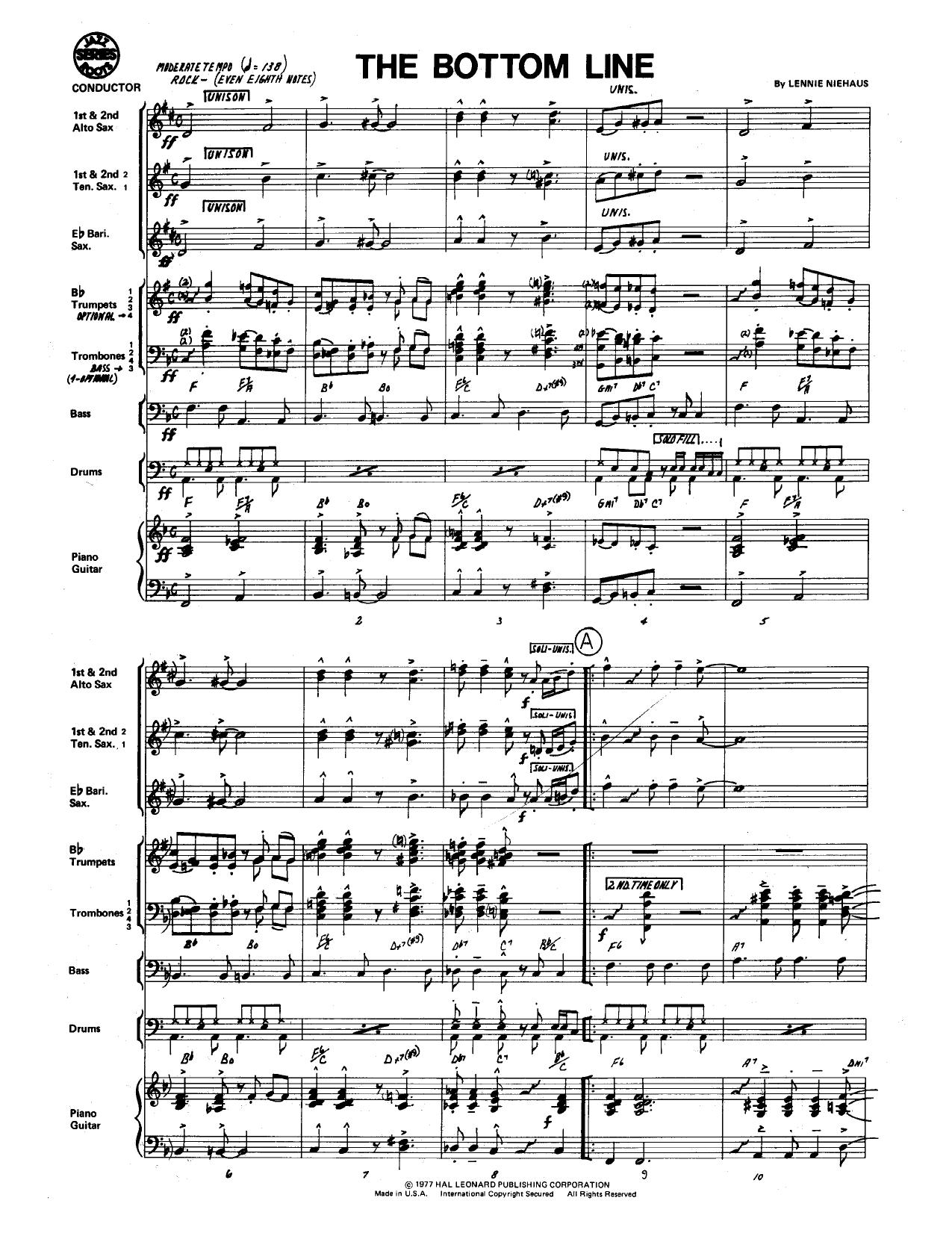
The Bottom Line (L.Niehaus)
Composed by Lennie Niehaus
Arranged by Lennie Niehaus
- Ensemble: Big Band
- Pages: 67
- Instruments (20): 1st Eb Alto Saxophone, 2nd Eb Alto Saxophone, 1st Bb Tenor Saxophone, 2nd Bb Tenor Saxophone, Eb Baritone Saxophone, 1st Bb Trumpet, 2nd Bb Trumpet, 3rd Bb Trumpet, 4th Bb Trumpet, 1st Trombone, 2nd Trombone, 3rd Trombone, 4th Trombone, Piano, Guitar, Bass, Drums, Horn in F (Trombone III), Tuba, Vibes
- Difficulty: advanced
- Content: Individual Parts
- Format: PDF Download (Instant)
- Price: $24.99
West Coast cool jazz found one of its most articulate and swinging voices in Lennie Niehaus, an alto saxophonist and arranger whose tenure with the Stan Kenton Orchestra cemented his reputation as a master of sophisticated counterpoint and crisp ensemble writing. "The Bottom Line" encapsulates the quintessential mid-century modern jazz aesthetic, balancing the intellectual rigor of bebop-derived linear writing with an accessible, driving momentum. Composed during an era when West Coast arrangers were redefining big band textures through lighter, more transparent voicings and intricate horn interleaving, this chart serves as a masterclass in how to make a large ensemble breathe with the agility of a small combo. Driven by an infectious, forward-leaning medium-up swing feel, the composition opens with a crisp, declarative head that immediately establishes its sophisticated harmonic palette. Niehaus utilizes close-interval harmony and linear counterpoint, distributing thematic material across the saxes and brass in interlocking conversational phrases. The emotional tone is confident, urbane, and relentlessly optimistic, evoking the cool sophistication of 1950s modernist jazz clubs. The arrangement avoids heavy, block-chord padding in favor of transparent, linear voice-leading that allows inner parts to move with independent melodic significance, creating a rich sonic tapestry that rewards close listening. As the chart unfolds, Niehaus builds structural tension through brilliantly crafted brass solis and a dynamic shout chorus that showcases his trademark economy of means—every note serves a structural purpose. The melodic burden is shared gracefully across the entire ensemble, though the alto saxophone and trumpet sections frequently take the lead, echoing Niehaus's own affinity for bright, articulate horn lines. Featured solo space allows improvisers to stretch out over clean, functional changes rooted in traditional bebop vocabulary. Technical challenges lie primarily in the realm of articulation and rhythmic precision rather than extreme altissimo or hyper-fast tempos; the chart demands immaculate tongue-control, uniform swing eighth-note interpretation, and a light, unforced ensemble blend. Advanced high school, collegiate, and professional jazz ensembles will find this arrangement an ideal vehicle for developing stylistic versatility and section cohesion. Because Niehaus writes with such innate knowledge of the idiom, student groups benefit immensely from studying its logical phrase structures and transparent scoring, which exposes individual players and eliminates the ability to hide behind sheer volume. For professional and community big bands, "The Bottom Line" offers a timeless, sophisticated crowd-pleaser that delivers high artistic yield and showcases a legendary arranger working at the absolute peak of his creative powers. Achieving an authentic rendition of "The Bottom Line" requires strict adherence to West Coast cool jazz articulation principles. The tempo should be kept at a steady, driving medium-up swing—avoiding the temptation to rush, as the groove relies entirely on a relaxed, behind-the-beat feel in the rhythm section while the horns articulate with crisp, lightweight precision. The primary technical challenge involves executing the rapid, harmonized linear passages with absolute rhythmic unison. Conductors should spend early rehearsals isolating the saxophone and trumpet sections to balance the inner voices, ensuring that no single part overpowers the linear counterpoint. Short notes must be played dry and accented without being harsh, while longer notes require a warm, centered tone devoid of excessive vibrato. The rhythm section must anchor the chart with a steady, unyielding pulse; the pianist should comp sparsely using rootless, modern voicings that complement Niehaus's linear writing, and the drummer should prioritize a crisp ride-cymbal-driven swing feel with controlled, subtle use of the hi-hat on beats two and four. Q: What instruments and parts are included in this publication? A: This complete big band arrangement spans 67 pages and includes a full conductor score alongside parts for 19 instruments: Alto Saxophone 1, Alto Saxophone 2, Tenor Saxophone 1, Tenor Saxophone 2, Baritone Saxophone, plus standard brass and rhythm sections. Q: What is the difficulty level of this arrangement? A: This chart is best suited for advanced high school, collegiate, and professional jazz ensembles capable of handling subtle swing feels, intricate linear counterpoint, and tight sectional blend. Q: What musical style and historical era does this piece represent? A: Written by Lennie Niehaus, "The Bottom Line" firmly represents the West Coast cool jazz movement of the 1950s, combining bebop-inspired harmonic sophistication with lighter, transparent big band orchestrations. Q: What makes this specific arrangement unique? A: Unlike dense, heavy swing charts that rely on thick block chords, Niehaus's arrangement stands out for its linear voice-leading, interlocking horn conversations, and a lack of padding that forces every section to play with absolute transparency. Q: What is the recommended performance tempo and duration? A: The piece is designed to be performed at a brisk, driving medium-up swing tempo that typically yields a duration of approximately 3 to 4 minutes depending on the length of the improvised solos.
Questions and answers
- What is included in the The Bottom Line (L.Niehaus) PDF?
- The verified current file contains a conductor score and individual parts across 67 pages.
- How many instruments or parts are listed for The Bottom Line (L.Niehaus)?
- The verified instrumentation list contains 20 entries for this Big Band arrangement.
- Who is credited for The Bottom Line (L.Niehaus)?
- Composer: Lennie Niehaus. Arranger: Lennie Niehaus.
- What difficulty is listed for The Bottom Line (L.Niehaus)?
- The verified difficulty level is advanced.
- Can I preview The Bottom Line (L.Niehaus) before buying?
- Yes. The product page provides a preview generated from the current PDF file.
- How is The Bottom Line (L.Niehaus) delivered?
- After successful payment, the digital PDF is made available for download. The displayed price is $24.99.
Musicians Also Search For
The Bottom Line Lennie Niehaus PDF • The Bottom Line Lennie Niehaus sheet music • The Bottom Line arranged by Lennie Niehaus • Lennie Niehaus big band charts • Lennie Niehaus jazz arrangements PDF • The Bottom Line Lennie Niehaus big band arrangements • The Bottom Line big band arrangements • The Bottom Line big band PDF download • The Bottom Line jazz sheet music • big band sheet music download • The Bottom Line conductor score PDF • The Bottom Line individual parts download • The Bottom Line sheet music PDF • buy The Bottom Line sheet music • download The Bottom Line PDF • The Bottom Line jazz charts • best Lennie Niehaus big band arrangements • The Bottom Line printable sheet music • big band repertoire PDF