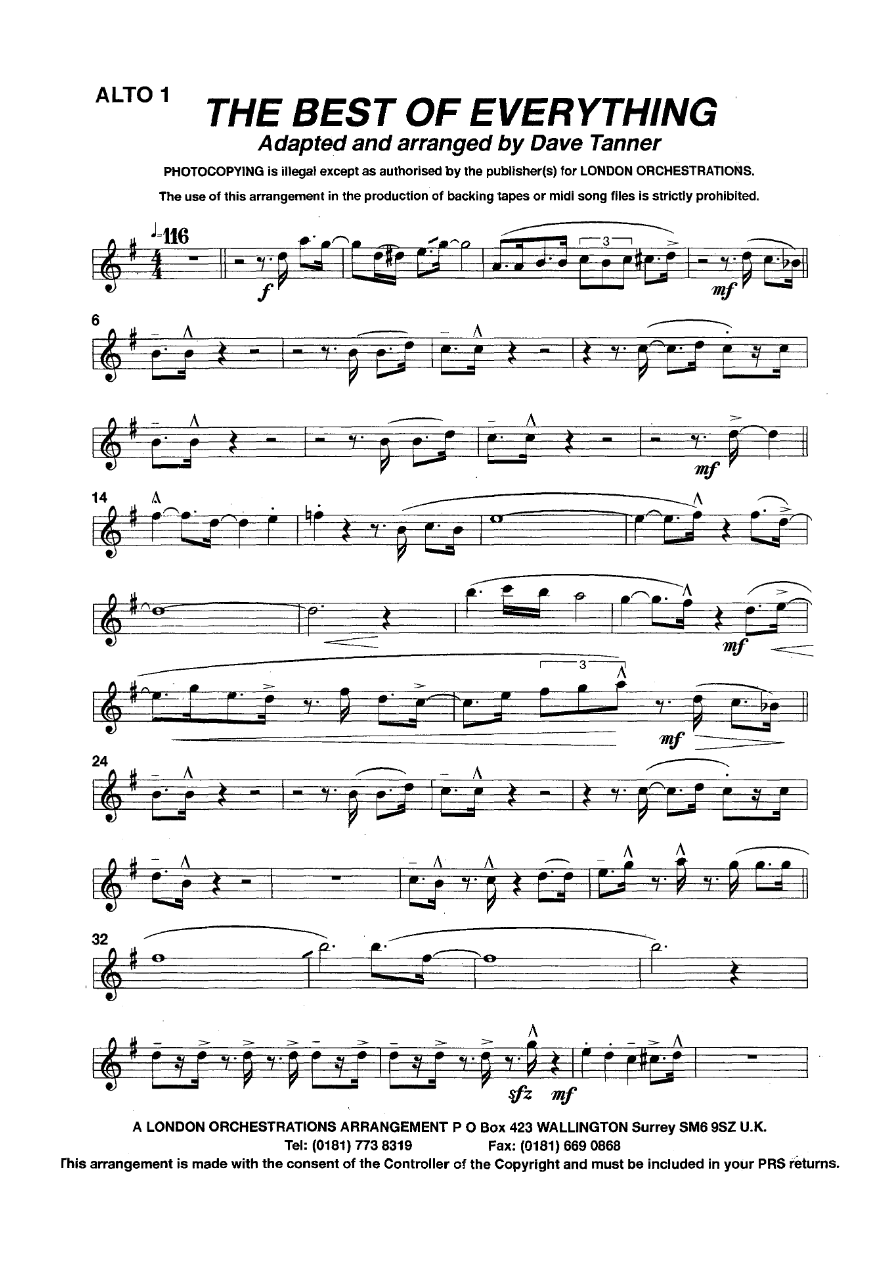
The Best Of Everything (D.Tanner) sheet music preview

The Best Of Everything (D.Tanner)

Composed by Dave Tanner

Arranged by Dave Tanner

  • Ensemble: Big Band
  • Pages: 32
  • Instruments (17): Alto 1, Alto 2, Tenor 1, Tenor 2, Baritone, Trumpet 1, Trumpet 2, Trumpet 3, Trumpet 4, Trombone 1, Trombone 2, Trombone 3, Trombone 4, Bass, Piano, Drums, Vocal
  • Difficulty: medium
  • Content: Individual Parts
  • Format: PDF Download (Instant)
  • Price: $24.99

Dave Tanner’s contemporary original composition "The Best Of Everything" bridges the sophisticated harmonic language of modern post-bop with the visceral, high-octane drive of a classic contemporary big band chart. Conceived in the lineage of modern writers who favor rich, extended tertian and quartal harmonies alongside driving rhythmic propulsion, this work captures the restless energy and optimistic sophistication of late-20th-century jazz composition. While rooted in the traditional 17-piece instrumentation pioneered during the mid-century swing era, the piece updates the idiom with intricate metric shifts, sophisticated linear counterpoint, and a contemporary harmonic palette that speaks directly to today's progressive jazz ensembles. Driving forward with a relentless, infectious medium-up swing groove in 4/4 time, "The Best Of Everything" establishes a vibrant, uplifting mood characterized by bright brass fanfares, interlocking saxophone soli passages, and a pervasive forward momentum. The underlying harmonic landscape shifts fluidly between modal vamp sections and densely chromatic chord progressions, evoking the sophisticated atmosphere of late-night metropolitan jazz clubs while maintaining a celebratory, anthemic intensity. The emotional arc moves effortlessly from crisp, understated coolness in the verses to an explosive, full-ensemble shout chorus that demands absolute rhythmic precision and dynamic control from every section. In this masterclass of modern big band writing, Tanner utilizes a layered developmental approach where thematic material is constantly tossed between sections rather than merely stated and repeated. Rich saxophone solis feature tight, modern block-chord voicings that recall the writing styles of Bob Mintzer and Bill Holman, while the brass section alternates between punctuating staccato stabs and lush, open-voiced pads. The rhythm section functions as an organic engine, with the piano and guitar providing nimble, comping voicings that outline the altered dominants, while the bass line locks tightly with the drum kit's crisp ride-cymbal pulsations to anchor the ensemble's shifting metric accents. Designed to challenge and reward advanced ensembles, this chart features prominent solo space for tenor saxophone and trumpet, allowing featured improvisers to stretch out over standard-based changes that open up into modal plateaus. The primary technical hurdles lie in the precise execution of fast-moving unison lines between the saxophones and upper brass, as well as maintaining a consistent, driving macro-tempo through complex syncopated ensemble figures. Advanced high school bands with strong section players, as well as collegiate and professional jazz orchestras, will find this arrangement an exceptional centerpiece for festival programs or concert sets, offering a thrilling blend of intellectual depth and crowd-pleasing visceral power across its robust 32-page conductor and instrumental layout. Success with "The Best Of Everything" hinges on maintaining an immaculate, forward-moving swing feel without ever rushing the tempo. Conductor and rhythm section should lock in early on the crisp eighth-note subdivision, ensuring that all swung passages remain articulate and light rather than heavy or squared off. The brass section must exercise careful dynamic restraint during the transitional vamp sections to allow the intricate saxophone counter-melodies to cut through the texture cleanly. Pay close attention to the dynamic contrasts marked leading into the shout chorus; the sudden drop in volume right before the final crescendo creates a dramatic tension-and-release cycle that defines the chart's emotional peak. Trumpets should approach high-register passages with a bright, focused tone rather than forced volume, utilizing standard jazz articulation—short accents on staccato notes and smooth, vocalized slurs across modal lines. The rhythm section drummer should act as a colorist, utilizing tasteful cymbal crashes and snare anticipations to accent the ensemble figures without over-cluttering the transparent mid-tempo swing texture. Q: What instruments and parts are included in this 17-instrument arrangement? A: The instrumentation comprises a standard 17-piece big band setup: 5 saxophones (Alto 1, Alto 2, Tenor 1, Tenor 2, Baritone), 4 trumpets, 4 trombones, and a 4-piece rhythm section consisting of piano, guitar, bass, and drums, supported by a comprehensive 32-page score. Q: What is the difficulty level of "The Best Of Everything"? A: This arrangement is graded as advanced, making it best suited for collegiate ensembles, top-tier high school jazz bands, and professional community big bands capable of handling intricate metric interplay and rapid unison passages. Q: What is the musical style and historical context of this piece? A: Written by Dave Tanner, the piece is a contemporary jazz composition that reflects the harmonic sophistication of modern post-bop while retaining the high-energy drive and structural integrity of classic mid-century big band jazz. Q: What makes this specific arrangement by Dave Tanner unique? A: Tanner distinguishes the chart through his seamless blending of dense, modern modal harmonies with traditional swing momentum, utilizing interlocking saxophone block-chord solis and dynamic structural tension-and-release cycles. Q: What is the recommended performance duration and tempo for this arrangement? A: The piece is performed at a driving medium-up swing tempo (approximately quarter note = 180-192 BPM) and runs for an average duration of roughly 5 to 6 minutes depending on the length of the improvised solos.

Questions and answers

What is included in the The Best Of Everything (D.Tanner) PDF?
The verified current file contains individual parts across 32 pages.
How many instruments or parts are listed for The Best Of Everything (D.Tanner)?
The verified instrumentation list contains 17 entries for this Big Band arrangement.
Who is credited for The Best Of Everything (D.Tanner)?
Composer: Dave Tanner. Arranger: Dave Tanner.
What difficulty is listed for The Best Of Everything (D.Tanner)?
The verified difficulty level is medium.
Can I preview The Best Of Everything (D.Tanner) before buying?
Yes. The product page provides a preview generated from the current PDF file.
How is The Best Of Everything (D.Tanner) delivered?
After successful payment, the digital PDF is made available for download. The displayed price is $24.99.

Musicians Also Search For

The Best Of Everything Dave Tanner PDFThe Best Of Everything Dave Tanner sheet musicThe Best Of Everything arranged by Dave TannerDave Tanner big band chartsDave Tanner jazz arrangements PDFThe Best Of Everything Dave Tanner big band arrangementsThe Best Of Everything big band arrangementsThe Best Of Everything big band PDF downloadThe Best Of Everything jazz sheet musicbig band sheet music downloadThe Best Of Everything individual parts downloadThe Best Of Everything sheet music PDFbuy The Best Of Everything sheet musicdownload The Best Of Everything PDFThe Best Of Everything jazz chartsbest Dave Tanner big band arrangementsThe Best Of Everything printable sheet musicbig band repertoire PDF

All arrangements by Dave Tanner All Dave Tanner sheet music