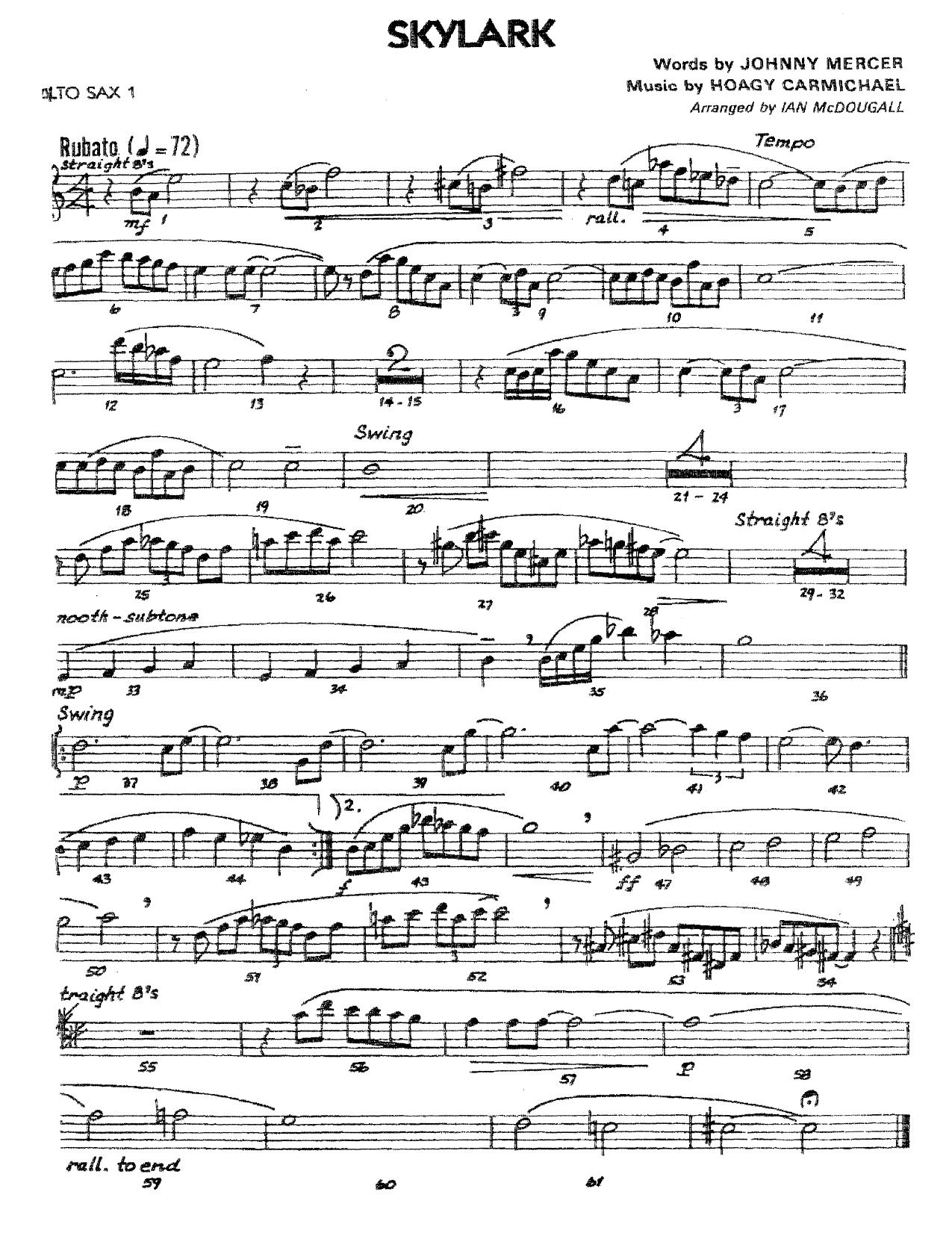
Skylark (I.McDougall) sheet music preview

Skylark (I.McDougall)

Composed by Hoagy Carmichael

Arranged by I.McDougall

  • Ensemble: Big Band
  • Style: Jazz Standard
  • Pages: 25
  • Instruments (17): Alto Sax 1, Alto Sax 2, Tenor Sax 1, Tenor Sax 2, Baritone Sax, Trumpet 1, Trumpet 2, Trumpet 3, Trumpet 4, Trombone 1, Trombone 2, Trombone 3, Trombone 4, Drums, Bass, Guitar, Piano
  • Difficulty: medium
  • Content: Individual Parts
  • Format: PDF Download (Instant)
  • Price: $24.99

Hoagy Carmichael and Johnny Mercer’s immortal 1941 creation, "Skylark," stands as one of the towering pillars of the Great American Songbook, capturing the sophisticated, bittersweet harmonic language of the late swing era. Immortalized by vocalists like Dinah Washington, Ella Fitzgerald, and Linda Ronstadt, as well as instrumental icons like Chet Baker and Paul Desmond, the tune has long tested a musician's ability to navigate complex, yearning major-minor shifts and soaring, suspended resolutions. It represents the quintessential introspective jazz ballad, demanding a high degree of emotional maturity, lyrical phrasing, and subtle rubato command from anyone who interprets it. In this masterful big band setting by the renowned Canadian arranger, composer, and trombonist Ian McDougall, "Skylark" is transformed into a lush, cinematic vehicle for a mature ensemble. Written for a standard 17-piece big band (5 saxophones, 4 trumpets, 4 trombones, and a 4-piece rhythm section), the chart unfolds at a spacious, unhurried ballad tempo in a concert key optimized for warm horn sonorities. McDougall utilizes dense, contemporary extended voicings—frequently drawing on upper-structure triads, fourth-interval stackings, and rich pedal points in the lower brass—to evoke a misty, nocturnal atmosphere. The mood shifts seamlessly from fragile, exposed vulnerability in the woodwinds to sweeping, cinematic crescendos that capture the vast, open-air imagery of Mercer’s poetry. McDougall’s signature arranging style shines through his transparent counterpoint and exquisite flugelhorn/alto saxophone color pairings. Rather than relying on a heavy-handed shout chorus, the chart builds tension through intricate, interlocking horn textures and beautifully orchestrated woodwind solis that weave around a featured instrumental soloist—typically a lead alto saxophone or flugelhorn. The melodic statements are shared delicately between the brass and reeds, demanding absolute blend, intonation control, and a shared concept of rubato time. The rhythm section acts as a subtle textural canvas; the pianist must voice comping chords with extreme sensitivity, avoiding rhythmic clutter to let McDougall’s rich suspensions breathe. Advanced high school, collegiate, and professional jazz orchestras will find this chart an exceptional centerpiece for a concert program or festival performance. While the individual technical demands on range or velocity are modest compared to an aggressive up-tempo chart, the intellectual and artistic rigor required to maintain pitch center, balance, and sustained emotional intensity across 25 pages of score is substantial. Performing this arrangement rewards the ensemble with a profound sense of dynamic cohesion, teaching young musicians the lost art of playing a ballad with breath support, horizontal momentum, and deeply communicative phrasing. Conductors approaching McDougall’s setting of "Skylark" must prioritize horizontal line over vertical beat-keeping. The tempo should feel suspended yet purposeful, hovering around a slow, relaxed 4/4 or 12/8 ballad feel where the eighth notes remain fluid rather than rigidly straight. A primary technical challenge lies in the brass section's intonation during exposed, soft-dynamic chord clusters; players must actively listen down to the bass trombone and baritone saxophone to lock in the upper extensions. Rehearsals should begin by having the saxophones and brass practice their choral passages unaccompanied to balance the inner voices before integrating the rhythm section. Ensure the piano and guitar keep comping sparse, allowing the rich, fourth-based chord voicings to bloom without muddying the texture. Encourage the featured soloist to treat the melody as a vocal line, utilizing wide dynamic contours and tasteful, unhurried phrasing that mirrors the iconic lyrics. Mutes are generally not required, keeping the acoustic profile warm, organic, and deeply resonant. Q: What instrumentation and parts are included in this arrangement? A: This arrangement is scored for a standard 17-piece big band, comprising 2 alto saxophones (doubling options where applicable), 2 tenor saxophones, 1 baritone saxophone, 4 trumpets (with optional flugelhorn changes), 4 trombones, piano, guitar, bass, and drums, spanning a comprehensive 25-page score and set of parts. Q: What is the difficulty level of this chart? A: This arrangement is graded as advanced, making it best suited for college, professional, or highly accomplished high school jazz ensembles due to its demand for mature intonation, subtle rubato control, and sophisticated harmonic balance. Q: What is the musical style and historical context of this piece? A: It is a jazz standard ballad rooted in the Great American Songbook tradition, originally composed by Hoagy Carmichael with lyrics by Johnny Mercer in 1941, and adapted here into a sophisticated, contemporary big band format. Q: What makes Ian McDougall's arrangement unique? A: McDougall's treatment is distinguished by its lush, contemporary extended harmonies, transparent counterpoint, and cinematic textures that replace a traditional heavy shout chorus with sweeping, interconnected horn solis and rich woodwind voicings. Q: What is the performance duration and tempo feel of this arrangement? A: The piece is performed at a slow, spacious ballad tempo with a flexible, breathing pulse, typically running between 4 to 5 minutes depending on the length of the featured improvised solo and the conductor's chosen rubato stretches.

Questions and answers

What is included in the Skylark (I.McDougall) PDF?
The verified current file contains individual parts across 25 pages.
How many instruments or parts are listed for Skylark (I.McDougall)?
The verified instrumentation list contains 17 entries for this Big Band arrangement.
Who is credited for Skylark (I.McDougall)?
Composer: Hoagy Carmichael. Arranger: I.McDougall.
What difficulty is listed for Skylark (I.McDougall)?
The verified difficulty level is medium.
What style is listed for Skylark (I.McDougall)?
The catalog lists the style as Jazz Standard.
Can I preview Skylark (I.McDougall) before buying?
Yes. The product page provides a preview generated from the current PDF file.
How is Skylark (I.McDougall) delivered?
After successful payment, the digital PDF is made available for download. The displayed price is $24.99.

Musicians Also Search For

Skylark I.McDougall PDFSkylark I.McDougall sheet musicSkylark arranged by I.McDougallI.McDougall big band chartsI.McDougall jazz arrangements PDFSkylark Hoagy Carmichael sheet musicSkylark Hoagy Carmichael big band arrangementsHoagy Carmichael big band chartsSkylark big band arrangementsSkylark big band PDF downloadSkylark jazz sheet musicbig band sheet music downloadSkylark individual parts downloadSkylark sheet music PDFSkylark Jazz Standard chartsJazz Standard big band arrangementsbuy Skylark sheet musicdownload Skylark PDFSkylark jazz chartsbest I.McDougall big band arrangementsHoagy Carmichael arranged by I.McDougallSkylark printable sheet musicbig band repertoire PDF

All arrangements by I.McDougall All Hoagy Carmichael sheet music