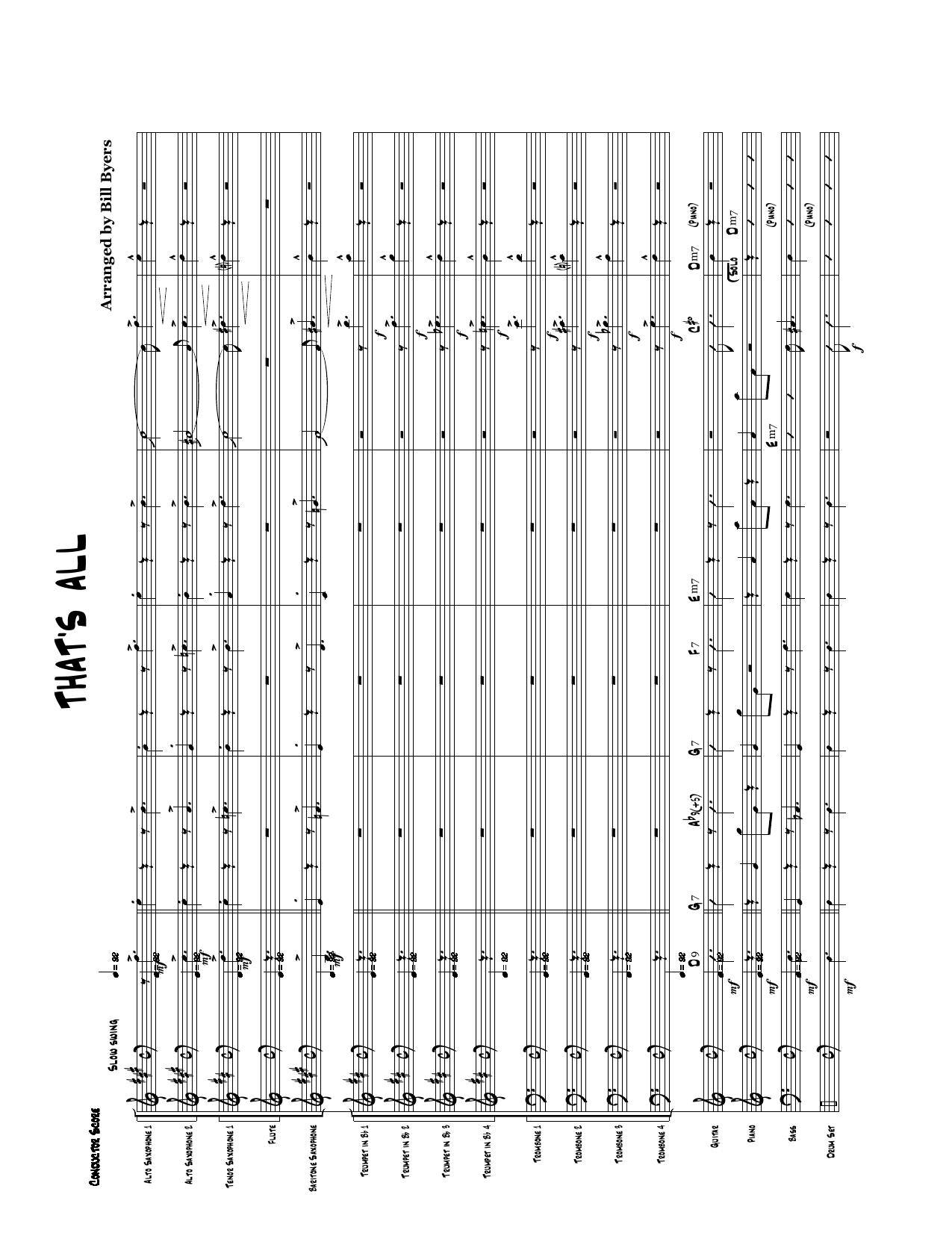
That's All (B.Byers) sheet music preview

That's All (B.Byers)

Composed by George W. Brown

Arranged by Billy Byers

  • Ensemble: Big Band
  • Pages: 47
  • Instruments (17): Alto Saxophone 1, Alto Saxophone 2, Tenor Saxophone 1, Tenor Saxophone 2 (Solo Flute), Baritone Saxophone, Trumpet 1, Trumpet 2, Trumpet 3, Trumpet 4, Trombone 1, Trombone 2, Trombone 3, Trombone 4, Guitar, Piano, Bass, Drums
  • Difficulty: medium
  • Content: Individual Parts
  • Format: PDF Download (Instant)
  • Price: $24.99

Written by Bob Haymes and Alan Brandt in 1952, "That's All" swiftly ascended from a popular ballad into an indispensable jazz standard, cemented in the public consciousness by definitive vocal and instrumental interpretations from artists like Nat King Cole, Frank Sinatra, and Dexter Gordon. While the composition is universally celebrated for its lush, cyclical chord progression and intimate lyrical sentiment, instrumental jazz arrangers have long gravitated toward its adaptable architecture. It represents the quintessential mid-century American popular song form (ABA' with a sophisticated harmonic palette), offering a canvas that balances vulnerability with rich, romantic sophistication. Master arranger Billy Byers approaches this iconic vehicle with a sophisticated, cinematic lens that translates the tune's inherent intimacy into a lush, dynamic orchestral canvas for standard 17-piece big band (featuring dual altos, dual tenors, baritone, four trumpets, four trombones, and a full four-man rhythm section, augmented by valuable woodwind doubling including flute). Unfolding at a relaxed, flowing medium-swing tempo, the chart opens with an evocative, atmospheric introduction that immediately establishes a warm, velvety mood. Byers eschews dense, high-energy bombast in favor of sublime textural contrast, utilizing shimmering brass pads, intricate woodwind interleavings, and sophisticated upper-structure extensions that evoke the golden era of studio jazz orchestration. The emotional arc moves effortlessly from tender introspection to swelling, harmonically rich ensemble passages that evoke late-night metropolitan sophistication. Throughout the arrangement, the melodic heavy lifting is shared masterfully between the alto saxophone and trumpet sections, though tenor saxophone and muted brass are frequently deployed to color key thematic statements. Byers builds momentum through brilliant use of chordal displacement and subtle counterpoint rather than relying on aggressive volume shifts. A standout feature is the designated solo space—tailored for a featured horn—which floats effortlessly over a subtly shifting, sophisticated rhythm section background. The technical challenges lie primarily in breath control, dynamic restraint, and intonation rather than breakneck velocity. Players must navigate tight, harmonically dense voicings where balance is everything; holding a pristine blend across the saxophone and brass sections during the sustained, rubato-leaning transitions demands acute listening and mature ensemble cohesion. Advanced high school, collegiate, and professional jazz orchestras will find this chart an exceptional vehicle for developing stylistic maturity, section blending, and micro-dynamic control. Because it avoids the trap of heavy-handed shout choruses, it forces musicians to lean into the nuances of swing subdivision, modern harmonic movement, and tonal warmth. It serves as a masterclass in how a veteran arranger elevates a familiar standard into an artistic statement of depth, elegance, and enduring appeal. Conductors should approach Billy Byers’ arrangement of "That's All" with an emphasis on horizontal line-driving and ultra-refined dynamic control rather than sheer volume. The tempo should settle comfortably into a relaxed medium swing; rushing the quarter note will instantly dissolve the sophisticated, late-night atmosphere the chart relies upon. Key technical challenges center around intonation within the dense, extended-harmony brass voicings and maintaining a silky, connected legato style across the saxophone soli sections. Horn players must pay careful attention to balance, ensuring that internal chord tones project without masking the lead voice. Muted brass passages require precise articulation—use cup or harmon mutes as indicated, keeping the timbre warm and vocal-like. Rehearsal should begin by isolating the rhythm section to lock in the subtle, buoyant swing groove before layering the horns. Work section by section on the dynamic swells, ensuring that crescendos peak naturally without forcing the tone. Emphasize that restraint is the ultimate virtue in this chart; the emotional impact is generated through collective breath, impeccable phrasing, and subtle tonal shading. Q: What instruments and parts are included in this arrangement? A: This 17-instrument big band arrangement includes parts for 2 alto saxophones, 2 tenor saxophones, baritone saxophone (with flute doubles), 4 trumpets, 4 trombones, guitar, piano, bass, and drums, alongside a comprehensive 47-page conductor score. Q: What is the difficulty level of this chart? A: It is best suited for advanced high school, collegiate, and professional jazz ensembles due to its demands for sophisticated intonation, nuanced dynamic control, and mature stylistic blend rather than extreme technical speed. Q: What is the style and historical context of this piece? A: Written originally as a 1952 popular song standard by Brandt and Haymes, this chart interprets the tune in a classic medium-swing big band style reminiscent of the golden era of sophisticated studio and jazz orchestra arrangements. Q: What makes Billy Byers' arrangement unique? A: Byers avoids a predictable high-volume shout chorus, instead utilizing lush upper-structure harmonies, cinematic texture shifts, clever woodwind doublings, and subtle harmonic reharmonizations to create an intimate yet grand orchestral statement. Q: What is the performance tempo and approximate duration? A: The arrangement is set at a relaxed, comfortable medium-swing tempo and typically runs between 3.5 to 5 minutes depending on the chosen length of the improvised solo section.

Questions and answers

What is included in the That's All (B.Byers) PDF?
The verified current file contains a conductor score and individual parts across 47 pages.
How many instruments or parts are listed for That's All (B.Byers)?
The verified instrumentation list contains 17 entries for this Big Band arrangement.
Who is credited for That's All (B.Byers)?
Composer: George W. Brown. Arranger: Billy Byers.
What difficulty is listed for That's All (B.Byers)?
The verified difficulty level is medium.
Can I preview That's All (B.Byers) before buying?
Yes. The product page provides a preview generated from the current PDF file.
How is That's All (B.Byers) delivered?
After successful payment, the digital PDF is made available for download. The displayed price is $24.99.

Musicians Also Search For

That's All Billy Byers PDFThat's All Billy Byers sheet musicThat's All arranged by Billy ByersBilly Byers big band chartsBilly Byers jazz arrangements PDFThat's All George W. Brown sheet musicThat's All George W. Brown big band arrangementsGeorge W. Brown big band chartsThat's All big band arrangementsThat's All big band PDF downloadThat's All jazz sheet musicbig band sheet music downloadThat's All conductor score PDFThat's All individual parts downloadThat's All sheet music PDFbuy That's All sheet musicdownload That's All PDFThat's All jazz chartsbest Billy Byers big band arrangementsGeorge W. Brown arranged by Billy ByersThat's All printable sheet musicbig band repertoire PDF

All arrangements by Billy Byers All George W. Brown sheet music