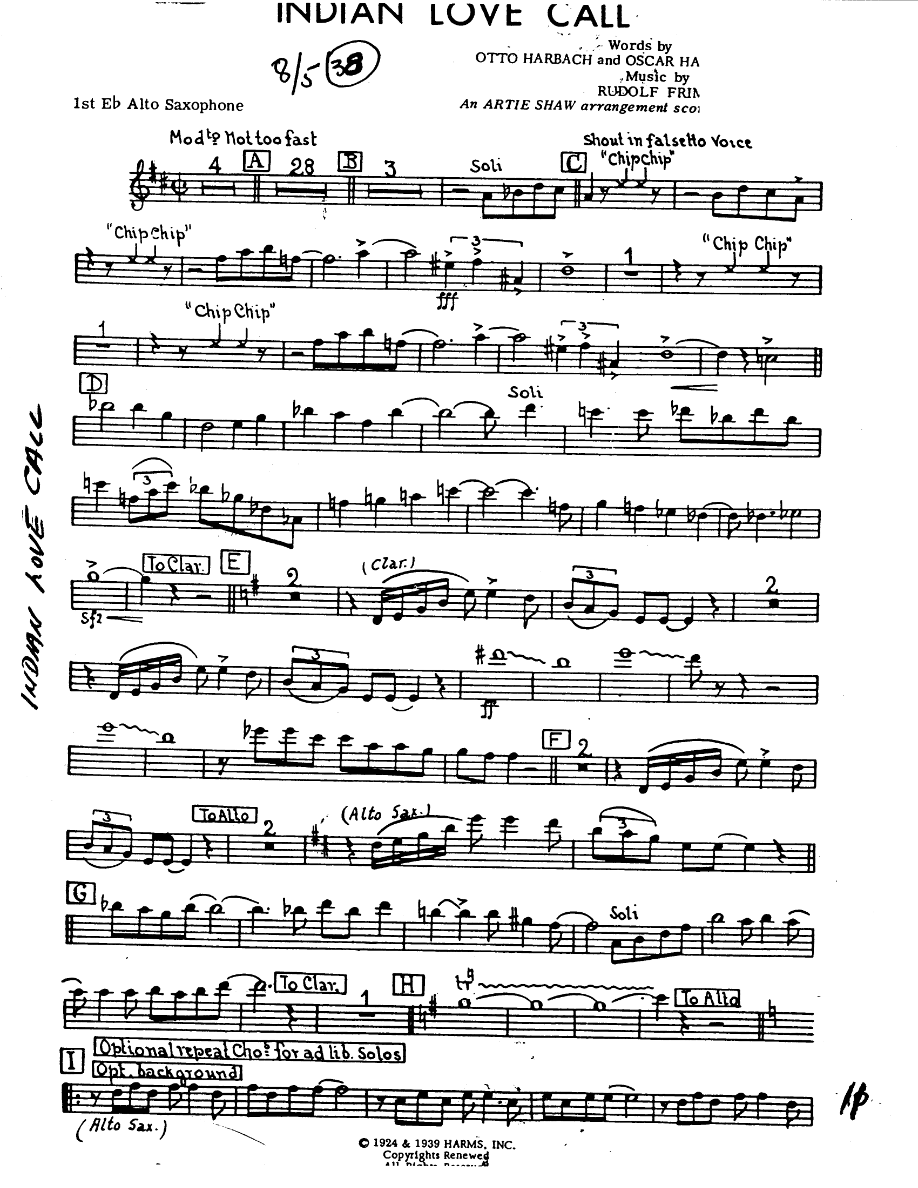
Indian Love Call (J.Gray) sheet music preview

Indian Love Call (J.Gray)

Composed by Rudolf Friml

Arranged by Artie Shaw

  • Ensemble: Big Band
  • Style: Jazz Standard
  • Pages: 38
  • Instruments (17): Alto Saxophone 1, Alto Saxophone 2, Tenor Saxophone 1, Tenor Saxophone 2, Baritone Saxophone, Trumpet 1, Trumpet 2, Trumpet 3, Trumpet 4, Trombone 1, Trombone 2, Trombone 3, Trombone 4, String Bass, Drum Set, Piano, Guitar
  • Difficulty: medium
  • Content: Individual Parts
  • Format: PDF Download (Instant)
  • Price: $24.99

Rudolf Friml's "Indian Love Call," originally composed in 1924 for the operetta *Rose-Marie*, transcended its theatrical origins to become an enduring American standard. Its haunting melody and romantic sentiment resonated deeply with audiences, particularly during the Golden Age of Hollywood and the Swing Era. While not initially a jazz tune, its memorable theme and harmonic flexibility made it a natural candidate for interpretation by jazz artists. Artie Shaw, a master of sophisticated big band jazz, famously recorded his rendition, imbuing the wistful melody with a distinctly swinging character that solidified its place in the jazz lexicon. This arrangement captures the essence of that iconic Shaw interpretation, offering a glimpse into the elegance and precision that defined his orchestra. Artie Shaw's take on "Indian Love Call" transforms the original's romanticism into a sophisticated, medium-swing jazz vehicle. The arrangement is primarily in the key of C major, offering a bright yet tender sonic landscape. Shaw's signature approach to big band writing is immediately apparent: meticulous voicings that blend warmth with clarity, often featuring the clarinet as a lyrical counterpoint or lead voice, reflecting his own virtuosity on the instrument. The mood is one of refined swing, evoking the dance halls and concert stages of the late 1930s and early 1940s, characterized by a smooth, flowing energy rather than aggressive drive. The arrangement maintains a consistent, understated elegance throughout, building intensity through harmonic development and textural layering rather than sheer volume. This arrangement showcases Shaw's genius for orchestration and melodic development. The primary melody is initially carried by the saxophone section, often with the lead alto or clarinet (doubled by the lead alto) taking the forefront, supported by lush, close-voiced harmonies. Expect a beautifully crafted soli section for the saxophones, demonstrating intricate ensemble playing and precise articulation. While specific solo sections are not explicitly notated in the traditional sense, the arrangement provides ample space for expressive interpretation within the ensemble and features the melodic lines passed between sections. Technical challenges include achieving the precise balance and blend in the saxophone soli, maintaining a consistent, relaxed medium-swing feel, and executing Shaw's characteristic dynamic nuances. The rewarding aspect lies in recreating the iconic sound of one of jazz's most sophisticated orchestras, demanding a high level of musicianship and ensemble cohesion. This arrangement is ideally suited for advanced high school, college, community, and professional big bands. Its demands on blend, intonation, and rhythmic precision require experienced players who can navigate complex voicings and articulate a nuanced swing feel. The absence of extended open solo sections means the focus is heavily on ensemble performance, making it an excellent piece for developing section cohesion and stylistic authenticity. Bands looking to explore the sophisticated, melodic side of the Swing Era, particularly the sound of Artie Shaw's orchestra, will find this arrangement an invaluable addition to their repertoire. Conductors should emphasize a relaxed, medium-swing feel from the outset, focusing on a smooth, legato articulation in the melody and accompaniment. The key technical challenge lies in the precise balance and blend of the saxophone soli, which requires careful attention to dynamics and intonation to achieve Shaw's characteristic warmth and clarity. Encourage saxophonists to listen across the section and blend their individual voices into a cohesive unit. The brass sections should play with a controlled brilliance, supporting the saxophones without overpowering them. Special attention should be paid to the dynamic markings, which are crucial for shaping the piece's elegant narrative. Rehearsal time should be dedicated to refining the ensemble's rhythmic precision and ensuring that the swing eighth notes are consistent and unhurried. The arrangement primarily relies on standard big band instrumentation; no special techniques like plunger mutes are explicitly required, allowing the focus to remain on tonal quality and ensemble execution. Q: What instruments and parts are included in this arrangement? A: This arrangement includes parts for 17 instruments: Alto Saxophone 1, Alto Saxophone 2, Tenor Saxophone 1, Tenor Saxophone 2, Baritone Saxophone, Trumpet 1, Trumpet 2, Trumpet 3, Trumpet 4, Trombone 1, Trombone 2, Trombone 3, Trombone 4, Piano, Bass, Drums, and Guitar. Q: What is the difficulty level of "Indian Love Call (J.Gray)" as arranged by Artie Shaw? A: This arrangement is considered advanced, suitable for experienced high school, college, community, and professional big bands due to its demands on ensemble blend, intonation, and nuanced swing articulation. Q: What musical style and historical context does this arrangement represent? A: This arrangement is a sophisticated big band jazz interpretation of a classic American standard from the Swing Era (late 1930s-early 1940s), showcasing the elegant and precise style of Artie Shaw's orchestra. Q: What makes Artie Shaw's arrangement of "Indian Love Call" unique? A: Shaw's arrangement is distinguished by its meticulous voicings, particularly in the saxophone section, its transformation of the original's romanticism into a refined medium-swing feel, and the prominent, lyrical role often given to the clarinet (doubled by lead alto). Q: What is the typical performance duration and tempo feel for this piece? A: The typical performance duration for this arrangement is approximately 3-4 minutes, performed at a consistent and relaxed medium-swing tempo.

Musicians Also Search For

Indian Love Call Artie Shaw PDFIndian Love Call Artie Shaw sheet musicIndian Love Call arranged by Artie ShawArtie Shaw big band chartsArtie Shaw jazz arrangements PDFIndian Love Call Rudolf Friml sheet musicIndian Love Call Rudolf Friml big band arrangementRudolf Friml big band chartsIndian Love Call big band arrangementIndian Love Call big band PDF downloadIndian Love Call jazz ensemble sheet musicbig band sheet music instant downloadIndian Love Call conductor score PDFIndian Love Call individual parts downloadIndian Love Call sheet music with partsIndian Love Call Jazz Standard chartJazz Standard big band arrangementsbuy Indian Love Call sheet music onlinedownload Indian Love Call PDFIndian Love Call jazz chartbest Artie Shaw big band arrangementsRudolf Friml songs arranged by Artie ShawIndian Love Call printable sheet musicbig band repertoire PDF

All arrangements by Artie Shaw All Rudolf Friml sheet music