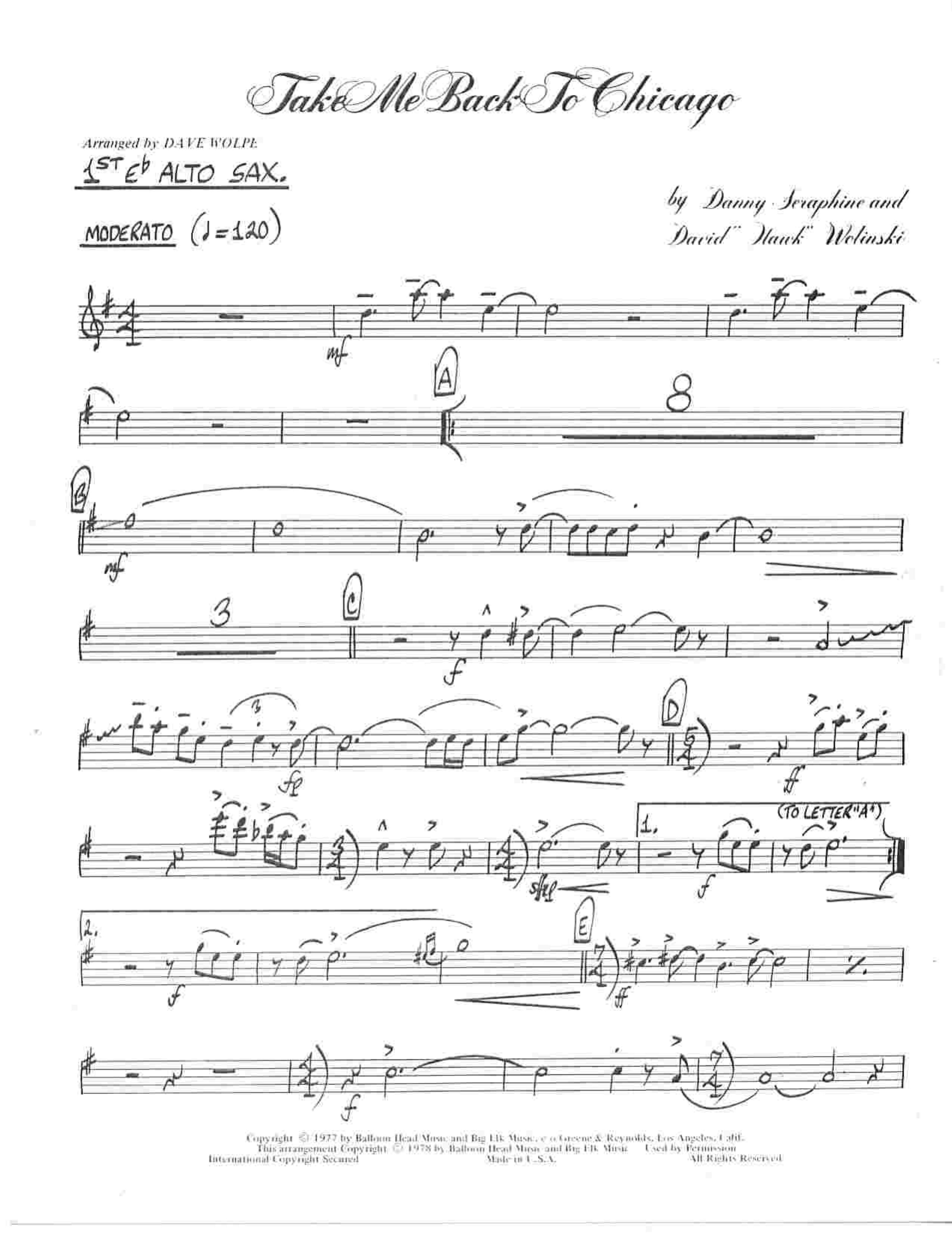
Take Me Back To Chicago (D.Wolpe)
Composed by Peter Cetera
Arranged by Dave Wolpe
- Ensemble: Big Band
- Pages: 36
- Instruments (17): 1st Eb Alto Sax, 2nd Eb Alto Sax, 1st Bb Tenor Sax, 2nd Bb Tenor Sax, Eb Baritone Sax, 1st Bb Trumpet, 2nd Bb Trumpet, 3rd Bb Trumpet, 4th Bb Trumpet, 1st Trombone, 2nd Trombone, 3rd Trombone, Bass Trombone, Piano, Guitar, Bass, Drums
- Difficulty: medium
- Content: Individual Parts
- Format: PDF Download (Instant)
- Price: $24.99
Chicago’s immortal 1976 track "Take Me Back To Chicago," originally penned by bassist Peter Cetera and featured on the multi-platinum album *Chicago XI*, stands as a masterclass in fusing sophisticated pop-rock songwriting with intricate horn-driven arrangements. Capturing the golden era of 1970s brass-rock fusion, the original recording relied on the legendary horn section of Lee Loughnane, James Pankow, and Walter Parazaider to drive its infectious groove. Translating this iconic crossover classic into the jazz big band idiom requires a delicate balance of crisp funk-rock articulation and straight-ahead swing sensibilities, a challenge met expertly by veteran arranger and orchestrator Dave Wolpe. Driving forward with an energetic, infectious medium-up funk-rock groove in 4/4 time, this chart radiates high-octane energy and nostalgia. Wolpe infuses the arrangement with a vibrant, punchy mood that immediately engages both the ensemble and the audience. The harmonic language retains the sophisticated chord extensions characteristic of Chicago’s signature sound—utilizing suspended chords, sharp chromatic passing tones, and rich major-seventh voicings—while opening up ample breathing room for authentic big band dynamic contrast. The overall sonic landscape evokes the sun-soaked, high-energy studio aesthetic of late-70s Los Angeles session recordings, blending tight horn stabs with an undeniable rhythmic drive. Wolpe approaches the score with his trademark pedagogical clarity and idiomatic scoring, ensuring that every section gets a chance to shine without muddying the texture. The arrangement features meticulously crafted brass and reed solis that echo the vocal and instrumental interplay of the original recording, alongside a powerful shout chorus that builds tension through dynamic layering and rhythmic syncopation. The rhythm section acts as the primary engine, requiring a tight, driving pocket from the drum kit and electric bass (or upright played with a punchy attack) to anchor the horns. Featured solo space allows a standout instrumentalist to stretch out over accessible, jazz-friendly changes that maintain the underlying momentum of the chart. Advanced high school, collegiate, and community jazz ensembles will find this 36-page chart to be an exceptionally rewarding addition to their repertoire. While the technical demands are approachable for developing players who possess a strong sense of syncopation and section blend, the chart offers enough sophisticated harmonic depth and stylistic nuance to satisfy professional-level bands looking for a crowd-pleasing concert closer or festival feature. The combination of nostalgic 70s crossover appeal and expert big band writing ensures a memorable experience for performers and listeners alike. Successfully executing this chart requires a unified approach to the underlying funk-rock groove. The rhythm section must lock in tightly; the drummer should emphasize a crisp backbeat on beats two and four while maintaining a steady eighth-note subdivision on the ride or hi-hat, avoiding any tendency to swing the straight sixteenth or eighth-note figures. Horn players must focus on ultra-precise articulation, ensuring that accented notes are clipped and short, while longer lines maintain a smooth, connected airflow. Pay close attention to dynamic markings during the transitional builds; undercutting the volume prior to the shout chorus will maximize the impact of the final ensemble release. Rehearsals should initially focus on isolating the rhythm section to secure the groove before layering in the saxophones, trumpets, and trombones section by section to dial in balance and intonation on the dense chordal punches. Q: What instrumentation and parts are included in this publication? A: The arrangement is scored for a standard 17-instrument big band, consisting of 5 saxophones (Alto 1, Alto 2, Tenor 1, Tenor 2, Baritone Sax), 4 trumpets, 4 trombones, and a full four-piece rhythm section (piano, guitar, bass, and drums), spanning a comprehensive 36 pages of score and parts. Q: What is the designated difficulty level for this specific chart? A: This arrangement is rated as medium to medium-advanced, making it ideal for proficient high school jazz bands, collegiate ensembles, and community big bands looking to bridge contemporary groove styles with traditional big band performance. Q: What is the musical style and historical background of the piece? A: Originating as a 1976 hit by the legendary horn-rock band Chicago from their album *Chicago XI*, this piece represents the pinnacle of 1970s pop-fusion and is reimagined here as an energetic, groove-oriented jazz big band chart. Q: What makes Dave Wolpe's arrangement unique compared to other big band charts? A: Wolpe expertly balances the vocal-driven horn lines of the original Peter Cetera composition with authentic big band voicings, incorporating dynamic soli sections and a high-impact shout chorus tailored specifically for modern jazz ensemble performance. Q: What is the performance duration and tempo feel of the arrangement? A: The piece is set in a driving 4/4 time signature at a medium-up tempo (approximately 120–126 BPM), offering a sustained, high-energy groove that typically runs for about 3.5 to 4 minutes in performance.
Questions and answers
- What is included in the Take Me Back To Chicago (D.Wolpe) PDF?
- The verified current file contains individual parts across 36 pages.
- How many instruments or parts are listed for Take Me Back To Chicago (D.Wolpe)?
- The verified instrumentation list contains 17 entries for this Big Band arrangement.
- Who is credited for Take Me Back To Chicago (D.Wolpe)?
- Composer: Peter Cetera. Arranger: Dave Wolpe.
- What difficulty is listed for Take Me Back To Chicago (D.Wolpe)?
- The verified difficulty level is medium.
- Can I preview Take Me Back To Chicago (D.Wolpe) before buying?
- Yes. The product page provides a preview generated from the current PDF file.
- How is Take Me Back To Chicago (D.Wolpe) delivered?
- After successful payment, the digital PDF is made available for download. The displayed price is $24.99.
Musicians Also Search For
Take Me Back To Chicago Dave Wolpe PDF • Take Me Back To Chicago Dave Wolpe sheet music • Take Me Back To Chicago arranged by Dave Wolpe • Dave Wolpe big band charts • Dave Wolpe jazz arrangements PDF • Take Me Back To Chicago Peter Cetera sheet music • Take Me Back To Chicago Peter Cetera big band arrangements • Peter Cetera big band charts • Take Me Back To Chicago big band arrangements • Take Me Back To Chicago big band PDF download • Take Me Back To Chicago jazz sheet music • big band sheet music download • Take Me Back To Chicago individual parts download • Take Me Back To Chicago sheet music PDF • buy Take Me Back To Chicago sheet music • download Take Me Back To Chicago PDF • Take Me Back To Chicago jazz charts • best Dave Wolpe big band arrangements • Peter Cetera arranged by Dave Wolpe • Take Me Back To Chicago printable sheet music • big band repertoire PDF