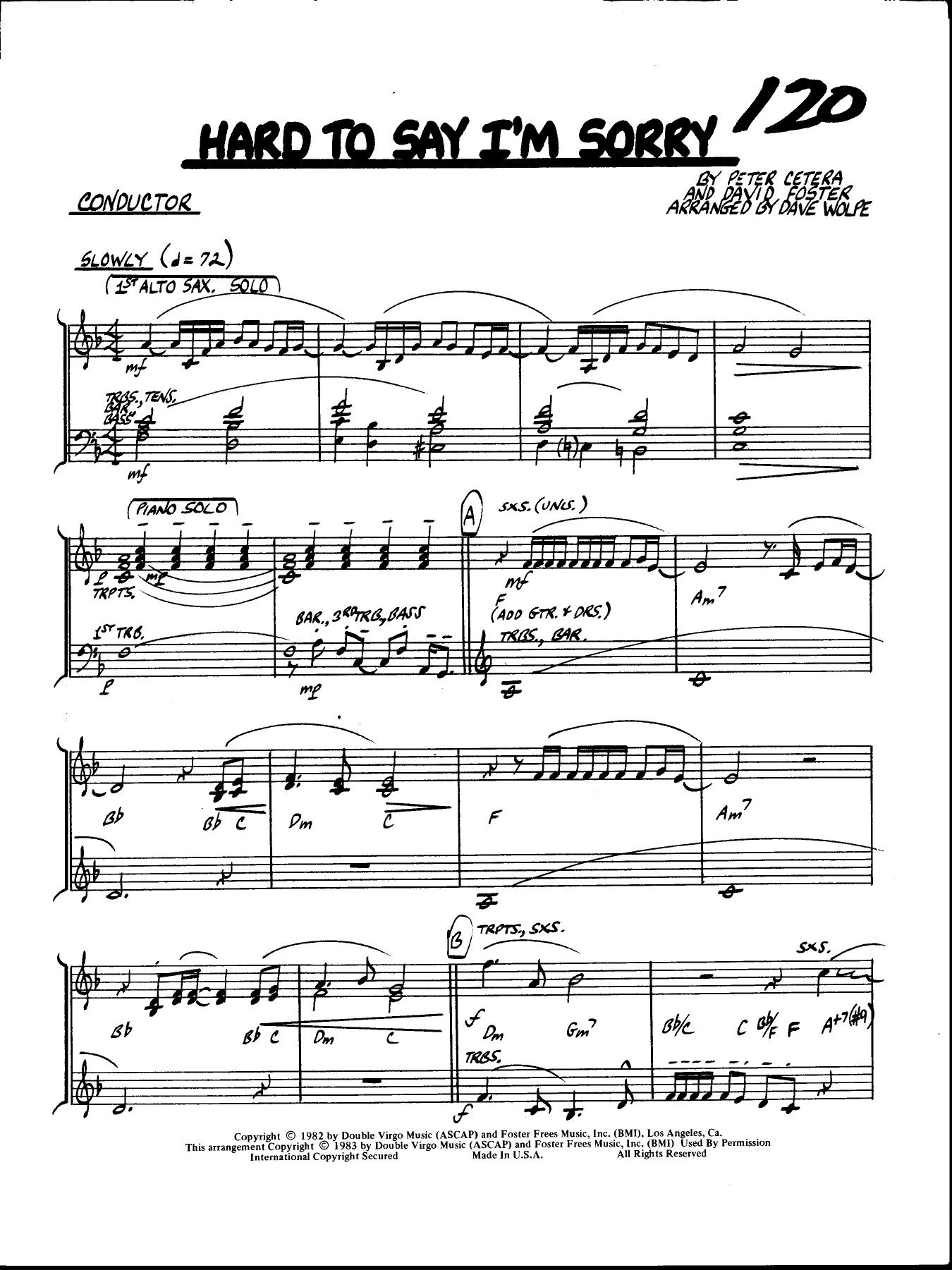
Hard To Say I'm Sorry (D.Wolpe) sheet music preview

Hard To Say I'm Sorry (D.Wolpe)

Composed by Peter Cetera

Arranged by Dave Wolpe

  • Ensemble: Big Band
  • Pages: 37
  • Instruments (17): Conductor, C Flute (Optional), 1st Eb Alto Sax., 2nd Eb Alto Sax., 1st Bb Tenor Sax., 2nd Bb Tenor Sax., Eb Baritone Sax., 1st Bb Trumpet, 2nd Bb Trumpet, 3rd Bb Trumpet, 1st Trombone, 2nd Trombone, 3rd Trombone, Bass, Drums, Piano, Guitar
  • Difficulty: medium
  • Content: Individual Parts
  • Format: PDF Download (Instant)
  • Price: $24.99

Chicago’s landmark 1982 power ballad "Hard To Say I'm Sorry," written by Peter Cetera and David Foster, defined the sophisticated adult-contemporary pop landscape of the early 1980s. Originally topping the Billboard Hot 100 and anchoring the band's multi-platinum *Chicago 16* album, the song’s lush harmonic architecture and soaring vocal lines made it an irresistible candidate for jazz ensemble adaptation. Translating a vocal-driven pop-rock masterpiece into a compelling big band chart requires a deft hand, and few arrangers possessed the commercial jazz intuition of the late Dave Wolpe, who brilliantly reimagined the tune into a sublime instrumental feature. Dave Wolpe’s arrangement casts the iconic composition as a lush, expressive ballad with an underlying contemporary groove, generally hovering at a comfortable, flowing tempo. The mood shifts masterfully from introspective and melancholic to soaring and triumphant. Wolpe builds the chart around rich, extended chord voicings that mirror Foster's original keyboard-heavy textures while fully exploiting the dynamic capabilities of a standard 17-piece big band. The arrangement opens with a gentle, atmospheric introduction that highlights the woodwind section before giving way to the primary melodic statements. Throughout the chart, the melody is thoughtfully distributed. The flugelhorns and alto saxophones frequently carry the initial thematic weight, delivering Peter Cetera’s signature vocal lines with lyrical warmth and controlled vibrato. As the arrangement unfolds, Wolpe introduces subtle harmonic modulations and lush brass swells that heighten the emotional intensity. A tastefully constructed solo section provides an ideal spotlight for a featured tenor saxophone or trumpet soloist, allowing room for expressive rubato phrasing before the ensemble surges into a rich, full-band climax. The chart avoids overly dense counterpoint, instead favoring pristine chordal balance, crystal-clear section writing, and dynamic peaks that feel organic rather than forced. Advanced high school ensembles, collegiate jazz orchestras, and professional community big bands will find this 37-page arrangement an exceptional vehicle for developing ensemble blend, intonation, and expressive ballad playing. Because the technical demands rely less on breakneck speed and far more on breath support, blend, and stylistic maturity, it serves as a masterclass in musicality. Audiences familiar with the timeless pop original will be captivated by the sophisticated jazz harmony, making this chart a guaranteed highlight for any standard concert program or festival performance. Achieving success with this Dave Wolpe arrangement depends entirely on the ensemble’s command of balance, intonation, and lyrical phrasing. The conductor should establish a relaxed, flowing tempo that avoids dragging while maintaining a sense of spaciousness. Because ballads expose intonation flaws quickly, spend dedicated rehearsal time balancing the chord voicings in the saxes and muted brass. The brass section should utilize gentle cup or harmon mutes where indicated, ensuring that muted passages remain warm and never edgy. Pay close attention to dynamic markings; the transition from the subdued, intimate opening statements to the expansive mid-chart swells requires seamless crescendo control. Solos should be approached with a lyrical mindset, staying true to the emotional contour of the original melody rather than over-playing. Finally, ensure the rhythm section locks into a steady, supportive groove that propels the ballad forward without sounding rushed or overly mechanical. Q: What instrumentation and parts are included in this arrangement? A: This chart is scored for a standard 17-instrument big band, consisting of 5 saxophones (2 altos, 2 tenors, 1 baritone), 4 trumpets, 4 trombones, guitar, piano, bass, and drums, spanning a total of 37 pages of music. Q: What is the difficulty level of this Dave Wolpe arrangement? A: It is moderately difficult, making it exceptionally well-suited for advanced high school bands, college ensembles, and professional community jazz orchestras looking to showcase their lyrical depth and blend. Q: What is the musical style and historical background of the piece? A: The arrangement transforms Peter Cetera and David Foster's 1982 Billboard-topping pop-rock hit by Chicago into a sophisticated, lush jazz ballad that retains the emotional gravity of the original era. Q: What makes this specific arrangement by Dave Wolpe unique? A: Wolpe expertly adapts complex pop harmonies into rich, horn-friendly voicings, balancing exposed melodic passages for the woodwinds and brass with a dynamic, soaring ensemble swell. Q: What is the approximate performance duration and tempo feel? A: It is performed as a flowing, expressive ballad in 4/4 time, typically running between 3.5 to 4.5 minutes depending on the length of the improvised solo section.

Questions and answers

What is included in the Hard To Say I'm Sorry (D.Wolpe) PDF?
The verified current file contains a conductor score and individual parts across 37 pages.
How many instruments or parts are listed for Hard To Say I'm Sorry (D.Wolpe)?
The verified instrumentation list contains 17 entries for this Big Band arrangement.
Who is credited for Hard To Say I'm Sorry (D.Wolpe)?
Composer: Peter Cetera. Arranger: Dave Wolpe.
What difficulty is listed for Hard To Say I'm Sorry (D.Wolpe)?
The verified difficulty level is medium.
Can I preview Hard To Say I'm Sorry (D.Wolpe) before buying?
Yes. The product page provides a preview generated from the current PDF file.
How is Hard To Say I'm Sorry (D.Wolpe) delivered?
After successful payment, the digital PDF is made available for download. The displayed price is $24.99.

Musicians Also Search For

Hard To Say I'm Sorry Dave Wolpe PDFHard To Say I'm Sorry Dave Wolpe sheet musicHard To Say I'm Sorry arranged by Dave WolpeDave Wolpe big band chartsDave Wolpe jazz arrangements PDFHard To Say I'm Sorry Peter Cetera sheet musicHard To Say I'm Sorry Peter Cetera big band arrangementsPeter Cetera big band chartsHard To Say I'm Sorry big band arrangementsHard To Say I'm Sorry big band PDF downloadHard To Say I'm Sorry jazz sheet musicbig band sheet music downloadHard To Say I'm Sorry conductor score PDFHard To Say I'm Sorry individual parts downloadHard To Say I'm Sorry sheet music PDFbuy Hard To Say I'm Sorry sheet musicdownload Hard To Say I'm Sorry PDFHard To Say I'm Sorry jazz chartsbest Dave Wolpe big band arrangementsPeter Cetera arranged by Dave WolpeHard To Say I'm Sorry printable sheet musicbig band repertoire PDF

All arrangements by Dave Wolpe All Peter Cetera sheet music