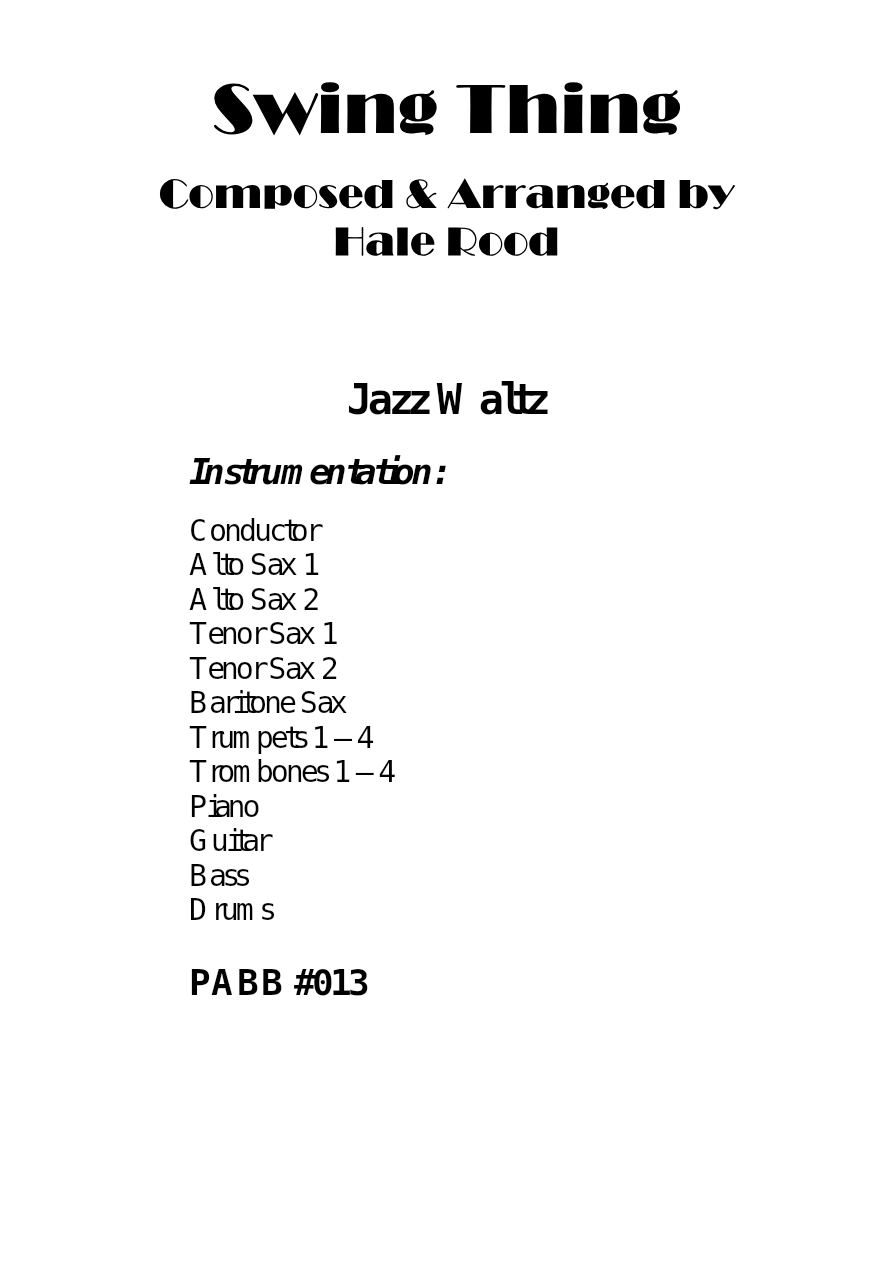
Swing Thing (H.Rood) sheet music preview

Swing Thing (H.Rood)

Composed by H. Rood

Arranged by H. Rood

  • Ensemble: Big Band
  • Style: Waltz
  • Pages: 52
  • Instruments (17): Alto Saxophone 1, Alto Saxophone 2, Tenor Saxophone 1, Tenor Saxophone 2, Baritone Saxophone, Trumpet 1, Trumpet 2, Trumpet 3, Trumpet 4, Trombone 1, Trombone 2, Trombone 3, Bass Trombone, Piano, Bass, Drums, Guitar
  • Difficulty: advanced
  • Content: Individual Parts
  • Format: PDF Download (Instant)
  • Price: $18.99

## SECTION 1: Description "Swing Thing (H.Rood)" is a captivating big band arrangement that transports listeners to the golden age of jazz waltzes, a subgenre that gained particular traction in the mid-20th century with iconic pieces like Dave Brubeck's "Take Five" and Cannonball Adderley's "Waltz for Debby." While H. Rood's original composition may not carry the same historical weight as these standards, it embodies the sophisticated charm and rhythmic ingenuity characteristic of the era's best 3/4 jazz. The piece, penned by H. Rood, presents a fresh yet familiar take on the jazz waltz, eschewing the often frantic pace of bebop for a more elegant, medium-tempo groove that invites both introspection and buoyant swing. It evokes a mood of sophisticated playfulness, perfect for setting a refined yet energetic atmosphere. Musically, "Swing Thing" is firmly rooted in a medium-tempo waltz feel, typically hovering around 150-160 beats per minute, allowing the intricate voicings and melodic lines to breathe. The primary key is often C minor, though H. Rood's signature harmonic palette frequently ventures into rich extended harmonies and subtle modulations, adding depth and color without sacrificing accessibility. The arrangement opens with a lyrical melody carried initially by the alto saxophone, later joined by the full sax section in a beautifully voiced soli, showcasing H. Rood's knack for lush, close-knit harmonies. The energy builds steadily, moving from a smooth, understated opening to a powerful, driving shout chorus that features the full ensemble in a dynamic interplay of brass and reeds. H. Rood's distinctive arranging approach is evident throughout "Swing Thing." Beyond the rich voicings, the piece features meticulously crafted counter-melodies and rhythmic figures that keep the ensemble engaged and the listener captivated. There are prominent featured solos for both Tenor Saxophone 1 and Trumpet 2, offering ample opportunity for improvisation over a harmonically interesting chord progression. The technical challenges lie primarily in maintaining the precise waltz feel, ensuring tight ensemble articulation, and navigating the sometimes dense harmonic structures in the soli sections. The rewarding aspect of performing this piece comes from its inherent musicality and the sheer joy of executing its vibrant, swinging passages. A particular standout moment is the dramatic build-up into the final shout chorus, culminating in a powerful, yet controlled, full-band statement that leaves a lasting impression. This arrangement is ideally suited for advanced high school, college, community, and even professional big bands. Its blend of accessible melodicism and sophisticated harmonic and rhythmic content makes it an excellent teaching tool for developing ensemble precision and stylistic nuance, while also providing a rewarding performance experience for seasoned musicians. The detailed scoring and thoughtful part writing ensure that each section has interesting and challenging material, making it a valuable addition to any big band's repertoire. ## SECTION 2: Performance Notes "Swing Thing (H.Rood)" thrives on a consistent, buoyant medium waltz feel, ideally around quarter note = 150-160 bpm. Conductors should emphasize a strong "one" beat within the 3/4 meter, avoiding a rushed or overly heavy approach. Key technical challenges include maintaining precise articulation in the sax soli sections, particularly the unison and octave passages, and ensuring the brass section's dynamic control during the powerful shout chorus. Rehearsal time should be dedicated to balancing the intricate counter-melodies in the rhythm section, especially the piano and bass, to support the melodic lines without overpowering them. Encourage soloists to embrace the waltz feel, focusing on melodic improvisation rather than purely rhythmic complexity. Pay close attention to dynamics throughout, as H. Rood utilizes a wide range to create dramatic tension and release, especially leading into and out of the full ensemble sections. ## SECTION 3: FAQ Q: What instruments and parts are included in the "Swing Thing (H.Rood)" arrangement? A: This big band arrangement includes parts for 17 instruments: Alto Saxophone 1 & 2, Tenor Saxophone 1 & 2, Baritone Saxophone, Trumpet 1, 2, 3 & 4, Trombone 1, 2, 3 & 4, Piano, Guitar, Bass, and Drums. Q: What is the difficulty level of "Swing Thing (H.Rood)"? A: This arrangement is rated as advanced high school to college/professional level, requiring strong ensemble precision, good sight-reading skills, and capable improvisers for the featured tenor saxophone and trumpet solos. Q: What musical style and historical context does "Swing Thing (H.Rood)" represent? A: "Swing Thing" is a jazz waltz, a style prominent in the mid-20th century, characterized by its medium tempo 3/4 groove, sophisticated harmonies, and a blend of lyrical melody with swinging improvisation. Q: What makes H. Rood's arrangement of "Swing Thing" unique? A: H. Rood's arrangement is distinguished by its lush, close-knit sax voicings, intricate counter-melodies, sophisticated harmonic progressions, and a dynamic build-up to a powerful yet controlled full-ensemble shout chorus. Q: What is the approximate performance duration and recommended tempo for "Swing Thing (H.Rood)"? A: The approximate performance duration is 4-5 minutes, and the recommended tempo is a medium waltz feel, typically around quarter note = 150-160 beats per minute.

All arrangements by H. Rood All H. Rood sheet music