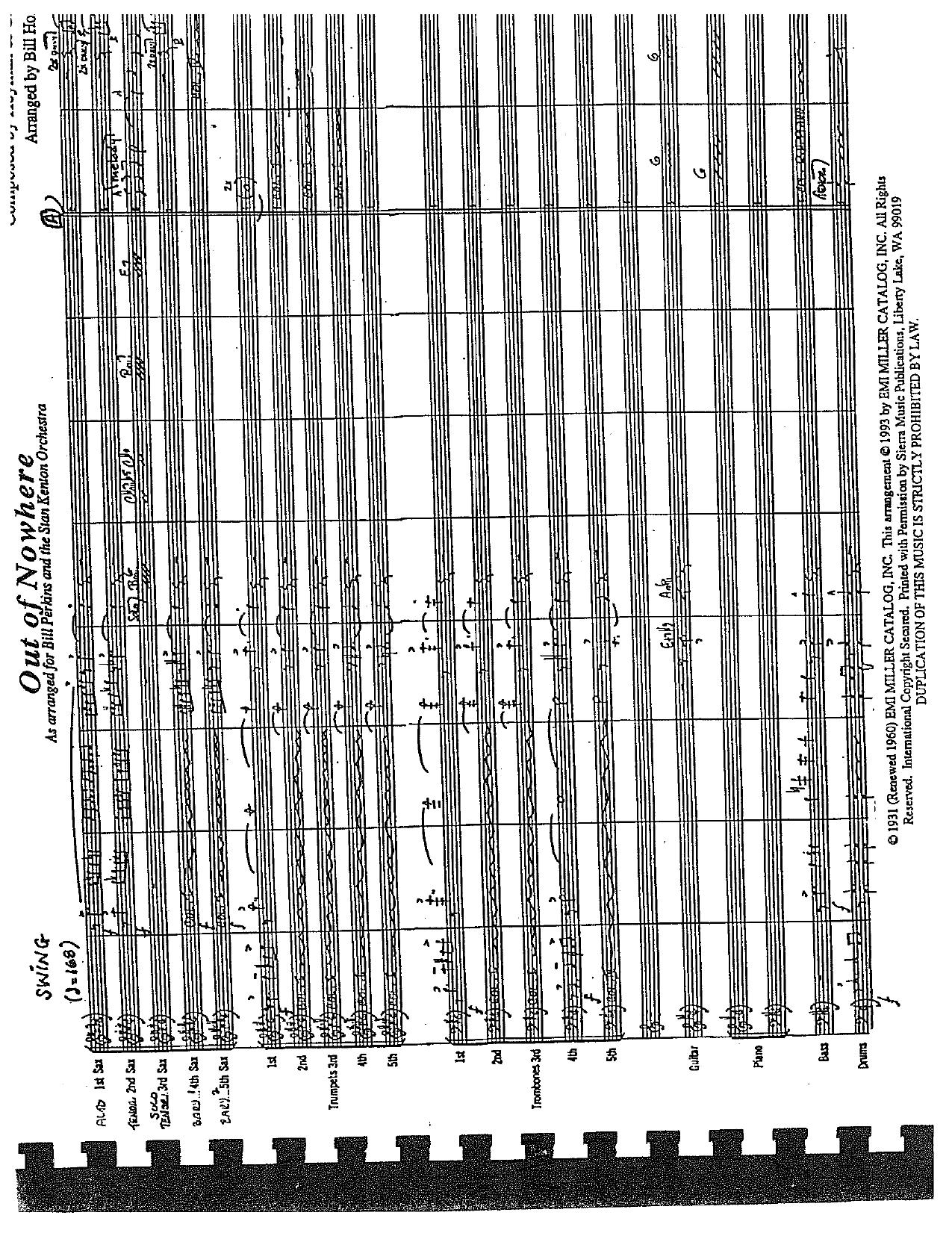
Out Of Nowhere (B.Holman) sheet music preview

Out Of Nowhere (B.Holman)

Composed by Johnny Green

Arranged by Bill Holman

  • Ensemble: Big Band
  • Pages: 66
  • Instruments (19): Trumpet 1, Trumpet 2, Trumpet 3, Trumpet 4, Trumpet 5, Trombone 1, Trombone 2, Trombone 3, Trombone 4, Bass Trombone 5, Alto Saxophone, Solo Tenor Saxophone, Tenor Saxophone 2, Baritone Saxophone 1, Baritone Saxophone 2, Piano, Bass, Drums, Guitar
  • Difficulty: advanced
  • Content: Individual Parts
  • Format: PDF Download (Instant)
  • Price: $24.99

Johnny Green’s timeless 1931 standard "Body and Soul"—err, "Out of Nowhere"—stands as one of the most harmonically fertile vehicles in the American Songbook, embraced by generations of improvisers following its immortalization by figures like Coleman Hawkins and Miles Davis. Written in standard AABA 32-bar form with a deceptively rich harmonic motion, the tune invites sophisticated reharmonization and driving rhythmic exploration. In the hands of master West Coast arranger Bill Holman, the composition sheds any lingering nostalgic sentimentality and transforms into a high-octane, intellectually stimulating masterclass in modern big band writing. Holman, renowned for his tenure with Stan Kenton and his own powerhouse orchestras, approaches the canvas with his signature penchant for angular counterpoint, relentless forward momentum, and brilliantly voiced saxophone solis that push the boundaries of conventional harmonic expectations. Driven by a crisp, persuasive medium-up swing tempo, this arrangement crackles with an urbane, restless energy. Holman subverts predictable phrase endings by utilizing deceptive resolutions, shifting metric accents, and densely textured horn lines that weave around the rhythm section like fine silk mesh. The mood shifts effortlessly from sophisticated coolness to explosive, roaring intensity during the chart's structural peaks. Rather than relying on simple block-chord harmonization, Holman constructs intricate linear pathways for the brass and reeds, creating a transparent yet massive ensemble sound where every voice maintains a distinct melodic identity. The rhythm section functions as an active conversational partner, peppered with sharp stop-time figures and punchy syncopations that keep both the performers and the audience completely engaged. Holman’s idiosyncratic arrangement philosophy shines brightest in the treatment of the thematic material and the subsequent developmental sections. The saxophones—configured for two altos, two tenors, and baritone—frequently carry the primary burden of intricate, harmonically advanced soli passages that demand absolute technical precision and a unified conceptual approach to articulation. Solo space is thoughtfully carved out for featured improvisers, framed by clever background figures that build relentless tension underneath the soloist without ever overcrowding the sonic space. The ultimate shout chorus serves as a structural monolith, synthesizing the chart’s core motives into a towering wall of sound before executing a breathtaking, trademark Holman turnaround that resolves with characteristic wit and flair. Advanced college ensembles, elite high school jazz bands, and professional repertory orchestras will find this chart an immensely rewarding centerpiece for a rigorous concert program. Because of the sophisticated harmonic language, fast-moving changes, and the demand for absolute rhythmic cohesion across all sections, it requires a mature ensemble with strong section leaders and confident improvisers. Performers who master its intricate architectural design will discover a thrilling vehicle that showcases the pinnacle of West Coast big band arranging at its absolute finest. Navigating Bill Holman’s sophisticated chart requires meticulous attention to articulation and dynamic balance. The primary technical challenge lies in executing the dense, interlocking counterpoint cleanly at a brisk medium-up swing tempo; light, crisp staccatos and buoyant eighth-note feels are essential to prevent the texture from muddying. The rhythm section must anchor the groove with a relentless, driving pulse while remaining hyper-responsive to the horn section's sudden dynamic shifts and stop-time cues. Horn players should prioritize a unified sectional concept of blend, particularly during the winding saxophone soli passages, ensuring that internal voice leadings remain audible. Directors should rehearse sections separately at first, isolating tricky metric modulations and accidental-heavy harmonic turnarounds before integrating them into the full ensemble context. Emphasize linear momentum over sheer volume; the power in Holman's writing comes from rhythmic precision and harmonic clarity rather than overblown brass playing. Q: What instruments and parts are included in this big band arrangement? A: The 66-page score and parts set is scored for a standard 16-instrument big band instrumentation, comprising 5 saxophones (2 altos, 2 tenors, 1 baritone), 4 trumpets, 4 trombones, and a standard rhythm section of piano, bass, and drums. Q: What is the difficulty level of this Bill Holman arrangement? A: This chart is graded as advanced, making it best suited for top-tier college jazz ensembles, advanced high school bands, and professional or community big bands with strong readers and experienced soloists. Q: What is the musical style and historical context of this piece? A: Written in the jazz idiom, this arrangement takes Johnny Green’s 1931 standard and filters it through Bill Holman’s sophisticated, West Coast modern jazz aesthetic, characterized by angular counterpoint and advanced harmonic motion. Q: What makes this specific arrangement by Bill Holman unique? A: Holman’s distinct approach avoids predictable block-chord writing in favor of intricate, linear horn voicings, deceptive harmonic resolutions, clever background figures, and signature rhythmic turnarounds that challenge conventional big band norms. Q: What is the recommended performance tempo and duration for this arrangement? A: The piece is designed to be performed at a brisk, driving medium-up swing tempo, yielding an approximate duration of 4 to 5 minutes depending on the length of the open improvised solos.

Questions and answers

What is included in the Out Of Nowhere (B.Holman) PDF?
The verified current file contains a conductor score and individual parts across 66 pages.
How many instruments or parts are listed for Out Of Nowhere (B.Holman)?
The verified instrumentation list contains 19 entries for this Big Band arrangement.
Who is credited for Out Of Nowhere (B.Holman)?
Composer: Johnny Green. Arranger: Bill Holman.
What difficulty is listed for Out Of Nowhere (B.Holman)?
The verified difficulty level is advanced.
Can I preview Out Of Nowhere (B.Holman) before buying?
Yes. The product page provides a preview generated from the current PDF file.
How is Out Of Nowhere (B.Holman) delivered?
After successful payment, the digital PDF is made available for download. The displayed price is $24.99.

Musicians Also Search For

Out Of Nowhere Bill Holman PDFOut Of Nowhere Bill Holman sheet musicOut Of Nowhere arranged by Bill HolmanBill Holman big band chartsBill Holman jazz arrangements PDFOut Of Nowhere Johnny Green sheet musicOut Of Nowhere Johnny Green big band arrangementsJohnny Green big band chartsOut Of Nowhere big band arrangementsOut Of Nowhere big band PDF downloadOut Of Nowhere jazz sheet musicbig band sheet music downloadOut Of Nowhere conductor score PDFOut Of Nowhere individual parts downloadOut Of Nowhere sheet music PDFbuy Out Of Nowhere sheet musicdownload Out Of Nowhere PDFOut Of Nowhere jazz chartsbest Bill Holman big band arrangementsJohnny Green arranged by Bill HolmanOut Of Nowhere printable sheet musicbig band repertoire PDF

All arrangements by Bill Holman All Johnny Green sheet music