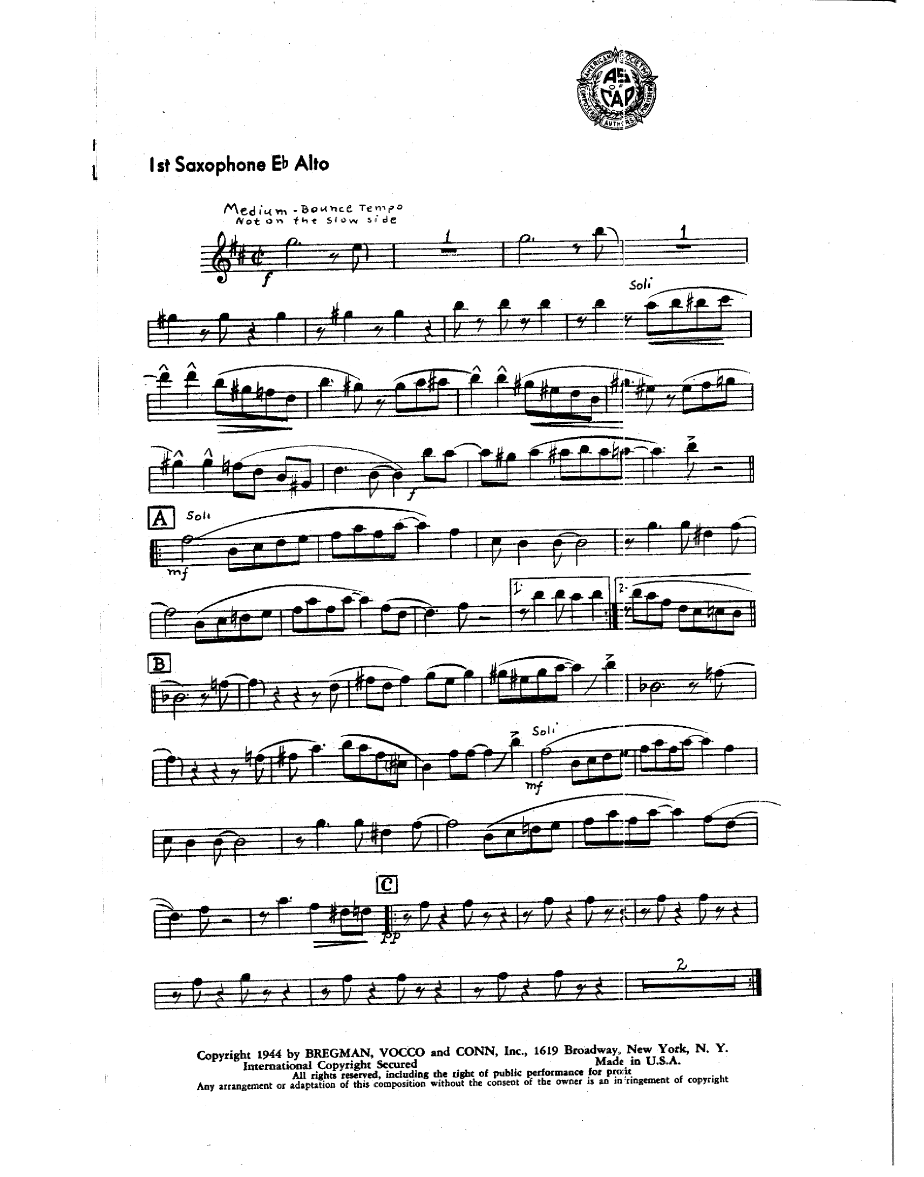
Swing Shift (B.Clayton)
Composed by Buck Clayton
Arranged by Buck Clayton
- Ensemble: Big Band
- Style: Jazz Standard
- Pages: 42
- Instruments (16): 1st Saxophone Eb Alto, 2nd Saxophone Bb Tenor, 3rd Saxophone Eb Alto, 4th Saxophone Bb Tenor, 5th Eb Baritone Saxophone, 1st Trumpet in Bb, 2nd Trumpet in Bb, 3rd Trumpet in Bb, 1st Trombone, 2nd Trombone, 3rd Trombone, Bass, Guitar, Drums, 1st Violins (Conductor), Piano
- Difficulty: medium
- Content: Individual Parts
- Format: PDF Download (Instant)
- Price: $24.99
"Swing Shift (B. Clayton)" is a quintessential big band jazz standard, originally composed and arranged by the legendary Buck Clayton, a pivotal figure in the Swing Era. First recorded by the Count Basie Orchestra, likely in the early 1940s, and transcribed from a 1944 Lang-Worth radio aircheck, this piece embodies the vibrant, driving energy of Kansas City swing. Clayton, renowned for his melodic trumpet playing and sophisticated arranging, was a key contributor to Basie's distinctive sound, serving unofficially as the orchestra's music director and contributing numerous compositions and arrangements. This piece stands as a testament to his genius, showcasing the infectious rhythmic vitality and elegant harmonic language that defined the era. Musically, "Swing Shift" is an up-tempo, fast and furious swing number, typically performed around a brisk tempo of quarter note = 230. It exudes an exhilarating and joyous mood, characterized by its propulsive rhythm section work and bright, brassy fanfares. The primary key often centers around G minor or C major, allowing for both bluesy inflections and sophisticated harmonic movement. The energy is consistently high, driving forward with an undeniable momentum that encourages both dancers and listeners alike. This arrangement captures the essence of a classic Basie-style chart, emphasizing tight ensemble work, riff-based passages, and the call-and-response patterns that are hallmarks of the Kansas City sound. Buck Clayton's arranging approach, as exemplified in "Swing Shift," is marked by clarity, precision, and an innate understanding of big band dynamics. He masterfully balances powerful brass soli sections with flowing saxophone lines, creating a rich textural tapestry. His arrangements often feature subtle yet effective harmonic extensions that add color without sacrificing the inherent swing feel. In this particular arrangement, the melody is predominantly carried by the trumpet section, often in unison or tight voicings, punctuated by robust saxophone counter-melodies. Featured solos include written-out transcriptions of iconic improvisations, such as the trumpet solo (believed to be by Harry 'Sweets' Edison) and the tenor saxophone solo (by Lester Young), providing invaluable insight into the improvisational styles of these giants. The technical challenges primarily lie in maintaining the demanding tempo with precision, achieving clean ensemble articulation, and executing the intricate soli passages with unified phrasing and balance. The rewarding aspect of performing "Swing Shift" is the sheer exhilaration of locking into its powerful groove and delivering a truly authentic swing experience. This arrangement is highly suitable for advanced high school, college, community, and professional big bands. Its "difficult" rating stems from the required technical proficiency and sectional discipline necessary to execute the fast tempo and intricate ensemble figures effectively. Bands with strong lead players in the trumpet and saxophone sections, as well as a rhythm section capable of sustaining a driving, authentic swing feel, will find this arrangement particularly rewarding. It offers an excellent opportunity to delve into the historical performance practices of the Swing Era and to develop the cohesive ensemble sound characteristic of the Count Basie Orchestra. Conductors should emphasize a relentless, driving medium-fast swing feel, aiming for a tempo around quarter note = 230, while ensuring rhythmic precision and a strong sense of forward motion. The primary technical challenge lies in the rapid-fire articulation required in the brass and saxophone soli sections; encourage musicians to practice these passages slowly and meticulously to achieve unified attacks and releases. Trumpet players should be prepared for sustained high notes and dynamic contrasts, utilizing cup mutes for specific sections to achieve the characteristic muted brass sound of the era. Saxophone sections need to focus on blend and intonation, particularly in the tightly voiced harmonies. The rhythm section is the backbone of this arrangement; the bass and drums must establish a rock-solid, swinging foundation, while the piano and guitar provide crisp, rhythmic comping. Rehearsal time should be dedicated to balancing the ensemble, ensuring that the powerful shout choruses build effectively without overwhelming the soloists or losing clarity in the inner voices. Pay close attention to dynamics and phrasing, as these elements are crucial for conveying the authentic character of this classic swing chart. Q: What instruments are included in this arrangement? A: This arrangement is scored for a standard big band, including Alto Saxophone 1, Alto Saxophone 3, Tenor Saxophone 2, Baritone Saxophone 5, Trumpet 1, and other typical big band instrumentation, totaling 15 instruments. Q: What is the difficulty level of "Swing Shift (B. Clayton)"? A: This arrangement is considered difficult, requiring advanced technical proficiency and strong sectional discipline, making it appropriate for advanced high school, college, community, and professional big bands. Q: What is the musical style and historical context of this piece? A: "Swing Shift" is a jazz standard in the Kansas City swing style, composed and arranged by Buck Clayton, a prominent figure of the Swing Era. It was notably recorded by the Count Basie Orchestra in the early 1940s. Q: What makes this arrangement unique? A: This arrangement features Buck Clayton's distinctive big band writing, including powerful soli sections, intricate voicings, and transcribed solos by jazz legends like Harry 'Sweets' Edison (trumpet) and Lester Young (tenor saxophone). Q: What is the typical performance duration or tempo for this piece? A: "Swing Shift" is an up-tempo, fast and furious swing number, typically performed around a brisk tempo of quarter note = 230.
Questions and answers
- What is included in the Swing Shift (B.Clayton) PDF?
- The verified current file contains a conductor score and individual parts across 42 pages.
- How many instruments or parts are listed for Swing Shift (B.Clayton)?
- The verified instrumentation list contains 16 entries for this Big Band arrangement.
- Who is credited for Swing Shift (B.Clayton)?
- Composer: Buck Clayton. Arranger: Buck Clayton.
- What difficulty is listed for Swing Shift (B.Clayton)?
- The verified difficulty level is medium.
- What style is listed for Swing Shift (B.Clayton)?
- The catalog lists the style as Jazz Standard.
- Can I preview Swing Shift (B.Clayton) before buying?
- Yes. The product page provides a preview generated from the current PDF file.
- How is Swing Shift (B.Clayton) delivered?
- After successful payment, the digital PDF is made available for download. The displayed price is $24.99.
Musicians Also Search For
Swing Shift Buck Clayton PDF • Swing Shift Buck Clayton sheet music • Swing Shift arranged by Buck Clayton • Buck Clayton big band charts • Buck Clayton jazz arrangements PDF • Swing Shift Buck Clayton big band arrangements • Swing Shift big band arrangements • Swing Shift big band PDF download • Swing Shift jazz sheet music • big band sheet music download • Swing Shift conductor score PDF • Swing Shift individual parts download • Swing Shift sheet music PDF • Swing Shift Jazz Standard charts • Jazz Standard big band arrangements • buy Swing Shift sheet music • download Swing Shift PDF • Swing Shift jazz charts • best Buck Clayton big band arrangements • Swing Shift printable sheet music • big band repertoire PDF