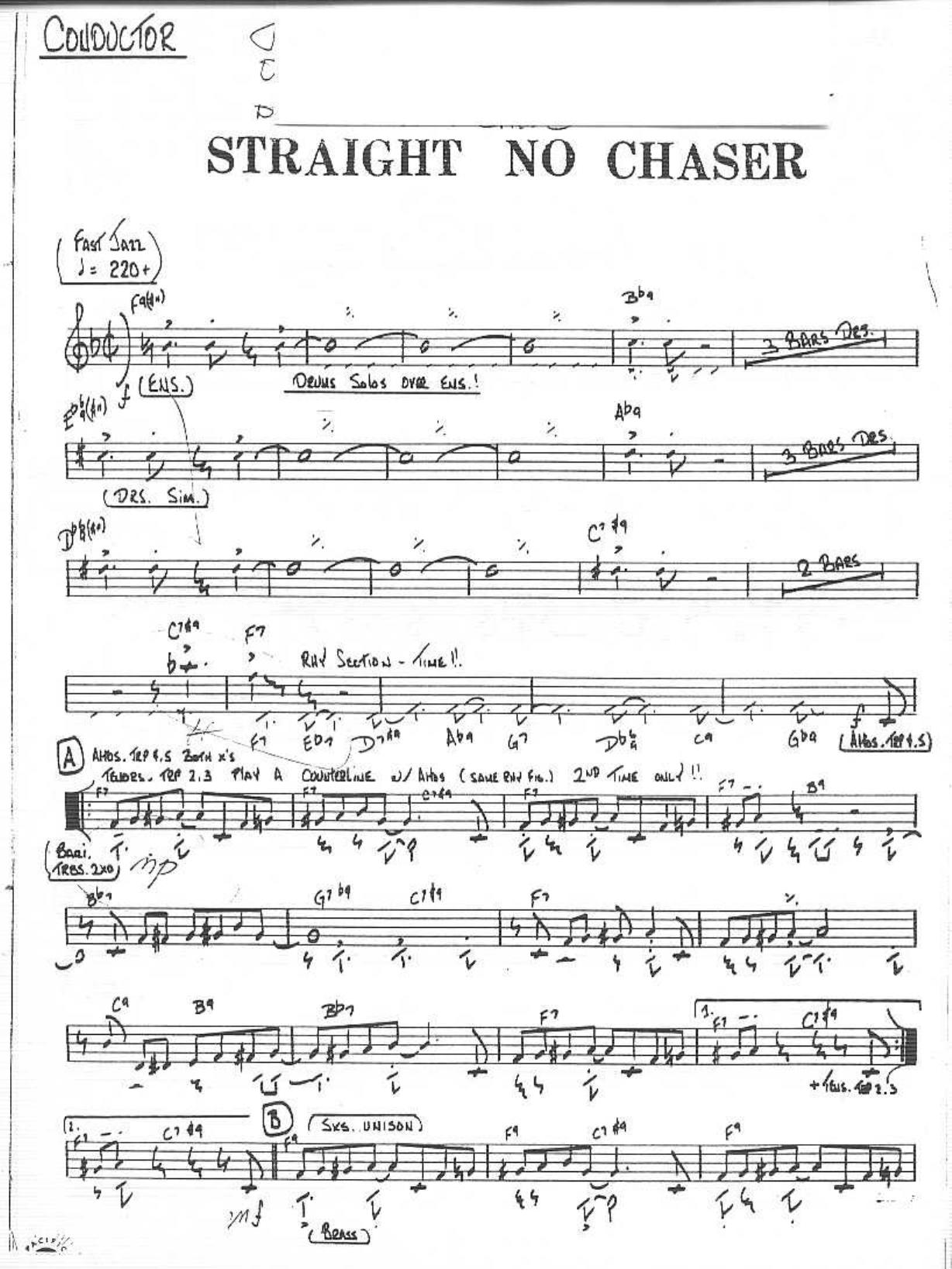
Straight No Chaser (D.Schamber) sheet music preview

Straight No Chaser (D.Schamber)

Composed by Thelonious Monk

Arranged by Don Schamber

  • Ensemble: Big Band
  • Pages: 60
  • Instruments (18): Conductor, Alto Saxophone 1, Alto Saxophone 2, Tenor Saxophone 1, Tenor Saxophone 2, Baritone Saxophone, Trumpet 1, Trumpet 2, Trumpet 3, Trumpet 4, Trumpet 5, Trombone 1, Trombone 2, Trombone 3, Trombone 4, Piano-Guitar, Bass, Drums
  • Difficulty: advanced
  • Content: Individual Parts
  • Format: PDF Download (Instant)
  • Price: $24.99

Thelonious Monk introduced "Straight No Chaser" to the jazz canon during his landmark 1951 sessions for Blue Note Records, cementing its status as one of the most enduring 12-bar blues compositions in modern music. Representing the pinnacle of early bebop architecture, Monk’s ingenious melody twists the standard blues form with asymmetrical phrasing, playful angularity, and subversive rhythmic displacement. Over subsequent decades, the tune transformed from a cerebral bebop vehicle into an essential jam-session standard, interpreted by virtually every major figure in jazz history, from Miles Davis to John Coltrane. Its deceptive simplicity masks a sophisticated harmonic landscape that continues to challenge and inspire improvisers across generations. Don Schamber’s masterful big band adaptation breathes fresh vitality into Monk’s classic blues framework, driving forward with an infectious, hard-swinging medium-up tempo. The overall mood is buoyant, clever, and unmistakably steeped in the modernist bebop tradition, juxtaposing tightly wound, angular ensemble lines with wide-open, blues-drenched breathing spaces. Schamber captures Monk’s idiosyncratic spirit not by imitating a small-group piano voicing, but by translating those spiky, dissonant intervals into rich, modern horn textures that snap with rhythmic urgency and sly wit. Schamber’s arrangement distinguishes itself through inventive counterpoint, clever section-writing, and dynamic brass-and-reed interplay that constantly recontextualizes the familiar blues head. The saxophones frequently carry the initial thematic weight with crisp, articulate bebop lines, while the brass interject with punchy, staccato punctuations that recall classic Count Basie economy combined with Kenton-esque harmonic muscle. Solo opportunities are carved out organically within the form, allowing featured improvisers ample room to stretch over standard blues changes. A brilliantly constructed shout chorus builds cumulative intensity through clever rhythmic layering and sectional hocketing before releasing the band into a high-energy final head. Advanced high school ensembles, collegiate jazz orchestras, and professional big bands will find this chart an exhilarating addition to their repertoire. While the technical demands require clean articulation, agile fingerwork in the woodwinds, and a deep internal sense of swing, the rewards of performing such a brilliantly scored piece of jazz history make it an absolute standout for festival competition or concert programming. Executing Don Schamber’s chart successfully requires a rigorous commitment to crisp, lightweight swing phrasing, particularly in the medium-up tempo sweet spot. Conductors should ensure the rhythm section locks into a driving, unhurried quarter-note pulse where the eighth notes are characteristically swung with an articulate, forward-moving weight rather than a lazy triplet feel. The primary technical challenge lies in the angularity of Monk’s thematic material; horn players must execute unison and harmonized passages with absolute precision, paying close attention to dynamic contrast between accented offbeats and sustained backgrounds. The brass section should utilize natural, clean attacks, reserving dramatic effects like falls and doits strictly for the climactic shout chorus to maintain stylistic integrity. In rehearsal, isolate the rhythm section first to establish a buoyant, communicative groove, ensuring the pianist and bassist capture the economic, modal-leaning voicings inherent in Monk's harmonic world without overcrowding the texture. Q: What instruments and parts are included in this publication? A: This complete 17-instrument big band arrangement includes parts for Alto Saxophone 1, Alto Saxophone 2, Tenor Saxophone 1, Tenor Saxophone 2, Baritone Saxophone, four trumpets, four trombones, guitar, piano, bass, and drums, alongside a comprehensive 60-page conductor score. Q: What is the difficulty level of this specific arrangement? A: This chart is best suited for advanced high school, collegiate, and professional big bands due to its intricate bebop lines, rhythmic precision requirements, and demands for mature ensemble blend. Q: What is the historical style and context of this piece? A: Based on Thelonious Monk’s 1951 bebop masterpiece, this arrangement honors the tradition of the 12-bar jazz blues while reinterpreting it through a sophisticated, modern big band lens. Q: What makes Don Schamber's arrangement unique compared to other big band charts of this tune? A: Schamber uniquely captures Monk’s idiosyncratic, angular phrasing through clever sectional hocketing, crisp counterpoint, and dynamic harmonic voicings that translate small-group bebop aesthetics into a powerful orchestral statement. Q: What is the recommended performance tempo and duration for this arrangement? A: The chart is designed to be performed at an energetic, driving medium-swing tempo, with a typical performance duration of approximately 4 to 5 minutes depending on the length of improvised solos.

Questions and answers

What is included in the Straight No Chaser (D.Schamber) PDF?
The verified current file contains a conductor score and individual parts across 60 pages.
How many instruments or parts are listed for Straight No Chaser (D.Schamber)?
The verified instrumentation list contains 18 entries for this Big Band arrangement.
Who is credited for Straight No Chaser (D.Schamber)?
Composer: Thelonious Monk. Arranger: Don Schamber.
What difficulty is listed for Straight No Chaser (D.Schamber)?
The verified difficulty level is advanced.
Can I preview Straight No Chaser (D.Schamber) before buying?
Yes. The product page provides a preview generated from the current PDF file.
How is Straight No Chaser (D.Schamber) delivered?
After successful payment, the digital PDF is made available for download. The displayed price is $24.99.

Musicians Also Search For

Straight No Chaser Don Schamber PDFStraight No Chaser Don Schamber sheet musicStraight No Chaser arranged by Don SchamberDon Schamber big band chartsDon Schamber jazz arrangements PDFStraight No Chaser Thelonious Monk sheet musicStraight No Chaser Thelonious Monk big band arrangementsThelonious Monk big band chartsStraight No Chaser big band arrangementsStraight No Chaser big band PDF downloadStraight No Chaser jazz sheet musicbig band sheet music downloadStraight No Chaser conductor score PDFStraight No Chaser individual parts downloadStraight No Chaser sheet music PDFbuy Straight No Chaser sheet musicdownload Straight No Chaser PDFStraight No Chaser jazz chartsbest Don Schamber big band arrangementsThelonious Monk arranged by Don SchamberStraight No Chaser printable sheet musicbig band repertoire PDF

All arrangements by Don Schamber All Thelonious Monk sheet music