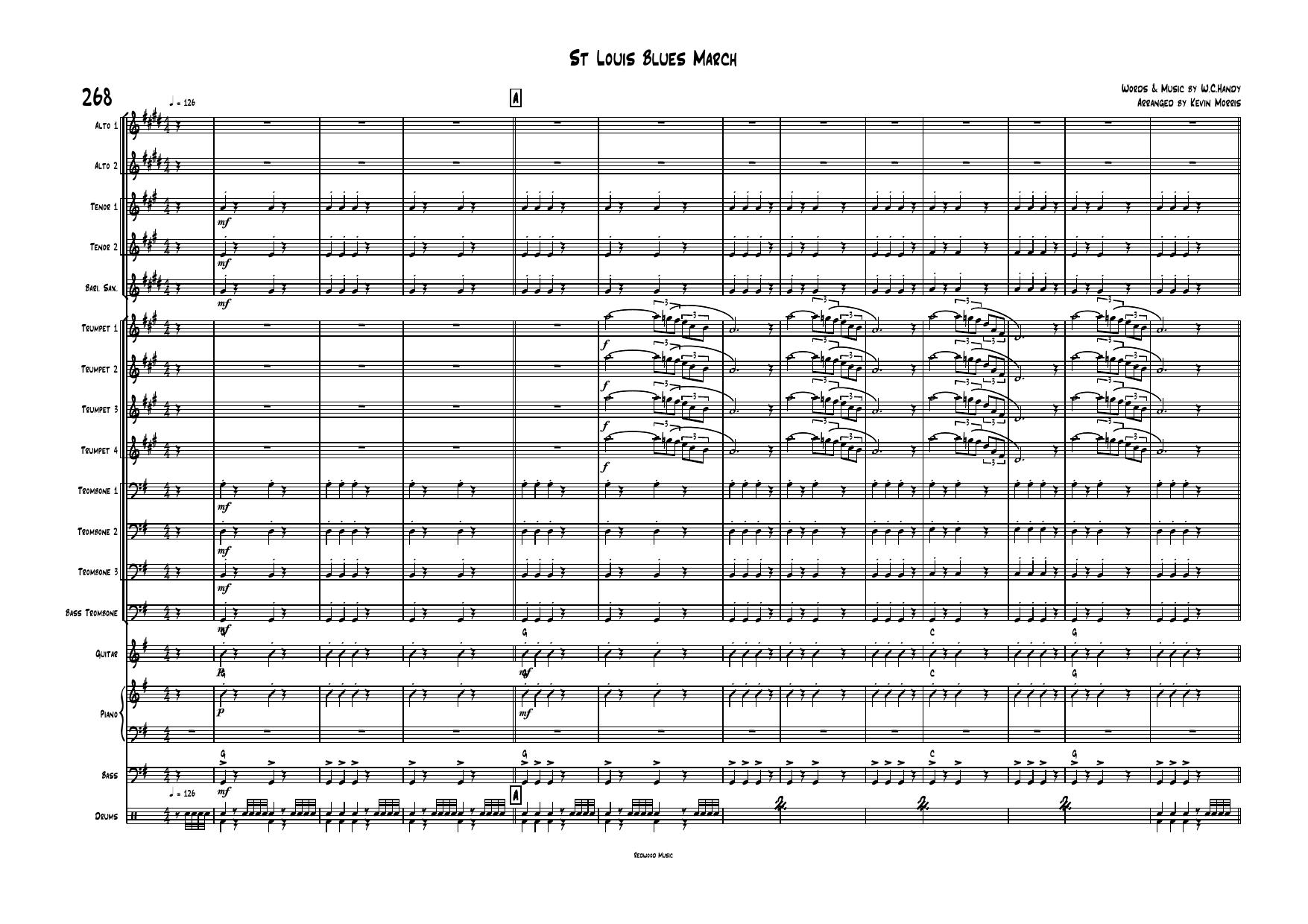
St.Louis Blues March (K.Morris)
Composed by W. C. Handy
Arranged by K.Morris
- Ensemble: Big Band
- Style: Jazz Standard
- Pages: 46
- Instruments (17): Alto Saxophone 1, Alto Saxophone 2, Tenor Saxophone 1, Tenor Saxophone 2, Baritone Saxophone, Trumpet 1, Trumpet 2, Trumpet 3, Trumpet 4, Trombone 1, Trombone 2, Trombone 3, Bass Trombone, Guitar, Piano, Bass, Drums
- Difficulty: medium
- Content: Individual Parts
- Format: PDF Download (Instant)
- Price: $24.99
W.C. Handy’s iconic 1914 composition forever altered the landscape of American music by bridging the gap between rural folk blues and structured urban composition. Originally published as a twelve-bar blues with a distinct habanera-tinged intermediate strain, the tune quickly became a cornerstone of the early jazz canon, immortalized by legends like Bessie Smith, Louis Armstrong, and Glenn Miller—whose 1943 swing-march hybrid popularized the military-inflected big band treatment. This enduring masterpiece remains a vital pedagogical and performance vehicle, celebrated for its infectious interplay between melancholy blues phrasing and driving, celebratory momentum. K.Morris captures this duality through a high-energy, swinging big band treatment that marries traditional New Orleans counterpoint with mid-century brass firepower. Set in a driving 4/4 meter with a buoyant, medium-up swing feel, the arrangement opens with a swaggering low-register vamp before introducing the primary theme in the lower reeds. The mood shifts dynamically across successive strains, transitioning from sultry, muted brass statements to an explosive, full-ensemble shout chorus that showcases rich extended harmonies and tight, interlocking cross-rhythms. The orchestration deliberately balances vintage 1920s flavor with contemporary big band punch, evoking a celebratory atmosphere that is both nostalgic and fiercely modern. The arrangement features robust sectional writing, highlighted by a tightly knit sax soli that reinterprets Handy’s secondary melodies with bebop-inflected chromaticism. Trumpets and trombones trade crisp call-and-response figures, while flexible solo space is provided over standard blues changes, allowing featured improvisers in the alto saxophone or trumpet sections to stretch out. Technical demands center on rhythmic precision, particularly in executing dotted eighth-sixteenth swing subdivisions cleanly at a brisk tempo, alongside agile fingerwork in the woodwind section during transitional modulations. The interplay between section solis and roaring tutti blocks ensures every chair remains actively engaged from downbeat to final chord. Advanced high school ensembles possessing confident section leaders, as well as college and community jazz orchestras looking to inject historical depth and crowd-pleasing energy into a program, will find this chart exceptionally rewarding. The scoring provides ample educational opportunities for students to study early jazz form while developing advanced articulation, blend, and stylistic versatility. Conductor-friendly score layouts and balanced voice-leading make it an accessible yet challenging centerpiece for festival performances and formal concert settings alike. Achieving an authentic performance of this chart requires meticulous attention to articulation and dynamic contrast. The tempo should remain steady and driving, avoiding any tendency to rush during the high-energy shout choruses. Brass players should utilize cup and bucket mutes where indicated to capture the classic early-jazz textural palette, ensuring that background figures remain supportive rather than overpowering the soloists. Rhythm section players are the engine of this arrangement: the drummer should maintain a crisp, feathered bass drum pulse with a lively ride cymbal pattern that emphasizes beats two and four, while the bassist walks a solid, quarter-note line emphasizing root-fifth motion with subtle chromatic approaches. Rehearsals should initially isolate the tricky rhythmic unisons between the saxophones and brass to lock in articulation styles—balancing short, clipped staccatos with smooth, blues-inflected slurs. Directors should encourage soloists to reference both traditional blues vocabulary and early swing phrasing to honor Handy's foundational blueprint while embracing Morris's vibrant contemporary harmonic extensions. Q: What instruments and parts are included in this big band arrangement? A: The complete 46-page package contains a full conductor score and 17 individual instrumental parts: Alto Saxophone 1, Alto Saxophone 2, Tenor Saxophone 1, Tenor Saxophone 2, Baritone Saxophone, four Trumpet parts, four Trombone parts, Guitar, Piano, Bass, and Drums. Q: What is the difficulty level of this specific arrangement? A: This chart is graded as advanced intermediate to advanced, making it ideal for skilled high school, collegiate, and community big bands that have strong section leaders and confident improvisers. Q: How does this arrangement relate to the historical origins of the tune? A: It honors W.C. Handy’s 1914 blues masterpiece while incorporating the high-energy swing-march performance traditions popularized during the mid-century big band era. Q: What makes K.Morris's arrangement unique compared to other versions? A: It features a distinctive blend of vintage New Orleans counterpoint, contemporary extended harmonies, a dynamic sax soli, and an explosive shout chorus that reinterprets the classic themes with modern big band punch. Q: What is the recommended performance tempo and duration for this piece? A: The arrangement is set to a brisk, driving medium-up swing feel (approximately 144-152 BPM) and typically runs around 3.5 to 4.5 minutes depending on the length of the improvised solo choruses.
Questions and answers
- What is included in the St.Louis Blues March (K.Morris) PDF?
- The verified current file contains a conductor score and individual parts across 46 pages.
- How many instruments or parts are listed for St.Louis Blues March (K.Morris)?
- The verified instrumentation list contains 17 entries for this Big Band arrangement.
- Who is credited for St.Louis Blues March (K.Morris)?
- Composer: W. C. Handy. Arranger: K.Morris.
- What difficulty is listed for St.Louis Blues March (K.Morris)?
- The verified difficulty level is medium.
- What style is listed for St.Louis Blues March (K.Morris)?
- The catalog lists the style as Jazz Standard.
- Can I preview St.Louis Blues March (K.Morris) before buying?
- Yes. The product page provides a preview generated from the current PDF file.
- How is St.Louis Blues March (K.Morris) delivered?
- After successful payment, the digital PDF is made available for download. The displayed price is $24.99.
Musicians Also Search For
St.Louis Blues March K.Morris PDF • St.Louis Blues March K.Morris sheet music • St.Louis Blues March arranged by K.Morris • K.Morris big band charts • K.Morris jazz arrangements PDF • St.Louis Blues March W. C. Handy sheet music • St.Louis Blues March W. C. Handy big band arrangements • W. C. Handy big band charts • St.Louis Blues March big band arrangements • St.Louis Blues March big band PDF download • St.Louis Blues March jazz sheet music • big band sheet music download • St.Louis Blues March conductor score PDF • St.Louis Blues March individual parts download • St.Louis Blues March sheet music PDF • St.Louis Blues March Jazz Standard charts • Jazz Standard big band arrangements • buy St.Louis Blues March sheet music • download St.Louis Blues March PDF • St.Louis Blues March jazz charts • best K.Morris big band arrangements • W. C. Handy arranged by K.Morris • St.Louis Blues March printable sheet music • big band repertoire PDF