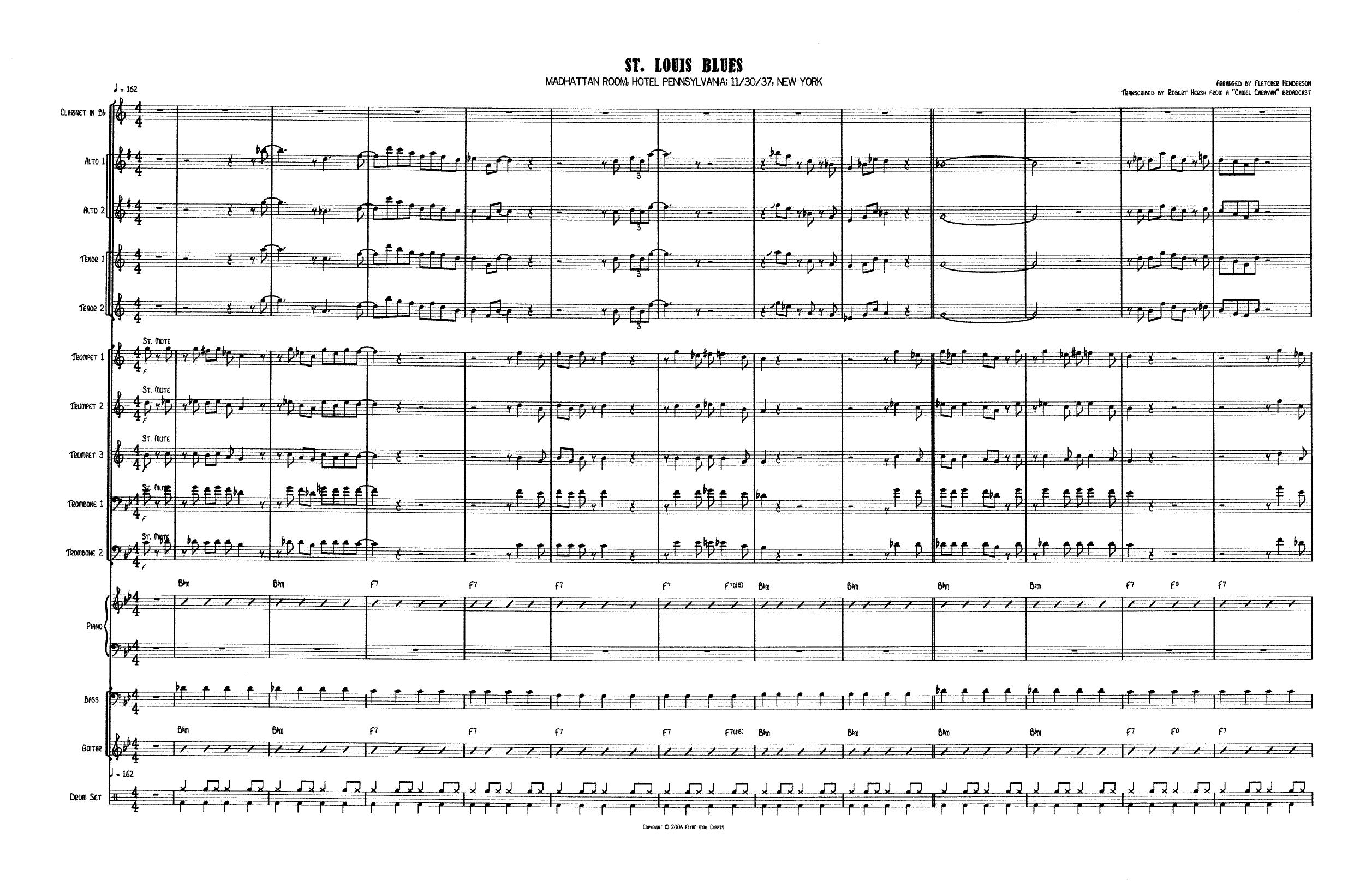
St. Louis Blues (F.Henderson) sheet music preview

St. Louis Blues (F.Henderson)

Composed by W. C. Handy

Arranged by Fletcher Henderson

  • Ensemble: Big Band
  • Pages: 15
  • Instruments (14): Clarinet in Bb, Alto Saxophone 1, Alto Saxophone 2, Tenor Saxophone 1, Tenor Saxophone 2, Trumpet 1, Trumpet 2, Trumpet 3, Trombone 1, Trombone 2, Piano, Bass, Guitar, Drum Set
  • Difficulty: easy
  • Content: Individual Parts
  • Format: PDF Download (Instant)
  • Price: $24.99

W.C. Handy’s immortal 1914 composition "St. Louis Blues" stands as one of the foundational pillars of both blues and early jazz, bridging the gap between rural folk traditions and sophisticated urban orchestration. When Fletcher Henderson turned his arranging genius toward the tune, he transformed the iconic 12-bar and tango-infused classic into a masterclass of 1920s and 30s big band architecture. Recorded and performed by Henderson’s pioneering orchestra—which famously featured luminaries like Louis Armstrong and later Red Allen and Coleman Hawkins—this arrangement captures the transitional pivot from collective New Orleans polyphony to the structured, section-driven brilliance of the swing era. It embodies a rich slice of Harlem Renaissance nightlife, channeling the smoky, sultry atmosphere of New York's historic ballrooms into a tightly wound orchestral statement. Musically, the chart operates at a steady, driving medium swing tempo infused with the stately swagger characteristic of Henderson’s finest work. The arrangement opens with the unmistakable habanera rhythm of Handy’s verse before locking into a robust 4/4 swing feel that alternates between melancholic blues tonalities and triumphant, brass-heavy jubilation. The mood shifts dynamically from moody, low-register clarinet and trombone interplay to explosive, high-energy shout choruses that showcase Henderson’s peerless command of tension and release. Texturally, the piece relies heavily on call-and-response frameworks between the reed and brass sections, utilizing rich, block-chord voicings that give the ensemble a massive, unified voice despite the relatively compact instrumentation of the early big band era. Henderson’s signature approach is immediately evident in his treatment of the harmonic structure and section writing. Rather than relying on simple accompaniment figures, he weaves counter-melodies into the inner voices, giving the rhythm and horn sections constant momentum. Solos are seamlessly integrated into the arrangement's architectural flow, allowing designated instrumentalists to step out over rolling stride-piano-style voicings and punchy horn riffs. Technical challenges center around stylistic authenticity: achieving an even, unhurried swing eighth-note feel, mastering the dynamic contrasts between delicate ensemble passages and roaring tutti declarations, and executing clean articulation in the rapid-fire scalar runs. The sheer joy of the chart lies in its historical authenticity, offering players a direct tactile connection to the birth of big band swing. Advanced high school, collegiate, and professional jazz ensembles will find this arrangement an exceptional vehicle for historical programming and stylistic education. While the raw technical demands on individual players are moderate compared to later bebop or contemporary charts, the ensemble demands a high degree of stylistic maturity, section cohesion, and rhythmic precision. Directors looking to instill a deep appreciation for the roots of jazz orchestration will find that Henderson’s "St. Louis Blues" serves as both a crowd-pleasing concert highlight and an invaluable pedagogical tool for teaching early swing articulation and balance. Executing Fletcher Henderson’s arrangement of "St. Louis Blues" requires an authentic early-swing mindset, prioritizing a relaxed, unforced macro-pulse over aggressive modern articulation. The tempo should remain anchored around a comfortable medium-swing groove; pushing the metronome too high robs the chart of its inherent blues swagger. Section leaders must emphasize a rounded, warm tone quality, particularly in the brass, avoiding the piercing brightness associated with post-war big band writing. Plunger mutes and gentle growls should be utilized where appropriate in the brass sections to mimic the vocalized, expressive effects popularized by Henderson’s early sidemen. Rehearsal should begin by isolating the rhythm section to lock in the foundational groove, ensuring the bass outlines the fundamental two-beat or walking patterns with crisp articulation. Horn players must meticulously match vibrato widths—using a narrower, period-appropriate vibrato—and pay close attention to dynamic shading during the transition from the habanera-inflected opening verse into the driving swing choruses. Balance is critical during the call-and-response episodes; the accompanying section must drop its volume dynamically to let the counter-melodies breathe without forcing the sound. Q: What instruments and parts are included in this arrangement? A: The chart is scored for a 15-instrument big band instrumentation, featuring three trumpets, two trombones, and a standard complement of reed and rhythm section parts spanning 15 total pages of music. Q: What is the difficulty level of this Fletcher Henderson arrangement? A: It is ideally suited for advanced high school, collegiate, and professional jazz ensembles that possess a strong grasp of early swing phrasing, stylistic balance, and ensemble listening. Q: What is the historical style and context of this piece? A: This arrangement reflects the transitional big band style of the late 1920s and early 1930s, bridging W.C. Handy’s foundational 1914 blues classic with the sophisticated section writing pioneered by Fletcher Henderson in Harlem. Q: What makes this specific arrangement unique? A: It stands out for its seamless integration of the original tune's tango-esque verse rhythm into a driving swing framework, alongside Henderson’s signature harmonic voicings and intricate section-against-section counterpoint. Q: What is the performance duration and recommended tempo feel? A: The arrangement runs approximately 3 to 4 minutes and is anchored by a steady, relaxed medium-swing tempo feel that prioritizes blues phrasing and dynamic contrast over sheer velocity.

Questions and answers

What is included in the St. Louis Blues (F.Henderson) PDF?
The verified current file contains a conductor score across 15 pages.
How many instruments or parts are listed for St. Louis Blues (F.Henderson)?
The verified instrumentation list contains 14 entries for this Big Band arrangement.
Who is credited for St. Louis Blues (F.Henderson)?
Composer: W. C. Handy. Arranger: Fletcher Henderson.
What difficulty is listed for St. Louis Blues (F.Henderson)?
The verified difficulty level is easy.
Can I preview St. Louis Blues (F.Henderson) before buying?
Yes. The product page provides a preview generated from the current PDF file.
How is St. Louis Blues (F.Henderson) delivered?
After successful payment, the digital PDF is made available for download. The displayed price is $24.99.

Musicians Also Search For

St. Louis Blues Fletcher Henderson PDFSt. Louis Blues Fletcher Henderson sheet musicSt. Louis Blues arranged by Fletcher HendersonFletcher Henderson big band chartsFletcher Henderson jazz arrangements PDFSt. Louis Blues W. C. Handy sheet musicSt. Louis Blues W. C. Handy big band arrangementsW. C. Handy big band chartsSt. Louis Blues big band arrangementsSt. Louis Blues big band PDF downloadSt. Louis Blues jazz sheet musicbig band sheet music downloadSt. Louis Blues conductor score PDFSt. Louis Blues sheet music PDFbuy St. Louis Blues sheet musicdownload St. Louis Blues PDFSt. Louis Blues jazz chartsbest Fletcher Henderson big band arrangementsW. C. Handy arranged by Fletcher HendersonSt. Louis Blues printable sheet musicbig band repertoire PDF

All arrangements by Fletcher Henderson All W. C. Handy sheet music