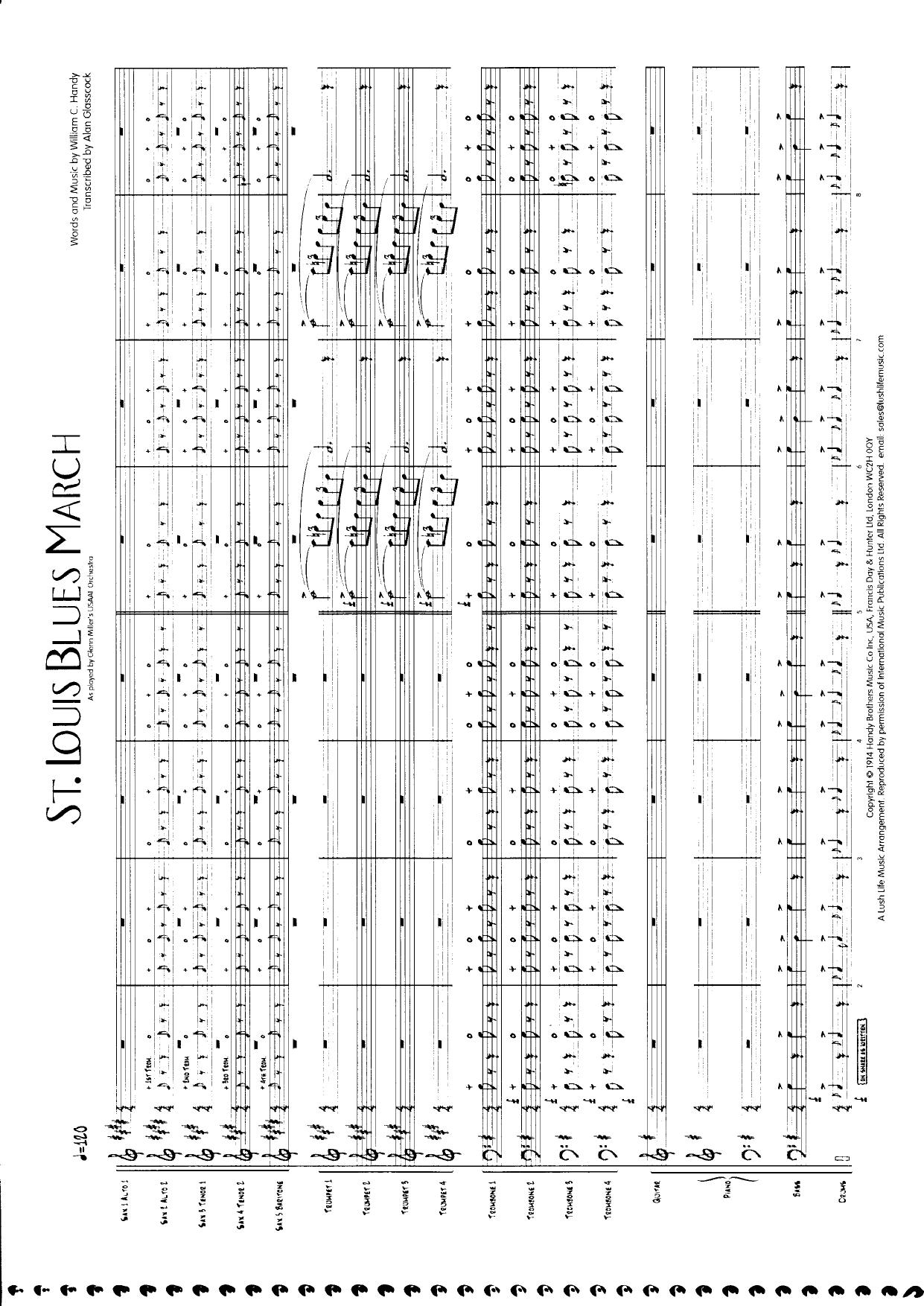
St.Louis Blues March (A.Glasscock) sheet music preview

St.Louis Blues March (A.Glasscock)

Composed by W.C. Handy

Arranged by A.Glasscock

  • Ensemble: Big Band
  • Style: Jazz Standard
  • Pages: 18
  • Instruments (17): Alto Saxophone 1, Alto Saxophone 2, Tenor Saxophone 1, Tenor Saxophone 2, Baritone Saxophone, Trumpet 1, Trumpet 2, Trumpet 3, Trumpet 4, Trombone 1, Trombone 2, Trombone 3, Trombone 4, Piano, Guitar, Bass, Drum Set
  • Difficulty: easy
  • Content: Individual Parts
  • Format: PDF Download (Instant)
  • Price: $24.99

W.C. Handy's "St. Louis Blues," composed in 1914, stands as one of the earliest and most enduring pillars of American music, often hailed as "the first published blues." Its innovative blend of blues form with ragtime and march elements not only captivated audiences but also laid foundational groundwork for the nascent jazz genre. The tune quickly became a global phenomenon, famously popularized by artists like Bessie Smith, Louis Armstrong, and Glenn Miller, transcending racial and stylistic boundaries to become a true jazz standard. Its iconic AAB blues lyrical structure, coupled with a distinct minor-key section, provides a timeless narrative of longing and resilience, making it instantly recognizable and deeply resonant across generations. This particular arrangement, "St. Louis Blues March" by A.Glasscock, reimagines Handy’s classic through a vibrant, medium-up swing lens, transforming its melancholic core into an energetic big band showcase. A.Glasscock’s arrangement masterfully captures the essence of a classic big band march, infusing it with a driving medium-up swing feel at approximately 152 BPM. The piece is primarily set in the key of G minor/Bb major, maintaining the original's characteristic bluesy tonality while elevating its energy. Glasscock employs a sophisticated yet accessible approach, featuring a powerful brass fanfare introduction that immediately sets a grand, celebratory mood. The melody is initially presented by the alto saxophone section, offering a smooth, lyrical interpretation before being passed to the full saxophone section in a rich, harmonized soli. The arrangement builds dynamically, incorporating a classic big band shout chorus that features layered brass figures against driving saxophone lines, culminating in a powerful, full-ensemble statement. The mood is one of jubilant swing, evoking the golden age of big band while remaining fresh and engaging. Distinctive to Glasscock's treatment are the carefully crafted voicings and dynamic contrasts that highlight the various sections of the big band. The arranger skillfully uses call-and-response patterns between the brass and saxophones, adding textural interest and maintaining momentum. While there are no extended improvised solo sections, the arrangement offers ample opportunity for individual sections to shine through intricate soli passages and powerful ensemble figures. The technical demands are moderate, focusing on precision, blend, and articulation within the swing idiom. Brass players will encounter strong, sustained lines and punchy accents, while saxophones navigate flowing melodic phrases and tight harmonies. The rhythm section provides a solid, driving foundation, essential for maintaining the infectious swing feel. This arrangement is particularly rewarding for its ability to transform a familiar melody into a high-energy, crowd-pleasing big band spectacle, making it a standout addition to any concert program. This arrangement is ideally suited for advanced high school, collegiate, and community jazz ensembles. Its blend of classic appeal and engaging big band writing makes it an excellent choice for developing ensemble precision, dynamic control, and a cohesive swing feel. While not overly complex in terms of individual improvisation, the ensemble challenges lie in achieving tight section work, accurate articulation, and a unified interpretation of the swing rhythm. Bands seeking to perform a well-known standard with a fresh, energetic big band treatment will find "St. Louis Blues March" by A.Glasscock to be an immensely satisfying and impactful selection. Conductors should aim for a consistent medium-up swing feel, approximately quarter note = 152 BPM, emphasizing a strong, driving pulse from the rhythm section. Articulation is paramount: ensure brass accents are sharp and precise, while saxophone lines maintain a smooth, connected swing legato. Pay close attention to dynamic contrasts, particularly between the initial melodic statements and the building intensity of the shout chorus, utilizing the full dynamic range of the ensemble. Rehearsal time should focus on achieving tight ensemble blend within the saxophone soli sections and unified attacks and releases in the brass figures. The rhythm section must maintain a relentless, yet flexible, swing groove throughout, providing a solid foundation for the horns. No special techniques like plunger mutes or falls are explicitly notated, allowing the ensemble to focus on fundamental big band execution. Q: What instruments are included in this arrangement? A: This big band arrangement includes parts for 17 instruments: Alto Saxophone 1, Alto Saxophone 2, Tenor Saxophone 1, Tenor Saxophone 2, Baritone Saxophone, Trumpet 1, Trumpet 2, Trumpet 3, Trumpet 4, Trombone 1, Trombone 2, Trombone 3, Trombone 4, Piano, Bass, Drums, and Guitar. A full conductor score is also included. Q: What is the difficulty level of "St. Louis Blues March (A.Glasscock)"? A: This arrangement is rated as suitable for advanced high school, collegiate, and community jazz ensembles. It presents moderate technical challenges focused on ensemble precision, blend, and achieving a cohesive swing feel rather than extensive improvisation. Q: What is the musical style and historical context of this arrangement? A: This is a big band jazz arrangement of W.C. Handy's "St. Louis Blues," a foundational jazz standard composed in 1914. A.Glasscock's treatment reimagines the piece with a medium-up swing feel, evoking the classic big band era while maintaining the original's bluesy character. Q: What makes A.Glasscock's arrangement of "St. Louis Blues March" unique? A: Glasscock's arrangement is distinctive for its transformation of the original into an energetic big band march with a driving medium-up swing feel. It features powerful brass fanfares, rich saxophone solis, and a classic big band shout chorus, creating a celebratory and dynamic interpretation without relying on extended improvised solos. Q: What is the typical performance duration and tempo for this piece? A: The typical performance duration for "St. Louis Blues March (A.Glasscock)" is approximately 3-4 minutes. It is designed to be performed at a medium-up swing tempo, around 152 beats per minute.

Musicians Also Search For

St.Louis Blues March A.Glasscock PDFSt.Louis Blues March A.Glasscock sheet musicSt.Louis Blues March arranged by A.GlasscockA.Glasscock big band chartsA.Glasscock jazz arrangements PDFSt.Louis Blues March W.C. Handy sheet musicSt.Louis Blues March W.C. Handy big band arrangementW.C. Handy big band chartsSt.Louis Blues March big band arrangementSt.Louis Blues March big band PDF downloadSt.Louis Blues March jazz ensemble sheet musicbig band sheet music instant downloadSt.Louis Blues March conductor score PDFSt.Louis Blues March individual parts downloadSt.Louis Blues March sheet music with partsSt.Louis Blues March Jazz Standard chartJazz Standard big band arrangementsbuy St.Louis Blues March sheet music onlinedownload St.Louis Blues March PDFSt.Louis Blues March jazz chartbest A.Glasscock big band arrangementsW.C. Handy songs arranged by A.GlasscockSt.Louis Blues March printable sheet musicbig band repertoire PDF

All arrangements by A.Glasscock All W.C. Handy sheet music