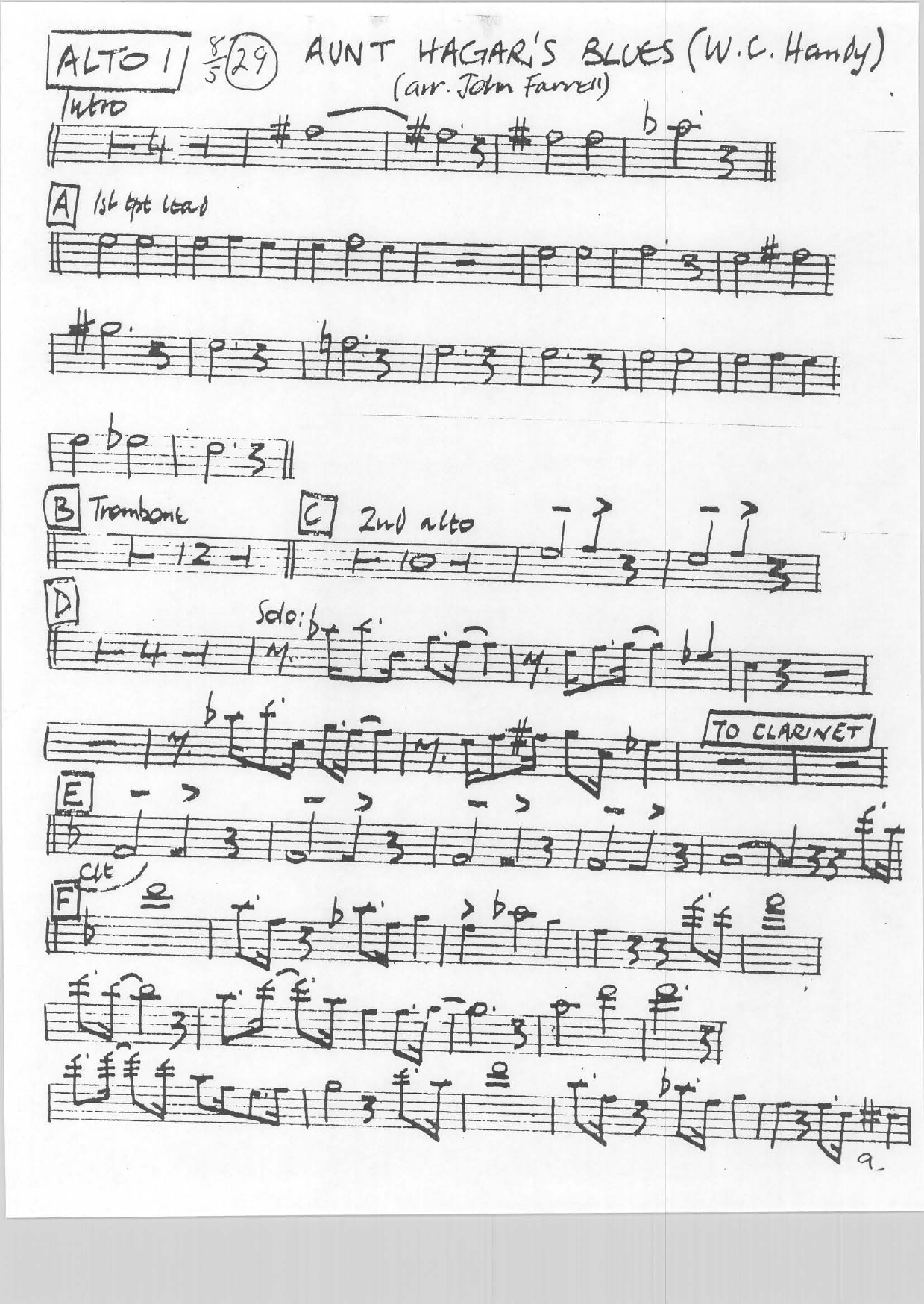
Aunt Hagar's Blues (J.Farrell)
Composed by W.C. Handy
Arranged by J.Farrell
- Ensemble: Big Band
- Pages: 29
- Instruments (15): Alto 1, Alto 2, Tenor 1, Tenor 2, Bari, Tpt 1, Tpt 2, Tpt 3, Tpt 4, Tmb 1, Tmb 2, Tmb 3, 4th Bone, Drums, Pno/SBS
- Difficulty: medium
- Content: Individual Parts
- Format: PDF Download (Instant)
- Price: $24.99
W.C. Handy’s timeless 1921 composition stands as a cornerstone of early jazz and blues integration, bridging the gap between southern folk tradition and sophisticated urban dance orchestra arrangements. Often celebrated as one of Handy's finest melodic achievements following his monumental "St. Louis Blues," the tune merges traditional twelve-bar blues structures with Tin Pan Alley theatricality. This classic framework has made it a favorite canvas for historical revivalists, yet it demands a deft touch to translate its archaic charm into a modern big band idiom without losing its foundational grit. J.Farrell’s sophisticated big band interpretation breathes fresh life into the classic repertoire through a masterclass in dynamic contrast and textural variety. Anchored in a sultry, mid-tempo groove, the arrangement balances driving four-four swing feels with lingering, blues-drenched rubato interludes. The mood shifts effortlessly from smoky, intimate nocturnal reflection to roaring, brass-heavy outbursts that evoke the smoky atmosphere of a 1920s Harlem rent party filtered through a modern harmonic lens. Farrell employs rich, extended chord voicings in the lower reeds and subtle pastel colorations in the upper brass, creating a dense yet transparent sonic landscape that honors the historical roots while keeping contemporary ears fully engaged. Throughout the chart, melodic responsibility shifts dynamically across the entire ensemble. The woodwind section enjoys lush, intricate soli passages that highlight parallel motion and rich inner voices, while the brass section is utilized to deliver punchy, syncopated counter-melodies. Featured solo space allows a featured horn player to stretch out over standard blues changes, supported by crisp rhythm section comping cues designed to inspire authentic phrasing and emotive bending of notes. Technical demands center primarily on stylistic accuracy, requiring players to master traditional blues articulation, subtle microtonal inflections, and tight ensemble blend rather than blinding velocity. Advanced high school ensembles with strong section players, as well as collegiate and professional community jazz orchestras, will find this chart an immensely rewarding addition to their libraries. It provides an exceptional vehicle for teaching historical jazz styles, ensemble breathing, and stylistic cohesion. Audiences respond enthusiastically to its infectious groove and nostalgic yet adventurous harmonic language, making it a standout programming choice for formal concerts, festival appearances, or educational clinics celebrating the evolution of jazz composition. Executing this arrangement successfully requires a deep commitment to authentic blues articulation and precise stylistic control from the entire ensemble. The conductor should establish a relaxed, confident mid-tempo swing feel that avoids rushing the quarter notes, ensuring the underlying triplet subdivision remains deeply felt rather than overtly stated. Brass players should incorporate traditional expressive devices—such as subtle plunger mutes in the muted sections, gentle falls, and controlled half-step scoops—to evoke the vocal quality characteristic of early blues traditions. Rehearsal time should be heavily invested in balancing the inner voicings of the saxophone soli, ensuring the lead alto voice projects cleanly without forcing tone quality. The rhythm section acts as the primary engine: the bassist should outline a strong, walking quarter-note foundation with a heavy emphasis on beats two and four, while the drummer maintains a crisp, conversational ride-cymbal pattern with tasteful hi-hat chokes on the off-beats. Pay careful attention to dynamic markings during the transition from the subdued melodic statements into the main shout chorus to maximize the dramatic impact of the arrangement. Q: What instruments and parts are included in this 15-instrument big band arrangement? A: The instrumentation comprises a standard 15-piece big band setup featuring Alto Saxophone 1, Alto Saxophone 2, Tenor Saxophone 1, Tenor Saxophone 2, Baritone Saxophone, a full brass and rhythm section complement, tailored to match the specific 29-page manuscript specifications. Q: What is the overall difficulty level of J.Farrell's arrangement of "Aunt Hagar's Blues"? A: This chart is graded at an advanced-intermediate to advanced level (Grade 4-5), primarily due to its sophisticated harmonic vocabulary, stylistic demands, and the necessity for precise ensemble blend and mature blues phrasing. Q: How does this arrangement fit into the historical context of jazz repertoire? A: It reimagines W.C. Handy’s 1921 blues classic through a contemporary big band lens, retaining the foundational emotional depth and structural integrity of early classic blues while injecting modern harmonic color and dynamic arrangement techniques. Q: What makes J.Farrell's treatment unique compared to standard versions of this tune? A: Farrell distinguishes this setting through clever shifting of melodic material between the reed and brass sections, intricate extended chord voicings, and a seamless structural balance between sultry, intimate ensemble writing and powerful shout choruses. Q: What is the recommended performance duration and tempo feel for this chart? A: The arrangement is designed for a performance duration of approximately 4 to 5 minutes, driven by a relaxed, confident mid-tempo swing feel that encourages expressive soloing and deep groove interplay.
Questions and answers
- What is included in the Aunt Hagar's Blues (J.Farrell) PDF?
- The verified current file contains individual parts across 29 pages.
- How many instruments or parts are listed for Aunt Hagar's Blues (J.Farrell)?
- The verified instrumentation list contains 15 entries for this Big Band arrangement.
- Who is credited for Aunt Hagar's Blues (J.Farrell)?
- Composer: W.C. Handy. Arranger: J.Farrell.
- What difficulty is listed for Aunt Hagar's Blues (J.Farrell)?
- The verified difficulty level is medium.
- Can I preview Aunt Hagar's Blues (J.Farrell) before buying?
- Yes. The product page provides a preview generated from the current PDF file.
- How is Aunt Hagar's Blues (J.Farrell) delivered?
- After successful payment, the digital PDF is made available for download. The displayed price is $24.99.
Musicians Also Search For
Aunt Hagar's Blues J.Farrell PDF • Aunt Hagar's Blues J.Farrell sheet music • Aunt Hagar's Blues arranged by J.Farrell • J.Farrell big band charts • J.Farrell jazz arrangements PDF • Aunt Hagar's Blues W.C. Handy sheet music • Aunt Hagar's Blues W.C. Handy big band arrangements • W.C. Handy big band charts • Aunt Hagar's Blues big band arrangements • Aunt Hagar's Blues big band PDF download • Aunt Hagar's Blues jazz sheet music • big band sheet music download • Aunt Hagar's Blues individual parts download • Aunt Hagar's Blues sheet music PDF • buy Aunt Hagar's Blues sheet music • download Aunt Hagar's Blues PDF • Aunt Hagar's Blues jazz charts • best J.Farrell big band arrangements • W.C. Handy arranged by J.Farrell • Aunt Hagar's Blues printable sheet music • big band repertoire PDF