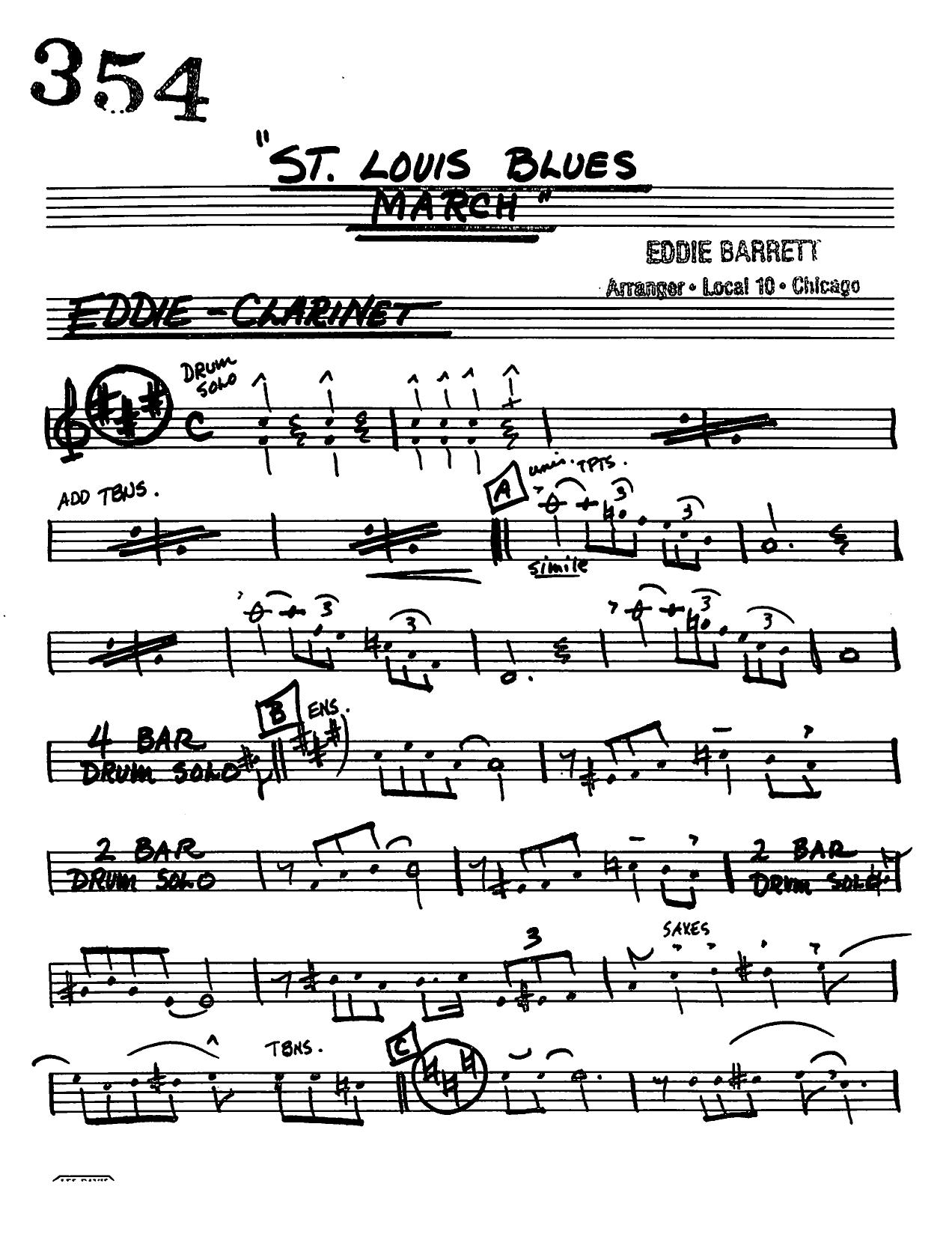
St.Louis Blues March (E.Barrett)
Composed by W. C. Handy
Arranged by E.Barrett
- Ensemble: Big Band
- Style: Jazz Standard
- Pages: 71
- Instruments (18): Clarinet, Alto Saxophone I, Alto Saxophone II, Tenor Saxophone I, Tenor Saxophone II, Baritone Saxophone, Trumpet I, Trumpet II, Trumpet III, Trumpet IV, Trombone I, Trombone II, Trombone III (Bass), Trombone IV, Piano, Guitar, Bass, Drums
- Difficulty: advanced
- Content: Individual Parts
- Format: PDF Download (Instant)
- Price: $24.99
W.C. Handy’s legendary 1914 composition "St. Louis Blues" underwent one of its most fascinating transformations when adapted into a high-energy march format, famously popularized by Glenn Miller and other mid-century swing orchestras during World War II. Merging the foundational 12-bar blues structure and habanera-tinged tango rhythm of Handy's original masterpiece with crisp, military-inspired brass cadences and driving big band swing, this hybrid style bridges early New Orleans tradition with the polished precision of the swing era. It stands as a vibrant testament to how early twentieth-century vernacular music continually reinvented itself across shifting commercial landscapes. Bouncing forward with an infectious, driving medium-up tempo two-beat feel that effortlessly transitions into a swinging four-bar groove, E.Barrett’s arrangement captures an atmosphere of jubilant swagger and brass-heavy bombastic power. The key centers shift logically to maximize bright horn voicings, evoking a celebratory atmosphere reminiscent of a New Orleans parade meeting a 1940s USO dance hall. The mood is irrepressibly optimistic, high-spirited, and rhythmically punchy, featuring cascading counter-melodies and crisp dynamic contrasts that keep both performers and listeners completely engaged from the opening snare roll to the final chord. E.Barrett approaches the classic material with a keen ear for traditional big band texture while injecting modern harmonic color into the brass and reed sections. Rather than treating the march sections as stiff or academic, the arranger infuses them with syncopated blues accents, clever saxophone solis, and rich, tertian-extended chord voicings in the trombones. The arrangement boasts a magnificent, multi-tiered shout chorus that builds steadily in volume and density, utilizing traditional call-and-response figures between the trumpets and saxophones before culminating in a roaring ensemble tutti. The melody is shared democratically across the 18-instrument ensemble, opening with a traditional clarinet-led lead before passing to the robust alto and tenor saxophones. Improvisational opportunities are carved out naturally within the form, allowing featured soloists space to stretch out over standard blues changes. Technically, the charts demand clean articulation, agile fingerwork in the woodwinds to navigate rapid scalar passages, and strong endurance from the lead trumpet. Advanced high school bands, collegiate ensembles, and professional community big bands will find this chart immensely rewarding, as it offers a brilliant crowd-pleasing vehicle that balances historical reverence with sheer theatrical excitement. Balancing the stylistic duality between a crisp march feel and relaxed swing is the primary interpretive challenge of this arrangement. Conductors should ensure the opening sections maintain a buoyant, dotted-eighth-and-sixteenth march cadence without sounding rigid, allowing the rhythm section to loosen up considerably once the underlying swing groove takes over. Brass players should utilize appropriate section mutes (cup and straight mutes where indicated) to achieve authentic period coloration, paying close attention to dynamic shading during the background figures. The saxophone section must articulate slurred-to-tongued passages with absolute uniformity, especially during the intricate soli lines. Rehearsal should begin with the rhythm section isolating the transition between the two-beat march feel and the four-bar swing groove to ensure seamless momentum. Work drill-style on the dynamic peaks of the shout chorus, ensuring the accompanying brass do not obscure the lead trumpet and upper-register saxophone counterlines. Q: What instruments and parts are included in this big band arrangement? A: The 71-page score and parts package is scored for a standard 18-instrument big band instrumentation, featuring full sections for reeds (including Clarinet, Alto Saxophone 1 & 2, Tenor Saxophone 1 & 2), brass, and a complete rhythm section. Q: What is the difficulty level of E.Barrett’s "St. Louis Blues March"? A: This arrangement is graded as medium-advanced (Grade 4), making it ideal for accomplished high school groups, collegiate jazz orchestras, and professional community big bands looking for a substantive challenge. Q: How does this arrangement fit into the historical context of the jazz standard? A: It bridges W.C. Handy’s 1914 blues masterpiece with the high-energy swing-march adaptations popularized by military and civilian big bands during the 1940s, blending traditional blues form with march cadences. Q: What makes this specific arrangement by E.Barrett unique? A: It stands out through its clever integration of syncopated blues inflections into a rigid march framework, highlighted by a dynamic, multi-tiered shout chorus and sophisticated harmonic voicings for the trombones. Q: What is the recommended performance tempo and duration for this chart? A: The arrangement is designed to be performed at a brisk, energetic medium-up tempo of approximately 144 to 152 BPM, resulting in a performance duration of roughly 3.5 to 4 minutes.
Questions and answers
- What is included in the St.Louis Blues March (E.Barrett) PDF?
- The verified current file contains individual parts across 71 pages.
- How many instruments or parts are listed for St.Louis Blues March (E.Barrett)?
- The verified instrumentation list contains 18 entries for this Big Band arrangement.
- Who is credited for St.Louis Blues March (E.Barrett)?
- Composer: W. C. Handy. Arranger: E.Barrett.
- What difficulty is listed for St.Louis Blues March (E.Barrett)?
- The verified difficulty level is advanced.
- What style is listed for St.Louis Blues March (E.Barrett)?
- The catalog lists the style as Jazz Standard.
- Can I preview St.Louis Blues March (E.Barrett) before buying?
- Yes. The product page provides a preview generated from the current PDF file.
- How is St.Louis Blues March (E.Barrett) delivered?
- After successful payment, the digital PDF is made available for download. The displayed price is $24.99.
Musicians Also Search For
St.Louis Blues March E.Barrett PDF • St.Louis Blues March E.Barrett sheet music • St.Louis Blues March arranged by E.Barrett • E.Barrett big band charts • E.Barrett jazz arrangements PDF • St.Louis Blues March W. C. Handy sheet music • St.Louis Blues March W. C. Handy big band arrangements • W. C. Handy big band charts • St.Louis Blues March big band arrangements • St.Louis Blues March big band PDF download • St.Louis Blues March jazz sheet music • big band sheet music download • St.Louis Blues March individual parts download • St.Louis Blues March sheet music PDF • St.Louis Blues March Jazz Standard charts • Jazz Standard big band arrangements • buy St.Louis Blues March sheet music • download St.Louis Blues March PDF • St.Louis Blues March jazz charts • best E.Barrett big band arrangements • W. C. Handy arranged by E.Barrett • St.Louis Blues March printable sheet music • big band repertoire PDF