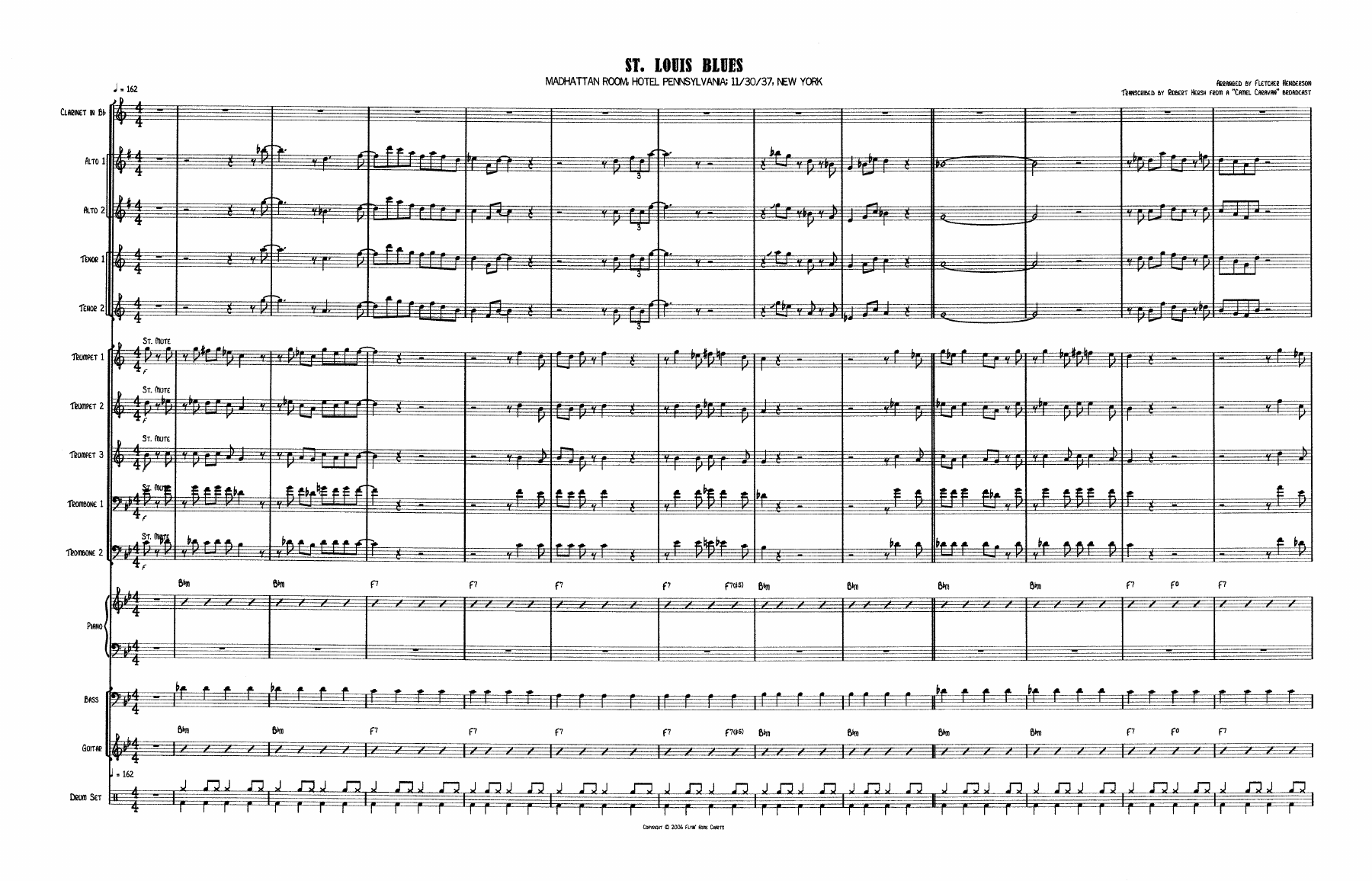
St.Louis Blues (F.Henderson)
Composed by W.C. Handy
Arranged by Benny Goodman
- Ensemble: Big Band
- Style: Jazz Standard
- Pages: 15
- Instruments (14): Clarinet in Bb, Alto Saxophone 1, Alto Saxophone 2, Tenor Saxophone 1, Tenor Saxophone 2, Trumpet 1, Trumpet 2, Trumpet 3, Trombone 1, Trombone 2, Piano, Bass, Guitar, Drum Set
- Difficulty: easy
- Content: Individual Parts
- Format: PDF Download (Instant)
- Price: $24.99
W.C. Handy's "St. Louis Blues," composed in 1914, stands as one of the earliest and most enduring pillars of the jazz and blues canon. Often hailed as "the genesis of the blues," its innovative fusion of traditional blues structure with tango rhythms and Tin Pan Alley sensibilities made it an instant classic, helping to popularize the blues form across America and Europe. It was one of the first blues songs to achieve widespread commercial success, famously recorded by Bessie Smith with Louis Armstrong in 1925, and later becoming a staple for countless jazz luminaries. Its iconic melody and harmonic progression have cemented its status as a foundational jazz standard, representing the very essence of early 20th-century American popular music and its evolution into jazz. This particular arrangement, credited to Benny Goodman, captures the vibrant energy and sophisticated swing of the big band era. Goodman's treatment typically emphasizes clarity, precision, and a driving, medium-up swing feel, often rooted in the Kansas City style popularized by Count Basie or the more intricate orchestrations of Fletcher Henderson. While the original composition is by Handy, the "F. Henderson" in the title likely refers to a specific interpretation or arrangement style that influenced Goodman, or perhaps even an earlier arrangement by Fletcher Henderson that Goodman adapted. Expect a bright, articulate key, likely in a comfortable brass range, designed to showcase the ensemble's collective power while maintaining the bluesy essence of the original. Goodman's signature approach often involves meticulously crafted soli sections for the saxophones, punctuated by powerful brass interjections and a robust shout chorus that builds intensity. The arrangement likely features the iconic melody passed between different sections, perhaps starting with a lead trumpet or saxophone, then expanding to full ensemble voicings. Featured solo opportunities are almost certainly present, offering a chance for improvisation over the familiar blues changes, typically for tenor saxophone or trumpet. The technical challenges lie in maintaining a consistent, authentic swing feel, achieving tight ensemble articulation, and navigating the dynamic contrasts that define big band performance. The rewarding aspect is performing a piece with such deep historical roots, experiencing the thrill of a well-executed shout chorus, and contributing to the timeless legacy of this essential standard. This arrangement is ideally suited for college-level jazz ensembles, advanced high school bands, or community big bands with strong section leaders and experienced soloists. Its demands for precise ensemble playing, authentic stylistic interpretation, and improvisational skill make it an excellent vehicle for developing musicianship within a classic big band context. The arrangement's historical significance and musical depth offer a rich educational experience, allowing musicians to connect directly with the origins of big band jazz. Achieving the authentic medium-up swing feel is paramount; emphasize a relaxed, yet driving pulse, ensuring the eighth notes are swung consistently without rushing. Articulation must be crisp and unified, particularly in the brass sections, which often feature short, punctuated figures. Pay close attention to dynamic contrasts, building intensity through the shout choruses and allowing for softer, more nuanced moments in melodic statements. Soloists should embrace the blues idiom, focusing on melodic improvisation rather than purely technical display. Encourage a strong, unified sound from the saxophone soli sections, ensuring balance and blend. Trumpet players should be prepared for potential high notes and strong lead playing, while the rhythm section must lay down a solid, grooving foundation. While no specific special techniques like plunger mutes are explicitly indicated, stylistic falls and scoops should be encouraged where appropriate to enhance the bluesy character. Q: What instruments and parts are included in this arrangement? A: This arrangement includes parts for a full 17-piece big band: Alto Saxophone 1, Alto Saxophone 2, Tenor Saxophone 1, Tenor Saxophone 2, Baritone Saxophone, Trumpet 1, Trumpet 2, Trumpet 3, Trumpet 4, Trombone 1, Trombone 2, Trombone 3, Trombone 4, Piano, Bass, Drums, and Guitar. A conductor's score is also included. Q: What is the difficulty level of this arrangement? A: This arrangement is rated as Medium-Advanced. It requires solid ensemble playing, good rhythmic precision, and capable soloists, making it suitable for strong high school, college, or community big bands. Q: What is the musical style and historical context of this arrangement? A: This is a classic big band jazz arrangement of W.C. Handy's "St. Louis Blues," a foundational jazz standard from 1914. Arranged by Benny Goodman, it embodies the swinging, sophisticated style of the big band era, likely influenced by the Fletcher Henderson style of the 1930s. Q: What makes this particular arrangement unique compared to other versions of "St. Louis Blues"? A: This arrangement by Benny Goodman is distinctive for its emphasis on tight ensemble voicings, driving swing feel, and meticulously crafted soli sections characteristic of Goodman's band. It offers a classic, authoritative big band interpretation of this seminal blues standard. Q: What is the typical performance duration and tempo for this piece? A: The typical performance duration for this arrangement is approximately 3-4 minutes, depending on the number and length of improvised solos. The tempo is a medium-up swing, generally around 160-180 beats per minute, maintaining a relaxed yet energetic feel.
Musicians Also Search For
St.Louis Blues Benny Goodman PDF • St.Louis Blues Benny Goodman sheet music • St.Louis Blues arranged by Benny Goodman • Benny Goodman big band charts • Benny Goodman jazz arrangements PDF • St.Louis Blues W.C. Handy sheet music • St.Louis Blues W.C. Handy big band arrangement • W.C. Handy big band charts • St.Louis Blues big band arrangement • St.Louis Blues big band PDF download • St.Louis Blues jazz ensemble sheet music • big band sheet music instant download • St.Louis Blues conductor score PDF • St.Louis Blues individual parts download • St.Louis Blues sheet music with parts • St.Louis Blues Jazz Standard chart • Jazz Standard big band arrangements • buy St.Louis Blues sheet music online • download St.Louis Blues PDF • St.Louis Blues jazz chart • best Benny Goodman big band arrangements • W.C. Handy songs arranged by Benny Goodman • St.Louis Blues printable sheet music • big band repertoire PDF