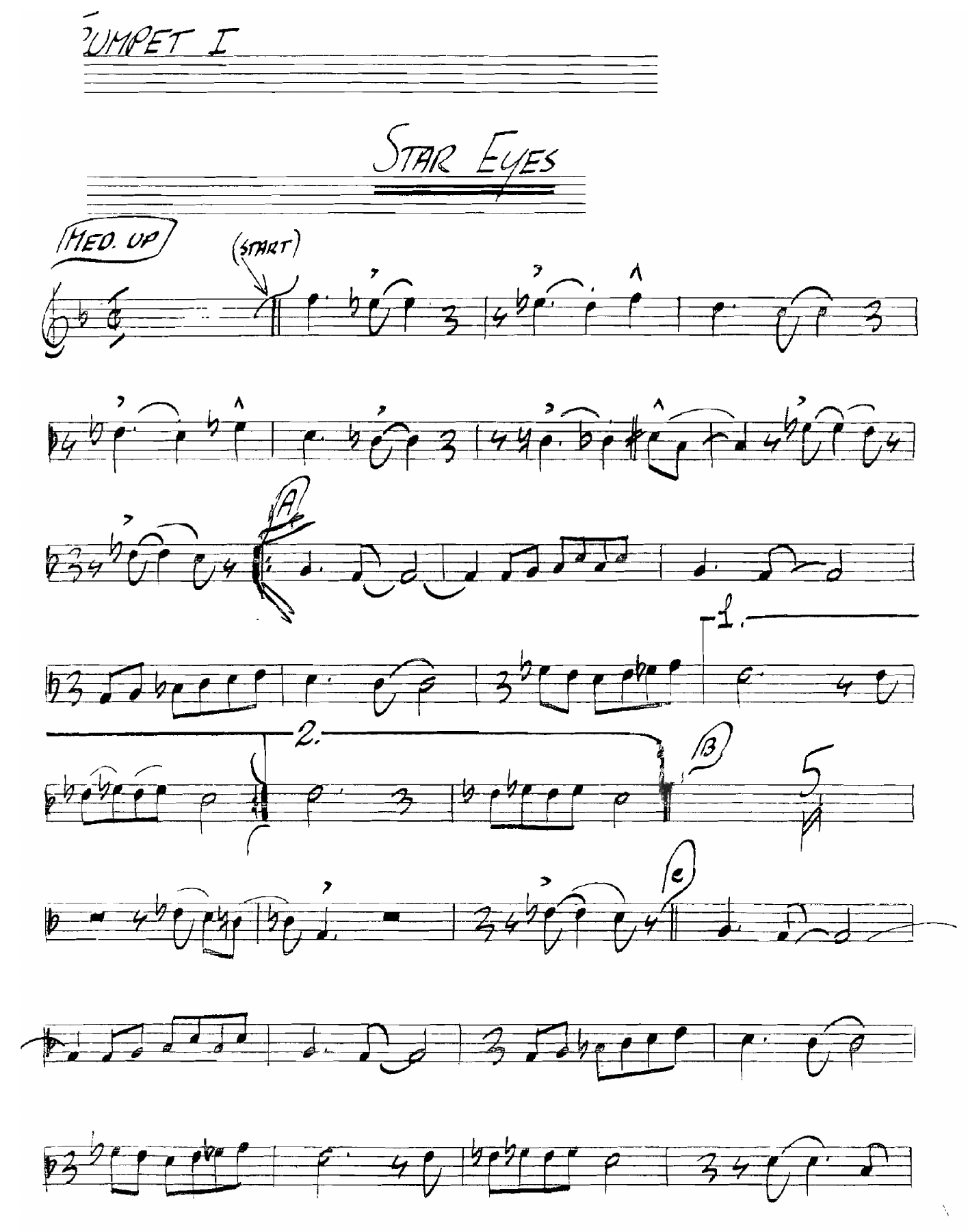
Star Eyes (4.Octet)
Composed by Don Raye, Gene De Paul
Arranged by 4 horns + Rhythm - Montrose - Dave Pell Octet
- Ensemble: Small Ensemble
- Style: Jazz Standard
- Pages: 26
- Instruments (8): Trumpet I, Tenor Saxophone, Trombone, Baritone Saxophone, Guitar, Piano, Bass, Drums
- Difficulty: easy
- Content: Individual Parts
- Format: PDF Download (Instant)
- Price: $12.99
"Star Eyes," a timeless jazz standard, emerged from the golden age of American songwriting, composed by Don Raye and Gene De Paul for the 1943 film *I Dood It*. While the film itself is largely forgotten, the song quickly transcended its cinematic origins, becoming a beloved staple in the repertoires of vocalists and instrumentalists alike. Its lyrical, sophisticated melody and harmonically rich chord changes resonated deeply with the burgeoning bebop movement, solidifying its place in the jazz canon. Artists such as Charlie Parker, who recorded an iconic instrumental version, and Frank Sinatra, who popularized it vocally, cemented its status as a piece that bridges the big band era with modern jazz improvisation. The tune's enduring appeal lies in its elegant AABA form, offering a perfect blend of memorable melodicism and fertile ground for harmonic exploration, making it a cornerstone for developing improvisational skills and understanding jazz harmony. This arrangement of "Star Eyes" is presented in a medium swing feel, typically around 140-160 BPM, and is set in the key of C major, offering a bright yet comfortable tessitura for the horn section. The overall mood is one of sophisticated buoyancy, evoking the classic West Coast cool jazz sound that the Dave Pell Octet epitomized. The energy is consistently engaging, driven by a crisp rhythm section foundation, allowing the horns to weave intricate melodic lines and lush harmonies. This rendition is designed to capture the quintessential sound of a small, tight-knit jazz ensemble, emphasizing clarity, precision, and a refined swing feel. The arrangement maintains a balance between ensemble cohesion and individual expression, ensuring that each part contributes meaningfully to the overall texture. The arranger, 4 horns + Rhythm - Montrose - Dave Pell Octet, brings a distinctive approach characterized by meticulous voicings and a keen sense of melodic counterpoint. True to the Dave Pell Octet's style, this arrangement features tightly voiced soli sections that showcase the horn section's blend and articulation, often employing close-position harmonies that create a shimmering, cohesive sound. While there isn't a traditional "shout chorus" in the big band sense, the ensemble passages build dynamically, offering moments of collective intensity. The arrangement incorporates subtle harmonic extensions and passing chords that enrich the standard changes without obscuring the original melody's integrity. Expect a sophisticated interplay between the horns, with carefully crafted lines that are both challenging and rewarding to execute, reflecting the octet's reputation for precision and musicality. The melody is primarily carried by the lead alto saxophone, often doubled or harmonized by the other horns, creating a rich, full sound despite the small ensemble size. There are ample opportunities for featured solos, typically over the form of the tune, allowing individual improvisers to shine. The arrangement includes written-out solo changes for all instruments, providing a clear roadmap for improvisation. Technical challenges include precise articulation in the soli sections, maintaining a consistent medium swing feel, and navigating the harmonic nuances. The reward lies in achieving the tight ensemble sound and the satisfaction of performing a classic standard with a polished, professional sheen. Specific musical moments that stand out include the intricate horn counter-melodies during the head and the dynamic shifts between ensemble and solo sections. This arrangement is particularly suitable for college-level jazz ensembles, community jazz bands with experienced players, and professional small groups seeking a refined and authentic West Coast jazz sound. Its detailed scoring and improvisational opportunities make it an excellent vehicle for developing ensemble precision and individual jazz vocabulary. Conductors should emphasize a relaxed yet precise medium swing feel, ensuring the rhythm section lays down a solid, unhurried groove around 140-160 BPM. Key technical challenges include achieving tight articulation and blend within the horn soli sections; meticulous attention to dynamics will enhance the interplay and prevent the ensemble from sounding overly dense. Rehearsal focus should be placed on breath support and consistent tone quality, particularly in the sustained harmonic passages. While no special techniques like plunger mutes or falls are explicitly notated, musicians are encouraged to employ standard jazz inflections (scoops, doits, subtle vibrato) to imbue the performance with authentic style. Pay close attention to the harmonic voicings, ensuring each note within a chord is balanced to create the intended shimmering effect. For soloists, encourage listening to classic recordings of "Star Eyes" to internalize the harmonic rhythm and melodic contours, while also fostering individual creative expression. Q: What instruments are included in this "Star Eyes (4.Octet)" arrangement? A: This arrangement is scored for a small ensemble consisting of four horns and a rhythm section. Specifically, the parts include Alto Saxophone, Tenor Saxophone, Trumpet, Trombone, Piano, Bass, and Drums. Q: What is the difficulty level of this arrangement? A: This arrangement is considered advanced intermediate to advanced. It requires proficient instrumental technique, a solid understanding of jazz harmony, and experience with ensemble playing, making it suitable for college-level ensembles or experienced community and professional groups. Q: What musical style and historical context does this arrangement represent? A: This arrangement is a classic jazz standard, "Star Eyes," presented in a medium swing feel. It embodies the sophisticated, precise sound of the West Coast cool jazz era, specifically influenced by the style of the Dave Pell Octet, originating from a 1943 film and popularized by jazz legends. Q: What makes this particular arrangement unique compared to other versions of "Star Eyes"? A: This arrangement stands out for its meticulous four-horn voicings, tight soli sections, and faithful adherence to the refined, swinging aesthetic of the Dave Pell Octet. It offers a balance of ensemble precision and improvisational opportunities, providing a distinct West Coast jazz interpretation. Q: What is the typical performance duration or tempo for this arrangement? A: The typical performance duration for "Star Eyes" in this arrangement is approximately 4-6 minutes, depending on the number and length of improvised solos. It is designed to be performed at a medium swing tempo, generally ranging from 140 to 160 beats per minute.
Questions and answers
- What is included in the Star Eyes (4.Octet) PDF?
- The verified current file contains individual parts across 26 pages.
- How many instruments or parts are listed for Star Eyes (4.Octet)?
- The verified instrumentation list contains 8 entries for this Small Ensemble arrangement.
- Who is credited for Star Eyes (4.Octet)?
- Composer: Don Raye, Gene De Paul. Arranger: 4 horns + Rhythm - Montrose - Dave Pell Octet.
- What difficulty is listed for Star Eyes (4.Octet)?
- The verified difficulty level is easy.
- What style is listed for Star Eyes (4.Octet)?
- The catalog lists the style as Jazz Standard.
- Can I preview Star Eyes (4.Octet) before buying?
- Yes. The product page provides a preview generated from the current PDF file.
- How is Star Eyes (4.Octet) delivered?
- After successful payment, the digital PDF is made available for download. The displayed price is $12.99.
Musicians Also Search For
Star Eyes 4 horns + Rhythm - Montrose - Dave Pell Octet PDF • Star Eyes 4 horns + Rhythm - Montrose - Dave Pell Octet sheet music • Star Eyes arranged by 4 horns + Rhythm - Montrose - Dave Pell Octet • 4 horns + Rhythm - Montrose - Dave Pell Octet small ensemble charts • 4 horns + Rhythm - Montrose - Dave Pell Octet jazz arrangements PDF • Star Eyes Don Raye, Gene De Paul sheet music • Star Eyes Don Raye, Gene De Paul small ensemble arrangements • Don Raye, Gene De Paul small ensemble charts • Star Eyes small ensemble arrangements • Star Eyes small ensemble PDF download • Star Eyes jazz sheet music • small ensemble sheet music download • Star Eyes individual parts download • Star Eyes sheet music PDF • Star Eyes Jazz Standard charts • Jazz Standard small ensemble arrangements • buy Star Eyes sheet music • download Star Eyes PDF • Star Eyes jazz charts • best 4 horns + Rhythm - Montrose - Dave Pell Octet small ensemble arrangements • Don Raye, Gene De Paul arranged by 4 horns + Rhythm - Montrose - Dave Pell Octet • Star Eyes printable sheet music • small ensemble repertoire PDF