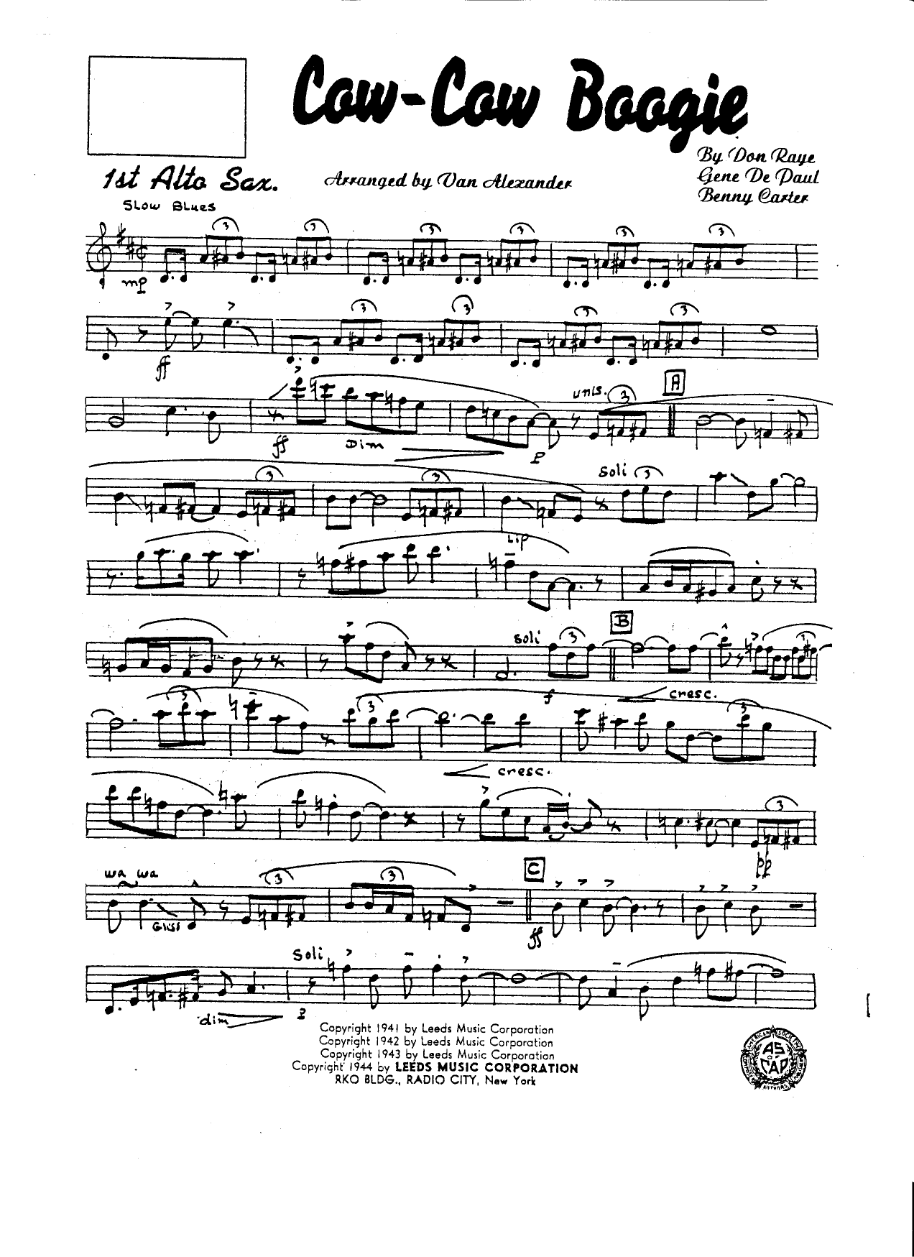
Cow-Cow Boogie (V.Alexander)
Composed by V. Alexander
Arranged by Benny Carter
- Ensemble: Big Band
- Style: Jazz Standard
- Pages: 42
- Instruments (16): 1st Alto Sax., 2nd Alto Sax., 3rd Tenor Sax., 4th Tenor Sax., 1st Trumpet, 2nd Trumpet, 3rd Trumpet, 4th Trumpet, 1st Trombone, 2nd Trombone, 3rd Trombone, 4th Trombone, Guitar, Piano, Bass, Drums
- Difficulty: medium
- Content: Individual Parts
- Format: PDF Download (Instant)
- Price: $24.99
"Cow-Cow Boogie," originally penned by V. Alexander, emerged as a vibrant novelty hit during the early 1940s, a period when big band jazz was at its zenith and wartime sentiments often found expression in upbeat, escapist tunes. First popularized by Ella Mae Morse with Freddie Slack and His Orchestra in 1942, and later famously covered by The Ink Spots and Ella Fitzgerald, the song masterfully blended Western swing motifs with classic boogie-woogie rhythms. Its infectious, driving pulse and playful narrative about a "cowboy boogie-woogie" dancer quickly cemented its status as a beloved jazz standard, embodying the era's fusion of diverse American musical traditions. This particular arrangement, crafted by the legendary Benny Carter, offers a sophisticated and swinging interpretation of this enduring classic, transforming its novelty charm into a showcase for big band artistry. Benny Carter's treatment of "Cow-Cow Boogie" is a masterclass in elegant big band writing. Set at a bright, medium-up swing tempo in the key of F major, the arrangement exudes an irresistible energy and a sophisticated, yet accessible, mood. Carter’s signature harmonic ingenuity is evident throughout, employing lush, close-voiced saxophone soli sections that glide effortlessly over the driving rhythm section. His orchestrational brilliance shines through in the way he balances the brass and reed sections, creating dynamic contrasts and rich textures without ever sounding over-dense. The piece maintains a joyous, effervescence, inviting both performers and listeners to tap their feet to its relentless boogie-woogie bass line and swinging melodic lines. The arrangement opens with a captivating ensemble statement, immediately establishing the piece's infectious groove. The melody is primarily carried by the saxophone section, often in tight, harmonized voicings, before being passed to the brass for powerful, punctuating figures. Carter incorporates several exciting soli passages, particularly for the saxophones, that demand precision and blend. While the arrangement is primarily an ensemble feature, there are ample opportunities for improvisation, with designated solo sections typically for tenor saxophone and trumpet, allowing for individual expression within Carter's meticulously crafted framework. A powerful shout chorus builds to an exhilarating climax, showcasing the full dynamic range of the big band. Technically, the primary challenges lie in maintaining the relentless boogie-woogie feel in the rhythm section, achieving precise articulation and tight ensemble blend in the soli sections, and navigating the sometimes intricate melodic lines at tempo. The reward, however, is a vibrant and historically significant performance that delights audiences and challenges musicians. This arrangement is ideally suited for college and advanced high school jazz ensembles, as well as community and professional big bands seeking a sophisticated yet accessible swing chart. Its blend of historical significance, infectious groove, and Benny Carter's masterful arranging makes it an invaluable addition to any big band library. It offers excellent opportunities for developing ensemble precision, swing feel, and understanding of classic big band voicings, while providing a highly engaging and rewarding performance experience. Conductors should emphasize a consistent, driving boogie-woogie feel in the rhythm section from the outset, particularly in the bass and piano, ensuring the quarter notes have a strong, forward momentum. Articulation in the saxophone soli sections is paramount; aim for a light, detached swing eighth-note feel, ensuring tight ensemble unison and blend. Brass players should focus on precise attacks and releases, using short, crisp articulations for rhythmic figures and controlled vibrato on sustained notes. Trumpet and trombone sections will benefit from careful attention to dynamics, building energy towards the shout chorus without overblowing. Soloists should be encouraged to embrace the bluesy, swinging character of the piece, drawing inspiration from the era's improvisational styles. There are no specific extended techniques required, but standard jazz inflections like falls, scoops, and subtle glissandi should be employed tastefully to enhance the authentic swing feel. Q: What instruments are included in this arrangement? A: This arrangement is scored for a standard 17-piece big band, including Alto Saxophone 1, Alto Saxophone 2, Tenor Saxophone 1, Tenor Saxophone 2, Baritone Saxophone, Trumpet 1, Trumpet 2, Trumpet 3, Trumpet 4, Trombone 1, Trombone 2, Trombone 3, Trombone 4, Piano, Bass, Drums, and Guitar. Q: What is the difficulty level of Benny Carter's "Cow-Cow Boogie"? A: This arrangement is rated as Medium-Advanced. It requires solid instrumental technique, strong ensemble playing, precise articulation, and an understanding of classic big band swing style. Q: What is the musical style and historical context of this piece? A: "Cow-Cow Boogie" is a classic jazz standard from the early 1940s, blending boogie-woogie rhythms with Western swing influences. Benny Carter's arrangement elevates this novelty tune into a sophisticated big band swing chart. Q: What makes Benny Carter's arrangement of "Cow-Cow Boogie" unique? A: Carter's signature style is evident in the lush, close-voiced saxophone soli sections, sophisticated harmonic treatments, and dynamic brass writing, transforming the original's charm into a polished and swinging big band showpiece. Q: What is the typical performance duration and tempo for this arrangement? A: The performance duration typically ranges from 3:00 to 3:30 minutes, played at a bright, medium-up swing tempo, generally around 160-180 beats per minute.
Questions and answers
- What is included in the Cow-Cow Boogie (V.Alexander) PDF?
- The verified current file contains individual parts across 42 pages.
- How many instruments or parts are listed for Cow-Cow Boogie (V.Alexander)?
- The verified instrumentation list contains 16 entries for this Big Band arrangement.
- Who is credited for Cow-Cow Boogie (V.Alexander)?
- Composer: V. Alexander. Arranger: Benny Carter.
- What difficulty is listed for Cow-Cow Boogie (V.Alexander)?
- The verified difficulty level is medium.
- What style is listed for Cow-Cow Boogie (V.Alexander)?
- The catalog lists the style as Jazz Standard.
- Can I preview Cow-Cow Boogie (V.Alexander) before buying?
- Yes. The product page provides a preview generated from the current PDF file.
- How is Cow-Cow Boogie (V.Alexander) delivered?
- After successful payment, the digital PDF is made available for download. The displayed price is $24.99.
Musicians Also Search For
Cow-Cow Boogie Benny Carter PDF • Cow-Cow Boogie Benny Carter sheet music • Cow-Cow Boogie arranged by Benny Carter • Benny Carter big band charts • Benny Carter jazz arrangements PDF • Cow-Cow Boogie V. Alexander sheet music • Cow-Cow Boogie V. Alexander big band arrangements • V. Alexander big band charts • Cow-Cow Boogie big band arrangements • Cow-Cow Boogie big band PDF download • Cow-Cow Boogie jazz sheet music • big band sheet music download • Cow-Cow Boogie individual parts download • Cow-Cow Boogie sheet music PDF • Cow-Cow Boogie Jazz Standard charts • Jazz Standard big band arrangements • buy Cow-Cow Boogie sheet music • download Cow-Cow Boogie PDF • Cow-Cow Boogie jazz charts • best Benny Carter big band arrangements • V. Alexander arranged by Benny Carter • Cow-Cow Boogie printable sheet music • big band repertoire PDF