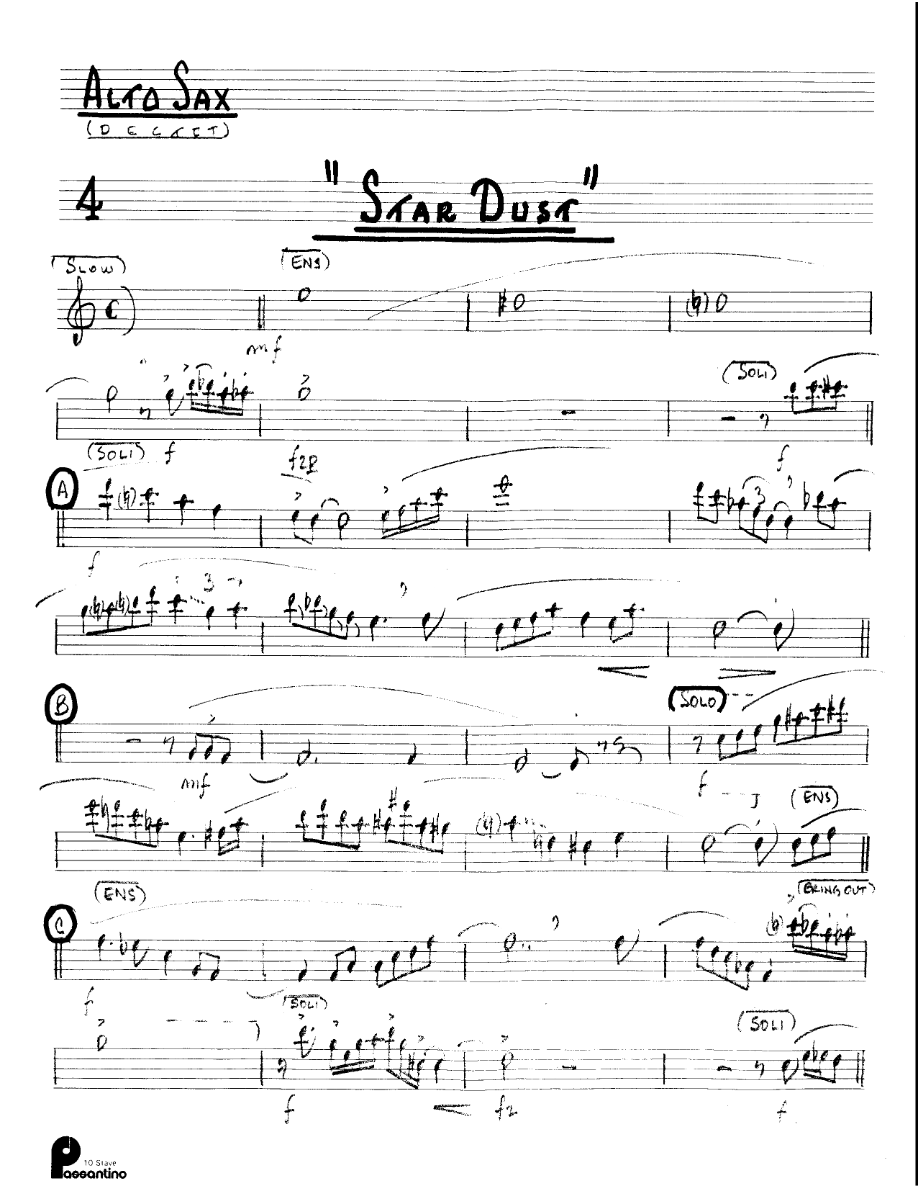
Star Dust (Kenton Dectet #004)
Composed by Hoagy Carmichael
Arranged by Stan Kenton Dected 176
- Ensemble: Small Ensemble
- Style: Jazz Standard
- Pages: 18
- Difficulty: easy
- Content: Sheet Music
- Format: PDF Download (Instant)
- Price: $12.99
Hoagy Carmichael's timeless ballad, "Star Dust," composed in 1927, stands as a cornerstone of the Great American Songbook and a quintessential jazz standard. Originally conceived as a mid-tempo instrumental, its melancholic melody and sophisticated harmonic progression quickly captured the public's imagination, becoming a pop hit with lyrics added by Mitchell Parish in 1929. The song's enduring appeal lies in its evocative narrative of lost love and nostalgic yearning, a sentiment perfectly encapsulated by its flowing, romantic lines. Over the decades, "Star Dust" has been recorded by an unparalleled roster of artists, from Louis Armstrong and Artie Shaw to Frank Sinatra and Willie Nelson, each interpretation solidifying its status as a benchmark for jazz musicianship and emotional depth. Its rich harmonic landscape and expressive melodic contours make it a perennial favorite for improvisation and arrangement, representing an era of sophisticated popular music that seamlessly blended into the burgeoning jazz idiom. This particular arrangement, "Star Dust (Kenton Dectet #004)," reimagines Carmichael's classic through the distinctive lens of the Stan Kenton Dectet 176. True to Kenton's pioneering "progressive jazz" aesthetic, even in a small ensemble setting, this chart presents a sophisticated, harmonically dense, and emotionally charged interpretation. The musical character is a slow, reflective ballad, typically performed in 4/4 time, though with a pervasive rubato feel in sections, emphasizing its dreamy, contemplative mood. The arrangement often explores lush, extended harmonies, frequently employing ninths, elevenths, and thirteenths, creating a rich, almost orchestral texture despite the limited instrumentation. The overall energy is one of profound introspection, evoking a sense of wistful longing and romantic melancholy. The arranger's approach is marked by intricate voicings and a masterful use of counterpoint, typical of the Kenton school. The melody, initially presented by a lead instrument (often trumpet or alto saxophone), is then woven through various instrumental combinations, creating dynamic shifts in timbre and emphasis. Expect sophisticated soli sections where the ensemble moves as a cohesive, harmonically rich unit, showcasing the arranger's skill in crafting complex inner voices. While there might not be a traditional "shout chorus" in a ballad of this nature, climactic moments are achieved through dense harmonic build-ups and carefully placed dynamic swells. Featured solo opportunities are integral, typically for a melodic instrument like trumpet or alto saxophone, allowing for expressive improvisation over the arrangement's rich harmonic changes. Technical challenges include precise control of dynamics, intonation within close voicings, and the ability to navigate complex harmonic progressions during solos. The rewarding aspect lies in the profound emotional impact and the sheer beauty of the ensemble's blend when executed with sensitivity and precision. This arrangement is ideally suited for college-level jazz ensembles, advanced community bands, or professional small groups seeking a challenging yet deeply rewarding piece. Its harmonic sophistication and demand for nuanced interpretation make it less suitable for most high school groups, though exceptionally strong programs might find it an aspirational goal. The performance requires mature musicianship, excellent blend, and a deep understanding of jazz ballad phrasing and harmonic language. The intricate interplay between voices and the sustained emotional arc make it a standout piece for any concert program. This arrangement of "Star Dust" requires meticulous attention to blend, balance, and intonation, particularly within its dense harmonic voicings. Conductors should emphasize a slow, expressive ballad tempo, allowing ample space for the melody to breathe and for the rich harmonies to resonate. While the overall feel is 4/4, encourage a flexible, rubato approach in the melodic sections to enhance the romantic, reflective mood. Key technical challenges include sustaining long tones with consistent tone quality and navigating the extended chord changes during solo sections. Rehearsal time should be dedicated to isolating the soli passages, ensuring precise rhythmic alignment and impeccable intonation, especially in the upper register of the brass. Dynamic contrasts are crucial; practice gradual swells and diminuendos to build and release tension effectively. Encourage soloists to embrace the melancholic character of the piece, focusing on melodic invention and emotional depth rather than purely technical display. Q: What instruments are included in the "Star Dust (Kenton Dectet #004)" arrangement? A: This arrangement is for a small ensemble, typically a dectet, including standard jazz instrumentation such as trumpet, trombone, alto saxophone, tenor saxophone, baritone saxophone, piano, bass, drums, and potentially additional instruments like guitar or French horn, depending on the specific Kenton Dectet instrumentation. Q: What is the difficulty level of this arrangement? A: This arrangement is considered advanced, suitable for college-level jazz ensembles, advanced community bands, or professional small groups due to its complex harmonic voicings, intricate counterpoint, and demands for mature musicianship and expressive interpretation. Q: What musical style and historical context does this arrangement represent? A: This arrangement is a jazz standard ballad, originally composed by Hoagy Carmichael in 1927. The Stan Kenton Dectet 176 arrangement reinterprets it in the "progressive jazz" style, characterized by sophisticated harmonies and a rich, often melancholic, emotional depth. Q: What makes this specific arrangement of "Star Dust" unique? A: This arrangement is unique for its Stan Kenton Dectet 176 treatment, which imbues the classic ballad with Kenton's signature sophisticated voicings, extended harmonies, and intricate ensemble interplay, creating a lush and emotionally profound interpretation for a small ensemble. Q: What is the typical performance duration or tempo for this piece? A: "Star Dust (Kenton Dectet #004)" is a slow, reflective ballad, typically performed in 4/4 time with a flexible, rubato feel. Its performance duration usually ranges from 4 to 6 minutes, depending on the solo lengths and the conductor's interpretation of the tempo.
Musicians Also Search For
Star Dust Stan Kenton Dected 176 PDF • Star Dust Stan Kenton Dected 176 sheet music • Star Dust arranged by Stan Kenton Dected 176 • Stan Kenton Dected 176 small ensemble charts • Stan Kenton Dected 176 jazz arrangements PDF • Star Dust Hoagy Carmichael sheet music • Star Dust Hoagy Carmichael small ensemble arrangement • Hoagy Carmichael small ensemble charts • Star Dust small ensemble arrangement • Star Dust small ensemble PDF download • Star Dust jazz ensemble sheet music • small ensemble sheet music instant download • Star Dust sheet music with parts • Star Dust Jazz Standard chart • Jazz Standard small ensemble arrangements • buy Star Dust sheet music online • download Star Dust PDF • Star Dust jazz chart • best Stan Kenton Dected 176 small ensemble arrangements • Hoagy Carmichael songs arranged by Stan Kenton Dected 176 • Star Dust printable sheet music • small ensemble repertoire PDF