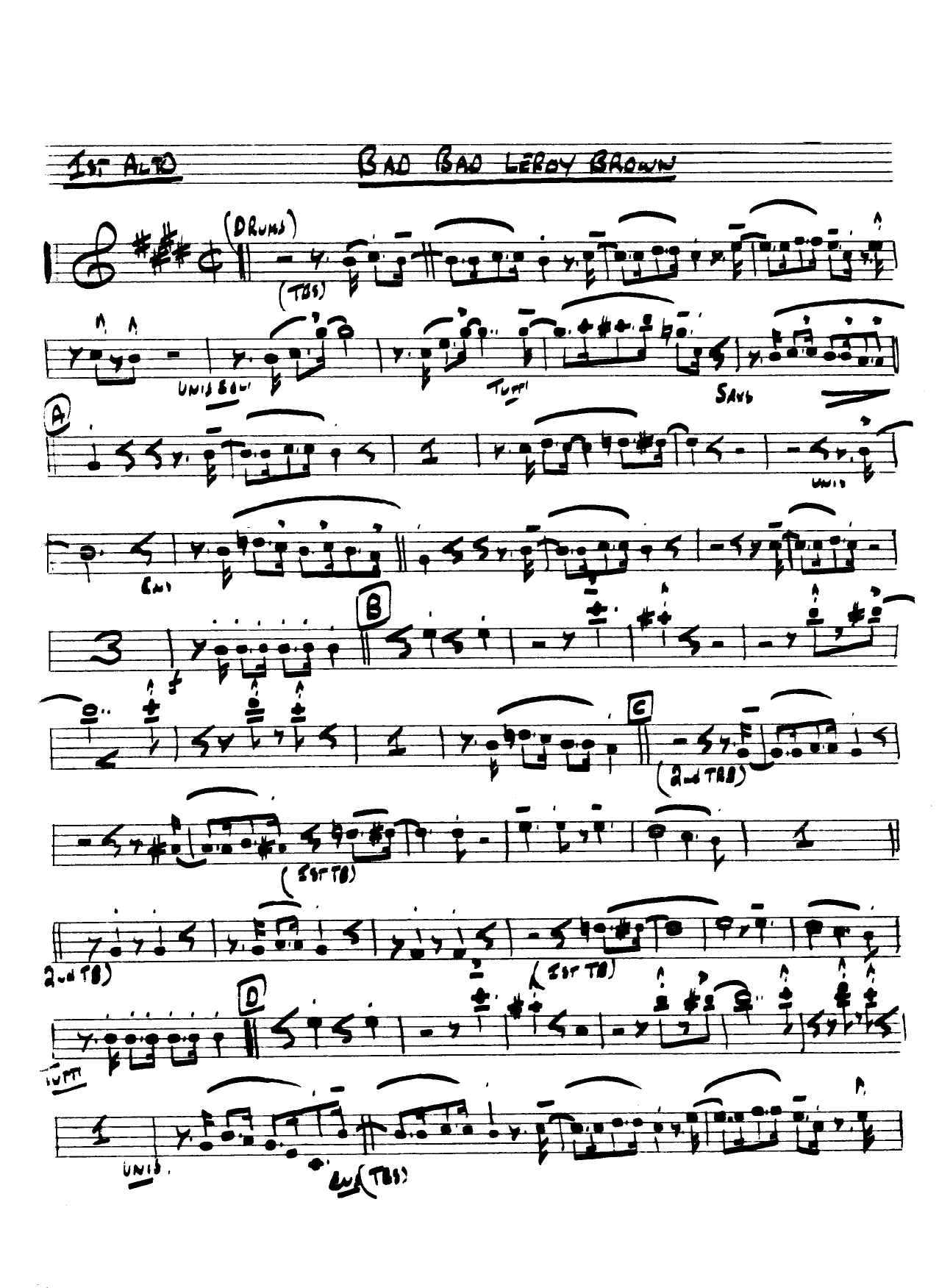
Bad, Bad Leroy Brow F.Sinatra (comp. null) sheet music preview

Bad, Bad Leroy Brow F.Sinatra (comp. null)

Composed by null

Arranged by London Orchestrations

  • Ensemble: Big Band
  • Pages: 27
  • Instruments (17): 1st Alto Saxophone, 2nd Alto Saxophone, 1st Tenor Saxophone, 2nd Tenor Saxophone, Baritone Saxophone, 1st Trumpet, 2nd Trumpet, 3rd Trumpet, 4th Trumpet, 1st Trombone, 2nd Trombone, 3rd Trombone, 4th Trombone, Piano, Guitar, Bass, Drums
  • Difficulty: medium
  • Content: Individual Parts
  • Format: PDF Download (Instant)
  • Price: $24.99

Originally written and made famous by singer-songwriter Jim Croce in 1973 before being triumphantly adapted into the traditional pop and jazz vocal canon by Frank Sinatra for his 1974 release *Some Nice Things I've Missed*, "Bad, Bad Leroy Brown" represents a brilliant collision of 1970s story-song lyricism and high-octane big band swing. This jazz arrangement bridges the gap between classic Croce folk-rock storytelling and the swaggering, punchy arrangements popularized by Sinatra’s late-career big band collaborations. The resulting musical character is defined by an aggressive, driving medium-up swing tempo, a bold brass-led attitude, and an infectious swagger that evokes the smoky, fast-paced atmosphere of a classic Chicago bar scene. London Orchestrations approaches this iconic chart with a signature emphasis on tight, interlocking horn voicings and dynamic sectional interplay. Rather than relying on a standard head arrangement, this chart utilizes clever chromatic counterlines in the lower reeds and punchy brass stabs to punctuate the narrative arc of the lyrics. The arrangement features dense, extended dominant harmonies that give the blues-infused chord progression a sophisticated contemporary jazz bite. Shifting textures keep the ensemble engaged throughout, moving seamlessly from sparse, rhythm-section-driven verse setups to roaring, full-ensemble shout choruses that demand precision and stamina from every section. The melodic weight is shared dynamically across the ensemble, with the alto and tenor saxophones frequently carrying the primary thematic material in tight unison or harmonized soli blocks, while the trumpet and trombone sections answer with sharp, declarative counter-melodies. Featured solo space allows improvisers to stretch out over standard blues changes, supported by punchy backgrounds that build natural dramatic tension. Technical challenges lie primarily in maintaining clean articulation at a brisk tempo, nailing the synchronized syncopated figures between the brass and rhythm sections, and balancing the dynamic contrast during heavy dynamic shifts. Advanced high school, collegiate, and professional community big bands will find this chart exceptionally rewarding to rehearse and perform. Its familiar narrative hook guarantees an enthusiastic audience response, while its sophisticated arranging style provides ample educational and artistic depth. Conductor and players alike will appreciate how the chart transforms a classic pop-culture staple into a genuine powerhouse jazz chart capable of anchoring any competitive festival set or evening concert program. Achieving the authentic swagger of this arrangement requires strict attention to the medium-up swing feel; avoid letting the eighth notes become too even or rushed. The rhythm section acts as the primary engine, so the drummer should maintain a crisp, driving ride cymbal pattern with a strong emphasis on beats two and four, locking tightly with the walking bassline. Brass players must execute short, clipped staccatos with aggressive tongue placement during the punctuated ensemble hits, utilizing controlled falls and doits where indicated to add vintage big band color. Rehearsal should initially focus on sectional balance, ensuring that the inner-voice counterlines in the tenor and trombone parts are clearly audible beneath the lead alto melody. Pay close attention to dynamic pacing, holding back slightly during the verse setups to maximize the explosive impact of the shout chorus. Q: What specific instruments and parts are included in this arrangement? A: This chart is scored for a 9-instrument big band instrumentation, featuring parts for Alto Saxophone, Tenor Saxophone, Baritone Saxophone, Trumpet, and Trombone, alongside a fully realized rhythm section score across its 27 comprehensive pages. Q: What is the difficulty level of this big band chart? A: This arrangement is calibrated for advanced high school, collegiate, and professional jazz ensembles, presenting moderate-to-advanced technical challenges in tempo management, articulation, and section synchronization. Q: What is the historical style and musical context of this piece? A: Drawing inspiration from Jim Croce's 1973 folk-rock crossover hit and its subsequent 1974 adaptation by Frank Sinatra, this chart reimagines the classic story-song as a high-energy, swinging big band showstopper. Q: What makes this specific arrangement by London Orchestrations unique? A: It distinguishes itself through sophisticated extended-chord voicings, driving chromatic counterlines in the lower reeds, and dynamically shifting textures that transform a familiar vocal narrative into a powerhouse instrumental feature. Q: What is the suggested performance tempo and duration for this piece? A: The arrangement is designed to be performed at a brisk, driving medium-swing tempo (approx. 152–160 BPM), resulting in a total performance duration of roughly 3 to 4 minutes depending on solo extensions.

Questions and answers

What is included in the Bad, Bad Leroy Brow F.Sinatra (comp. null) PDF?
The verified current file contains individual parts across 27 pages.
How many instruments or parts are listed for Bad, Bad Leroy Brow F.Sinatra (comp. null)?
The verified instrumentation list contains 17 entries for this Big Band arrangement.
Who is credited for Bad, Bad Leroy Brow F.Sinatra (comp. null)?
Composer: null. Arranger: London Orchestrations.
What difficulty is listed for Bad, Bad Leroy Brow F.Sinatra (comp. null)?
The verified difficulty level is medium.
Can I preview Bad, Bad Leroy Brow F.Sinatra (comp. null) before buying?
Yes. The product page provides a preview generated from the current PDF file.
How is Bad, Bad Leroy Brow F.Sinatra (comp. null) delivered?
After successful payment, the digital PDF is made available for download. The displayed price is $24.99.

Musicians Also Search For

Bad, Bad Leroy Brow F.Sinatra London Orchestrations PDFBad, Bad Leroy Brow F.Sinatra London Orchestrations sheet musicBad, Bad Leroy Brow F.Sinatra arranged by London OrchestrationsLondon Orchestrations big band chartsLondon Orchestrations jazz arrangements PDFBad, Bad Leroy Brow F.Sinatra null sheet musicBad, Bad Leroy Brow F.Sinatra null big band arrangementsnull big band chartsBad, Bad Leroy Brow F.Sinatra big band arrangementsBad, Bad Leroy Brow F.Sinatra big band PDF downloadBad, Bad Leroy Brow F.Sinatra jazz sheet musicbig band sheet music downloadBad, Bad Leroy Brow F.Sinatra individual parts downloadBad, Bad Leroy Brow F.Sinatra sheet music PDFbuy Bad, Bad Leroy Brow F.Sinatra sheet musicdownload Bad, Bad Leroy Brow F.Sinatra PDFBad, Bad Leroy Brow F.Sinatra jazz chartsbest London Orchestrations big band arrangementsnull arranged by London OrchestrationsBad, Bad Leroy Brow F.Sinatra printable sheet musicbig band repertoire PDF

All arrangements by London Orchestrations All null sheet music