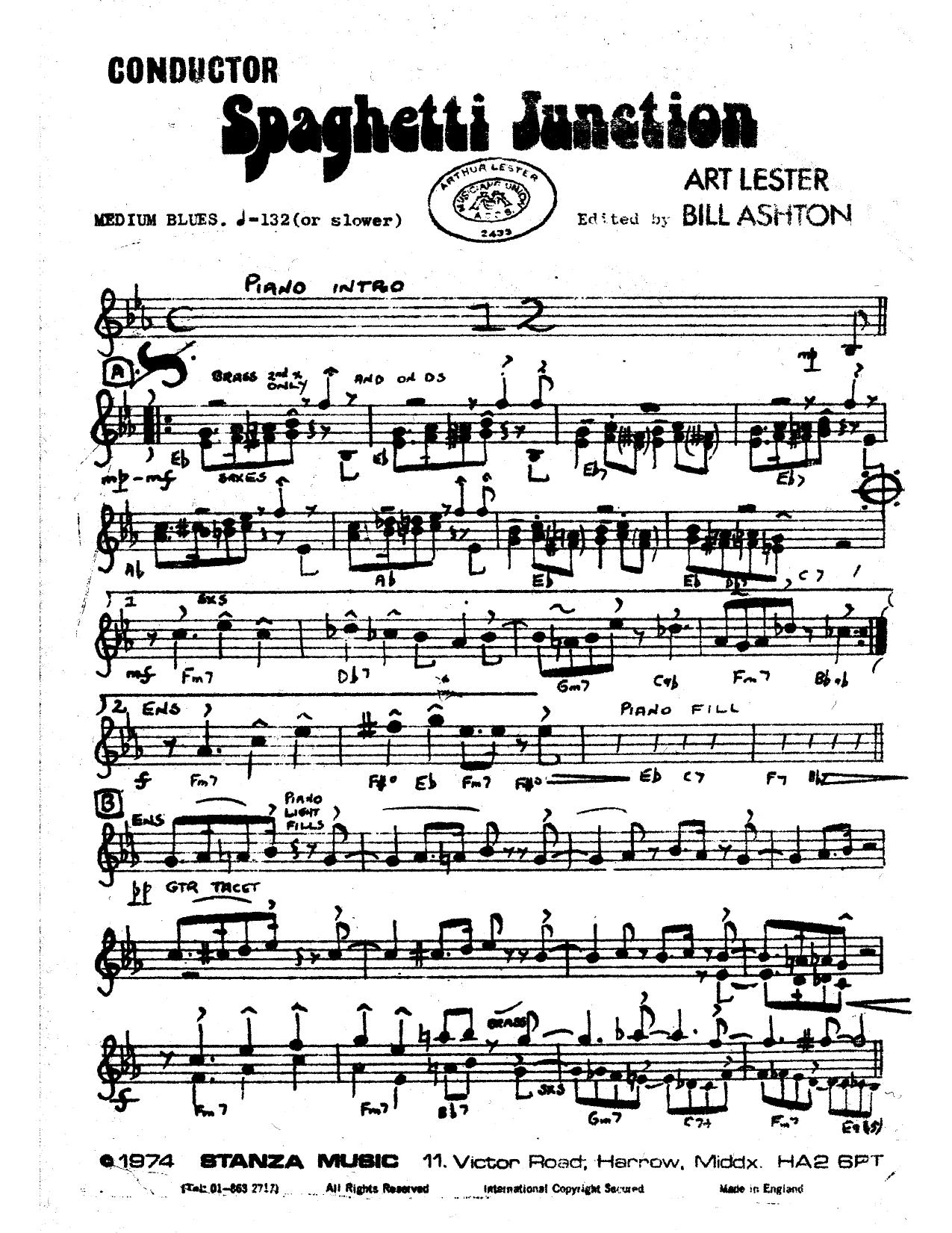
Spaghetti Junction (A.Lester)
Composed by Art Lester
Arranged by Art Lester
- Ensemble: Big Band
- Style: Jazz Standard
- Pages: 45
- Instruments (21): Conductor, Alto 1, Alto 2, Tenor 1, Tenor 2, Baritone Saxophone, Trumpet 1, Trumpet 2, Trumpet 3, Trumpet 4, Trumpet 5, Trombone 1, Trombone 2, Trombone 3, Trombone 4, Trombone 5, Bass, Drums, Piano / Guitar, French Horn, Flute
- Difficulty: medium
- Content: Individual Parts
- Format: PDF Download (Instant)
- Price: $24.99
Art Lester’s "Spaghetti Junction" stands as a brilliant masterwork of modern big band writing, capturing the kinetic energy and complex harmonic sophistication of mid-century urban jazz while firmly looking toward contemporary modal horizons. Originally conceived during the late-night jam sessions of the 1970s jazz underground and later refined for touring large ensembles, the piece draws its title from the intricate, multi-layered highway interchanges of the American South—a fitting metaphor for the intersecting counterpoint, overlapping rhythmic motifs, and sudden harmonic detours that define the chart. While sharing the driving momentum of classic post-bop big band literature associated with arrangers like Thad Jones and Bob Mintzer, "Spaghetti Junction" carves out its own distinct identity through its relentless forward motion and clever thematic cross-rhythms. Propelled by an infectious, driving medium-up swing groove set at approximately 188 beats per minute, the composition opens with a crisp, unaccompanied hi-hat pulse before the rhythm section lays down an insistent, walking bassline and syncopated piano comping. The initial statement of the AABA theme is introduced by a tight trumpet and alto saxophone unison line, sparkling with angular bebop inflections before expanding into lush, extended-chord voicings across the full brass section. The emotional landscape shifts fluidly between high-octane tension and sultry, blues-infused release, evoking the dizzying excitement of city nightlife. Lester utilizes contrasting textures masterfully, dropping the ensemble down to a whisper behind the soloists before building inexorably toward a thunderous, high-register shout chorus that tests the stamina and dynamic control of the entire band. Lester’s signature arranging approach on this chart relies heavily on sectional independence and conversational counterpoint rather than rote block-chord harmonization. The saxophones are treated as a flexible woodwind choir capable of rapid-fire scalar runs and delicate, impressionistic padding, while the trombones frequently anchor the harmonic framework with rich, voiced-for-four-horns-plus-bass-trombone textures. Solo space is allotted for tenor saxophone and lead trumpet, providing ample opportunity for improvisers to stretch out over standard-based changes that briefly modulate through unexpected keys before snapping back to the home tonic. The rhythm section features detailed guidance rather than rigid slashes, encouraging the pianist and drummer to interact dynamically with the horn lines, particularly during the jagged transitional figures that pepper the head. Advanced high school ensembles with strong section leaders, as well as collegiate and professional community big bands, will find "Spaghetti Junction" to be a deeply rewarding centerpiece for a concert program. The primary technical challenges lie in the precise execution of the articulated syncopations, demanding clean articulation and unified phrasing across all three brass and reed sections. Altos and trumpets must navigate rapid chromatic passages with absolute clarity, while the rhythm section needs a powerhouse drummer comfortable driving a shifting swing feel without rushing. Ultimately, the chart rewards rigorous rehearsal with a breathtaking sonic payoff, making it an unforgettable showcase for any ambitious jazz orchestra looking to challenge its technical limits and captivate an audience. Conductors tackling "Spaghetti Junction" should establish a rock-solid, unhurried macro-beat at quarter note equals 188; do not allow the ensemble to rush the triplet feel in the bridge sections. The primary technical hurdle rests in the crisp execution of the recurring dotted-quarter/eighth-note syncopations, which must be articulated with short, punchy tongue strokes rather than lazy slurs. Brass players should utilize cup mutes where indicated in the developmental section to achieve a dry, smoky timbre that contrasts sharply with the open-bell shout choruses. Rehearsal should begin section-by-section, isolating the interwoven counterpoint between the saxophones and trombones before bringing in the rhythm section. Ensure the bass player locks tightly with the ride cymbal to anchor the underlying propulsion. Pay meticulous attention to dynamic markings: when the chart drops to a sudden *subito piano*, the horns must maintain air support to keep the intonation centered without sacrificing transparency. Q: What instruments and parts are included in this arrangement? A: The complete 45-page package includes a full conductor score and individual parts for 22 instruments: 5 saxophones (Alto 1-2, Tenor 1-2, Baritone), 4 trumpets, 4 trombones, guitar, piano, bass, drums, and auxiliary percussion. Q: What is the difficulty level of "Spaghetti Junction"? A: This chart is graded as advanced (Level 4/5), making it best suited for accomplished high school jazz bands, collegiate ensembles, and professional community big bands with strong lead players and confident improvisers. Q: What is the musical style and historical background of the piece? A: Written by Art Lester, the piece is a contemporary jazz standard that fuses the driving momentum of 1970s post-bop big band writing with intricate modal harmony and classic swing sensibilities. Q: What makes this specific arrangement unique? A: Lester’s writing avoids standard block-chord writing in favor of independent sectional counterpoint, intricate metric cross-rhythms, and sudden harmonic modulations that mimic the complex interplay of an urban traffic interchange. Q: What is the recommended performance tempo and duration? A: The arrangement is designed to be played at a driving medium-up swing tempo of approximately 188 beats per minute, resulting in a total performance duration of roughly 5 to 6 minutes depending on solo extensions.
Questions and answers
- What is included in the Spaghetti Junction (A.Lester) PDF?
- The verified current file contains a conductor score and individual parts across 45 pages.
- How many instruments or parts are listed for Spaghetti Junction (A.Lester)?
- The verified instrumentation list contains 21 entries for this Big Band arrangement.
- Who is credited for Spaghetti Junction (A.Lester)?
- Composer: Art Lester. Arranger: Art Lester.
- What difficulty is listed for Spaghetti Junction (A.Lester)?
- The verified difficulty level is medium.
- What style is listed for Spaghetti Junction (A.Lester)?
- The catalog lists the style as Jazz Standard.
- Can I preview Spaghetti Junction (A.Lester) before buying?
- Yes. The product page provides a preview generated from the current PDF file.
- How is Spaghetti Junction (A.Lester) delivered?
- After successful payment, the digital PDF is made available for download. The displayed price is $24.99.
Musicians Also Search For
Spaghetti Junction Art Lester PDF • Spaghetti Junction Art Lester sheet music • Spaghetti Junction arranged by Art Lester • Art Lester big band charts • Art Lester jazz arrangements PDF • Spaghetti Junction Art Lester big band arrangements • Spaghetti Junction big band arrangements • Spaghetti Junction big band PDF download • Spaghetti Junction jazz sheet music • big band sheet music download • Spaghetti Junction conductor score PDF • Spaghetti Junction individual parts download • Spaghetti Junction sheet music PDF • Spaghetti Junction Jazz Standard charts • Jazz Standard big band arrangements • buy Spaghetti Junction sheet music • download Spaghetti Junction PDF • Spaghetti Junction jazz charts • best Art Lester big band arrangements • Spaghetti Junction printable sheet music • big band repertoire PDF