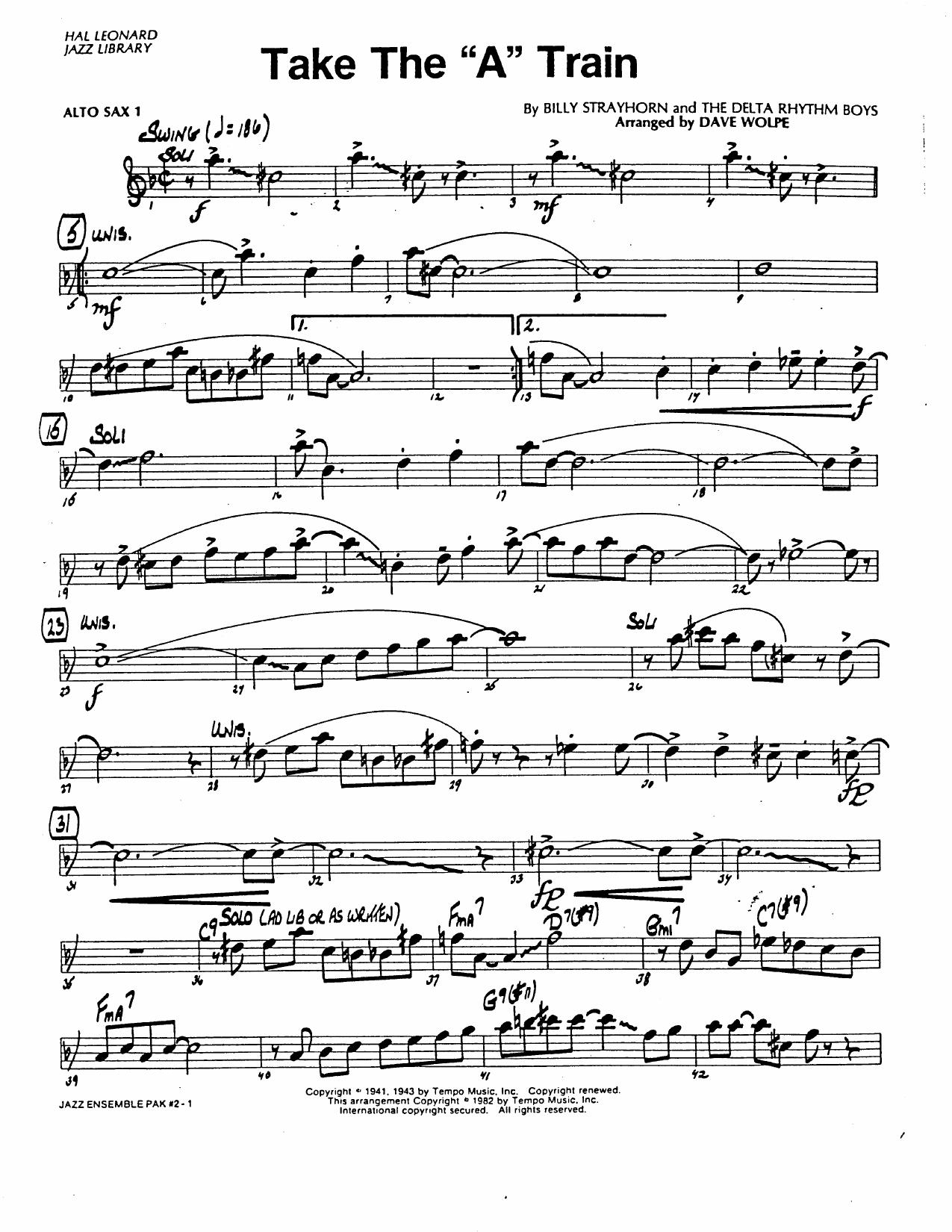
Take The A Train (D.Wolpe)
Composed by Billy Strayhorn
Arranged by Dave Wolpe
- Ensemble: Big Band
- Pages: 36
- Instruments (17): Alto Sax 1, Alto Sax 2, Tenor Sax 1, Tenor Sax 2, Baritone Sax, Trumpet 1, Trumpet 2, Trumpet 3, Trumpet 4, Trombone 1, Trombone 2, Trombone 3, Trombone 4, Guitar, Piano, Bass, Drums
- Difficulty: medium
- Content: Individual Parts
- Format: PDF Download (Instant)
- Price: $24.99
Billy Strayhorn’s iconic "Take the 'A' Train" stands as one of the definitive masterpieces of the twentieth-century American songbook, serving as the official theme song of the Duke Ellington Orchestra since its composition in 1941. Rooted firmly in the golden era of big band swing, Strayhorn penned the tune on the back of an envelope using subway directions given to him by Ellington himself, transforming a simple transit route into an immortal jazz anthem. Its swinging momentum, instantly recognizable opening figures, and brilliant integration of Tin Pan Alley structure with Harlem stride sensibilities established it immediately as a jazz standard. Generations of musicians have revisited the composition, yet it retains an unmatched freshness that continues to define the apex of big band arranging. Dave Wolpe’s dynamic big band adaptation captures the electrifying vitality of the original Ellington recordings while injecting a polished, contemporary punch tailored for modern educational and community ensembles. Propelled by an infectious, driving medium-up swing groove in 4/4 time, the arrangement radiates vibrant energy, balancing sophisticated harmonic structures with joyous, foot-tapping accessibility. Wolpe masterfully crafts lush brass voicings and interwoven woodwind textures that evoke the classic Duke Ellington palette—complete with characteristic plunger-mute colors and sparkling ensemble interplay—while maintaining a clean, contemporary clarity that lets the iconic melody breathe with renewed momentum. The structural framework of the chart highlights brilliant sectional contrast, opening with the signature brass fanfare before trading the primary melody seamlessly between the saxophones and muted brass. A high-energy shout chorus serves as the emotional apex of the chart, showcasing full ensemble integration, punchy syncopated accents, and a roaring dynamic contour that demands disciplined articulation. Solos are thoughtfully integrated into the arrangement, giving featured performers ample space to stretch out over standard blues or changes-based backgrounds that keep the rhythm section intensely engaged. The interplay between the crisp ride cymbal patterns and the walking bass line anchors the entire ensemble, demanding a tight, unified pocket from the rhythm section. Advanced high school ensembles, collegiate jazz orchestras, and professional community big bands will find this arrangement to be an exceptional cornerstone for concert programming and festival adjudication. The chart strikes an ideal balance between technical attainability and stylistic depth, challenging players to master authentic swing eighth-note subdivision, section blend, and dynamic control without presenting insurmountable technical roadblocks. Performing this Dave Wolpe chart provides students and seasoned professionals alike with a masterclass in classic big band phrasing, ensuring an unforgettable experience for both the performers and the audience. Success with Dave Wolpe’s arrangement of "Take the 'A' Train" hinges on establishing an unyielding, relaxed medium-up swing groove from the first downbeat. Conductor and rhythm section players must prioritize a buoyant, forward-moving pulse, ensuring that eighth notes are properly swung with light articulation on the upbeat rather than being heavily tongued. The drummer should maintain a steady, feather-light bass drum foot ("four-on-the-floor" style) while driving the ensemble with crisp ride cymbal phrasing and sharp backbeats on beats two and four from the hi-hat. Brass players should make ample use of cup and plunger mutes where indicated to authentically replicate the classic Ellington-era tonal colors, paying careful attention to intonation adjustments inherent in muted playing. Articulation is paramount: short notes must be clipped and clean, while longer accented lines require a warm, sustained vibrato appropriate for the style. During the shout chorus, dynamic restraint in the early measures is essential to preserve headroom for the ultimate climax at the section's conclusion. Rehearsals should initially isolate the rhythm section to lock in the groove before layering in the horn sections, focusing intensely on section blend, breath support, and unified release points across all 17 voices. Q: What specific instruments and parts are included in this big band arrangement? A: The arrangement is scored for a standard 17-piece big band instrumentation, comprising 5 saxophones (Alto Sax 1, Alto Sax 2, Tenor Sax 1, Tenor Sax 2, Baritone Sax), 4 trumpets, 4 trombones, and a full 4-piece rhythm section consisting of piano, guitar, bass, and drums. Q: What is the difficulty level of this Dave Wolpe chart? A: This arrangement is rated as medium-advanced, making it exceptionally well-suited for advanced high school bands, collegiate jazz ensembles, and professional community big bands looking for a polished festival or concert piece. Q: What is the historical style and musical context of this piece? A: This piece is a quintessential swing-era jazz standard originally composed by Billy Strayhorn in 1941 as the theme song for the Duke Ellington Orchestra, arranged here by Dave Wolpe to capture that authentic vintage big band excitement. Q: What makes this specific arrangement by Dave Wolpe unique? A: Wolpe uniquely bridges traditional Ellington-style voicings—such as characteristic muted brass effects and lush section solis—with a crisp, contemporary editorial clarity that helps modern ensembles achieve professional polish and dynamic balance effortlessly. Q: What is the performance duration and tempo recommendation for this arrangement? A: While performance time generally ranges between 3 to 4 minutes depending on solo lengths, the chart is designed to be performed at a brisk, driving medium-swing tempo of approximately 160 to 172 beats per minute.
Questions and answers
- What is included in the Take The A Train (D.Wolpe) PDF?
- The verified current file contains individual parts across 36 pages.
- How many instruments or parts are listed for Take The A Train (D.Wolpe)?
- The verified instrumentation list contains 17 entries for this Big Band arrangement.
- Who is credited for Take The A Train (D.Wolpe)?
- Composer: Billy Strayhorn. Arranger: Dave Wolpe.
- What difficulty is listed for Take The A Train (D.Wolpe)?
- The verified difficulty level is medium.
- Can I preview Take The A Train (D.Wolpe) before buying?
- Yes. The product page provides a preview generated from the current PDF file.
- How is Take The A Train (D.Wolpe) delivered?
- After successful payment, the digital PDF is made available for download. The displayed price is $24.99.
Musicians Also Search For
Take The A Train Dave Wolpe PDF • Take The A Train Dave Wolpe sheet music • Take The A Train arranged by Dave Wolpe • Dave Wolpe big band charts • Dave Wolpe jazz arrangements PDF • Take The A Train Billy Strayhorn sheet music • Take The A Train Billy Strayhorn big band arrangements • Billy Strayhorn big band charts • Take The A Train big band arrangements • Take The A Train big band PDF download • Take The A Train jazz sheet music • big band sheet music download • Take The A Train individual parts download • Take The A Train sheet music PDF • buy Take The A Train sheet music • download Take The A Train PDF • Take The A Train jazz charts • best Dave Wolpe big band arrangements • Billy Strayhorn arranged by Dave Wolpe • Take The A Train printable sheet music • big band repertoire PDF