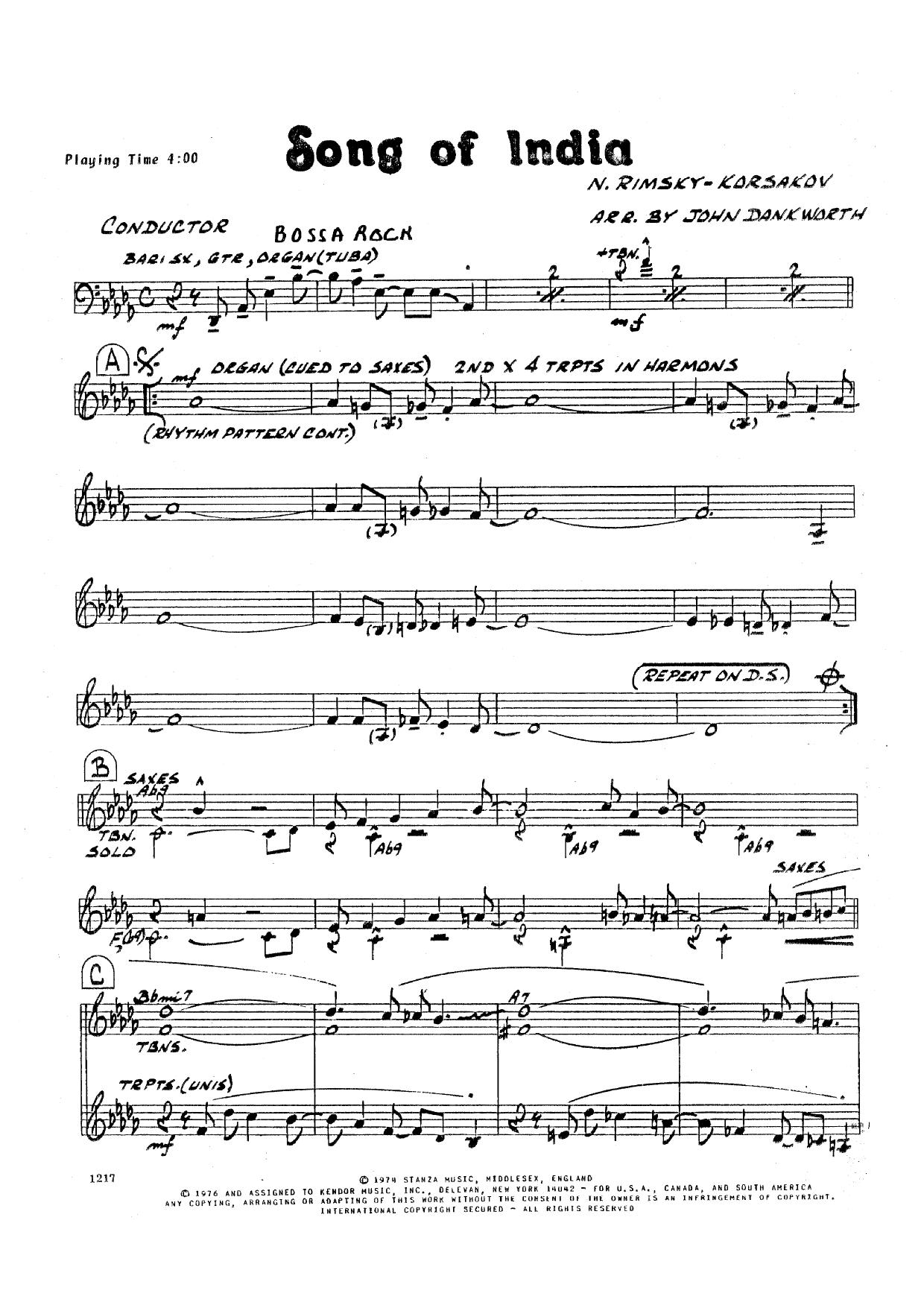
Song Of India (J.Dankworth)
Composed by Nikolai Rimsky-Korsakov
Arranged by J.Dankworth
- Ensemble: Big Band
- Style: Jazz Standard
- Pages: 41
- Instruments (19): Conductor, 1st Eb Alto Sax, 2nd Eb Alto Sax, 1st Bb Tenor Sax, 2nd Bb Tenor Sax, Baritone Sax, 1st Bb Trumpet, 2nd Bb Trumpet, 3rd Bb Trumpet, 4th Bb Trumpet, 1st Trombone, 2nd Trombone, 3rd Trombone, 4th Trombone, Guitar, Organ (Electric Piano), Tuba (Opt.), Bass, Drums
- Difficulty: medium
- Content: Individual Parts
- Format: PDF Download (Instant)
- Price: $24.99
Nikolai Rimsky-Korsakov’s iconic 1896 melody from the opera *Sadko*, "Song of India," underwent one of its most compelling transformations when British jazz pioneer Johnny Dankworth applied his sophisticated modern big band language to the exotic theme. Emerging from the vibrant post-war British jazz scene where Dankworth’s orchestra bridged the gap between traditional swing and modern modal and bebop-inflected orchestration, this arrangement reimagines a classical standard as a high-octane vehicle for contemporary big band expression. While Tommy Dorsey famously commercialized a sweet-swing version in the late 1930s, Dankworth’s charts approach the material with a sharper, cooler British modernism characterized by intricate counterpoint, biting brass writing, and an unmistakable driving momentum. Propelled by a relentless, infectious medium-up groove, the arrangement balances the hypnotic, winding chromaticism of the original Russian orientalism with crisp, swinging articulation and extended harmonic colorations. The mood shifts masterfully between slinking, sultry minor-key statements and roaring, full-ensemble climaxes that evoke both the mystique of the original programmatic suite and the urban sophistication of modern jazz. Dankworth utilizes rich, contemporary chord voicings that thicken the texture without losing the stark clarity of Rimsky-Korsakov's famous recurring motif, creating an atmosphere that is simultaneously nostalgic and sharply avant-garde for its era. Dankworth’s structural approach relies heavily on shifting tonal landscapes and brilliant sectional interplay. The woodwind-heavy saxophone section—featuring parts for two altos, two tenors, and baritone—frequently carries the intricate, snake-charmer-esque melodic lines in tight, harmonized solis, while the brass section interjects with punchy, harmonically advanced counter-melodies. The arrangement features ample space for featured improvised solos, allowing lead players to stretch out over sophisticated changes that expand upon the tune's modal framework. A meticulously crafted shout chorus builds relentless tension through syncopated cross-rhythms and dynamic swells, driving the ensemble toward a powerful, high-energy climax before a clever, understated final resolution. Advanced high school, collegiate, and professional big bands will find this chart an exceptionally rewarding addition to their repertoire. Because of its demanding saxophone lines, intricate time-feel transitions, and the need for tight stylistic cohesion within the brass section, it requires an ensemble with strong technical command and a mature sense of swing phrasing. Conducting this piece demands careful balance to ensure the inner contrapuntal voices cut through the heavy ensemble textures, making it a stellar festival piece or concert closer that consistently captivates sophisticated audiences. Mastering Johnny Dankworth’s treatment of "Song of India" requires rigorous attention to articulation and dynamic contrast. The rhythm section must anchor the chart with a steady, driving pulse, avoiding any tendency to rush the fast medium-swing tempo, particularly during complex unison horn passages. Horn players should focus on clean, short articulations on backbeats to maintain the characteristic British "cool jazz" crispness. A primary technical challenge lies in the woodwind and saxophone sections executing the rapid, scalar chromatic passages with absolute precision and uniform tone. Conductors should rehearse these lines slowly, ensuring that every note speaks clearly before building up to performance speed. Brass players must exercise careful control over dynamic swells, particularly during the transition into the shout chorus, ensuring that trumpets and trombones blend without overpowering the foundational bass line. Utilize dynamic terracing to highlight the counter-melodies woven beneath the primary theme, and pay close attention to breath support during the extended phrase groups in the saxophone solis. Q: What specific instrumentation and parts are included in this arrangement? A: This chart is scored for a standard 18-instrument big band lineup, featuring two alto saxophones, two tenor saxophones, baritone saxophone, standard brass instrumentation, and a full rhythm section, complete with the conductor's score across 41 pages. Q: What is the designated difficulty level for this arrangement? A: This piece is best suited for advanced high school, collegiate, and professional big bands due to its intricate saxophone soli lines, sophisticated harmonic language, and demand for precise ensemble tightness. Q: What is the musical style and historical context of this version? A: Arranged by British jazz icon Johnny Dankworth, this chart reimagines Nikolai Rimsky-Korsakov’s 1896 classical theme through a sophisticated post-war modern jazz and swing lens. Q: What makes J.Dankworth’s arrangement unique compared to other versions? A: Unlike the sweeter, commercial swing interpretations of the 1930s, Dankworth’s chart utilizes cutting modern voicings, intricate counterpoint, and sharp dynamic contrasts that highlight a distinctly British modernism. Q: What is the expected performance duration and tempo feel of the piece? A: The arrangement is set in a driving, medium-up swing feel that typically runs between 3.5 and 4.5 minutes, depending on the length of the open improvised solo sections.
Questions and answers
- What is included in the Song Of India (J.Dankworth) PDF?
- The verified current file contains a conductor score and individual parts across 41 pages.
- How many instruments or parts are listed for Song Of India (J.Dankworth)?
- The verified instrumentation list contains 19 entries for this Big Band arrangement.
- Who is credited for Song Of India (J.Dankworth)?
- Composer: Nikolai Rimsky-Korsakov. Arranger: J.Dankworth.
- What difficulty is listed for Song Of India (J.Dankworth)?
- The verified difficulty level is medium.
- What style is listed for Song Of India (J.Dankworth)?
- The catalog lists the style as Jazz Standard.
- Can I preview Song Of India (J.Dankworth) before buying?
- Yes. The product page provides a preview generated from the current PDF file.
- How is Song Of India (J.Dankworth) delivered?
- After successful payment, the digital PDF is made available for download. The displayed price is $24.99.
Musicians Also Search For
Song Of India J.Dankworth PDF • Song Of India J.Dankworth sheet music • Song Of India arranged by J.Dankworth • J.Dankworth big band charts • J.Dankworth jazz arrangements PDF • Song Of India Nikolai Rimsky-Korsakov sheet music • Song Of India Nikolai Rimsky-Korsakov big band arrangements • Nikolai Rimsky-Korsakov big band charts • Song Of India big band arrangements • Song Of India big band PDF download • Song Of India jazz sheet music • big band sheet music download • Song Of India conductor score PDF • Song Of India individual parts download • Song Of India sheet music PDF • Song Of India Jazz Standard charts • Jazz Standard big band arrangements • buy Song Of India sheet music • download Song Of India PDF • Song Of India jazz charts • best J.Dankworth big band arrangements • Nikolai Rimsky-Korsakov arranged by J.Dankworth • Song Of India printable sheet music • big band repertoire PDF