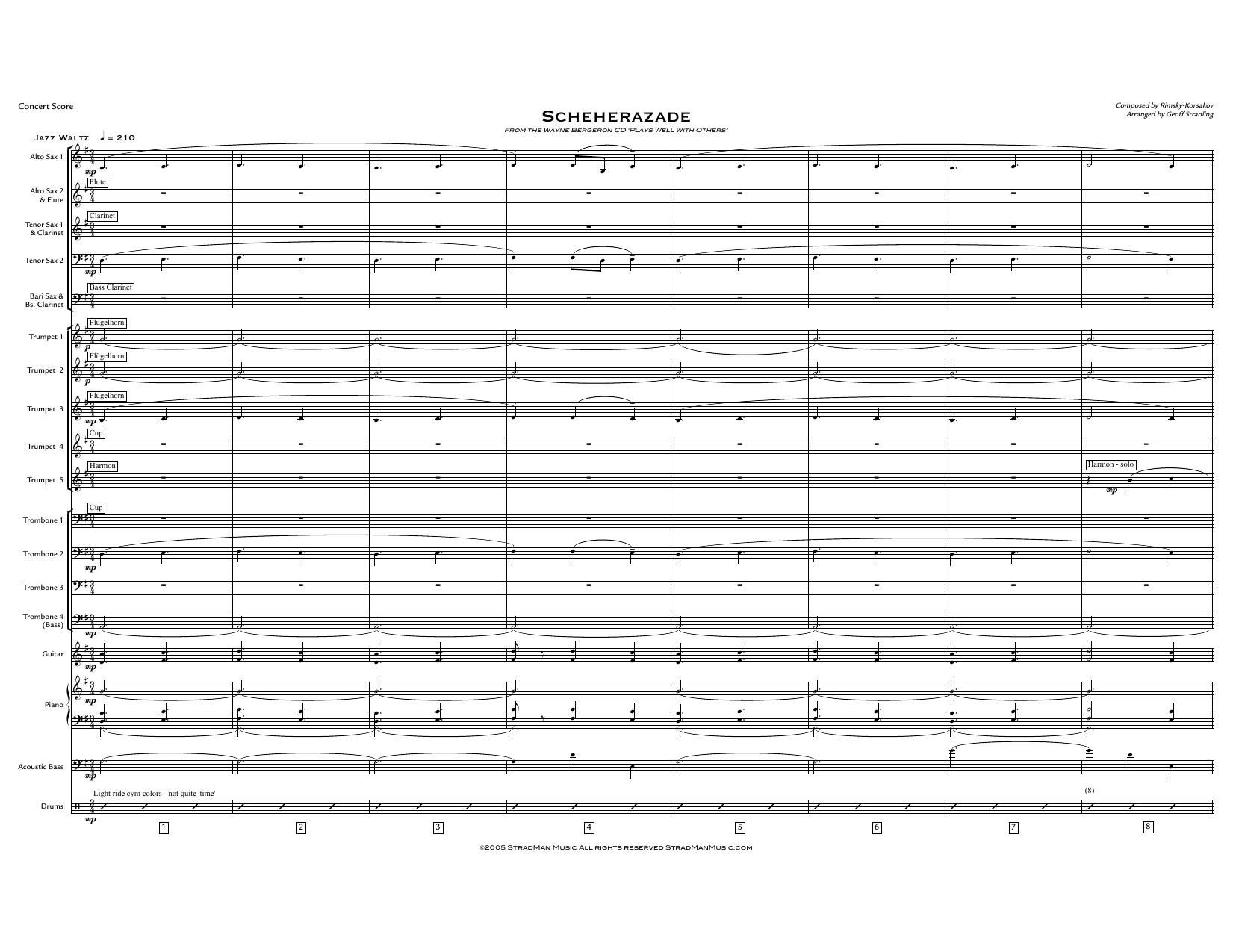
Scheherazade (G.Stradling)
Composed by Nikolai Rimsky-Korsakov
Arranged by G.Stradling
- Ensemble: Big Band
- Style: Jazz Standard
- Pages: 133
- Instruments (18): Alto Sax 1, Alto Sax 2 & Flute, Tenor Sax 1 & Clarinet, Tenor Sax 2, Bari Sax & Bs. Clarinet, Trumpet 1, Trumpet 2, Trumpet 3, Trumpet 4, Trumpet 5, Trombone 1, Trombone 2, Trombone 3, Trombone 4 (Bass), Guitar, Piano, Acoustic Bass, Drums
- Difficulty: advanced
- Content: Individual Parts
- Format: PDF Download (Instant)
- Price: $24.99
Nikolai Rimsky-Korsakov’s 1888 symphonic masterpiece *Scheherazade* has long captivated listeners with its exotic modal flavors, sweeping orchestration, and mesmerizing programmatic narrative based on *One Thousand and One Nights*. In this ambitious big band adaptation, arranger G.Stradling bridges the opulent 19th-century Russian nationalist tradition with the sophisticated harmonic language of modern jazz. While Rimsky-Korsakov utilized the solo violin to represent the cunning sultana weaving her tales, this jazz standard reimagines the iconic recurring motif through a dynamic contemporary lens, shifting the exoticism into a vibrant, swinging vernacular that honors the original thematic integrity while exploring rich, extended tertian and quartal harmonies. Propelled by a driving contemporary swing groove intertwined with undulating modal vamps, the arrangement balances lush, impressionistic chord clusters with high-energy modal blowing sections. The mood oscillates seamlessly between sultry, mysterious nocturnal intrigue and explosive, brass-heavy intensity. G.Stradling employs lush woodwinddoubling textures—featuring prominent parts for flute and clarinet alongside the standard saxophone section—to capture the shimmering, ethereal orchestrations of the original score. Richly voiced sax solis and a towering, multi-tiered shout chorus showcase masterclass big band writing, utilizing modern reharmonizations that breathe fresh life into familiar melodies without losing the unmistakable flavor of the original programmatic suite. Throughout the 133-page comprehensive conductor score and 22-part instrumentation, thematic material is distributed democratically across the ensemble. The flutes and alto saxophones frequently handle the sinuous opening statements, while the tenor saxophones and trumpets take charge during the high-octane swing episodes. Improvised solo spaces are thoughtfully provided for tenor saxophone and lead trumpet, backed by crisp, interactive rhythm section writing that encourages sophisticated comping. Technical demands center on clean articulation in fast woodwind passages, precise ensemble intonation during dense chromatic modulations, and a mature command of stylistic contrast between lush ballad-esque sub-sections and aggressive up-tempo swing feels. Advanced collegiate, community, and professional big bands will find this chart an exhilarating centerpiece for festival performance or formal concert programming. The sheer scope of the 133-page score demands meticulous sectional preparation, making it an ideal vehicle for showcasing a mature ensemble's blend, dynamic control, and improvisational prowess. Conductor and players alike will relish the intricate interplay between Rimsky-Korsakov’s immortal melodies and G.Stradling's inspired, forward-thinking jazz architecture. Navigating G.Stradling’s grand treatment of *Scheherazade* requires careful attention to dynamic balance and stylistic fluidity. The tempo should maintain a flexible, conversational momentum, anchored by a steady, buoyant swing feel that never rushes during dense chromatic passages. Woodwind doublers must ensure their instruments blend seamlessly with the brass section during unison lines, particularly when doubling the high-register melodic motives originally written for solo violin. Conductor focus should be directed toward the subtle rubato transitions leading into the up-tempo swing sections; these require clean, unified breath attacks to preserve the mysterious, exotic tension. Pay close attention to articulation markings—contrasting legato modal phrasing with crisp, biting accents in the shout chorus will define the stylistic success of the chart. Rhythm section players should approach the comping with an ear toward modal openness, avoiding heavy-handed comping during the quieter thematic expositions and building intensity alongside the horns as the arrangement drives toward its thunderous, high-energy climax. Q: What instruments and parts are included in this publication? A: This comprehensive arrangement features 22 separate instrument parts, including Alto Saxophone 1 (with flute doubling), Alto Saxophone 2 (with clarinet doubling), Tenor Saxophone 1, Tenor Saxophone 2, Baritone Saxophone, 4 Trumpets, 4 Trombones, Piano, Guitar, Bass, Drums, and a full 133-page conductor score. Q: What is the difficulty level of this arrangement? A: This chart is graded as advanced, best suited for collegiate, advanced high school, community, and professional big bands due to its complex harmonies, extensive woodwind doubling, and high technical demands. Q: What is the musical style and historical context of this piece? A: It is a modern jazz standard adaptation of Nikolai Rimsky-Korsakov’s 1888 symphonic suite *Scheherazade*, merging 19th-century Russian programmatic motifs with contemporary big band swing and modal jazz concepts. Q: What makes G.Stradling's arrangement unique? A: It uniquely preserves the exotic, shimmering orchestrations of the original orchestral masterwork while incorporating sophisticated extended harmonies, rich woodwind textures, and a towering, multi-tiered shout chorus. Q: What is the expected performance duration and tempo framework? A: The arrangement is conceived as an extended concert piece—typically running between 7 and 9 minutes depending on solo choruses—and moves fluidly between rubato mood-setting introductions and a driving, medium-up swing tempo.
Questions and answers
- What is included in the Scheherazade (G.Stradling) PDF?
- The verified current file contains a conductor score and individual parts across 133 pages.
- How many instruments or parts are listed for Scheherazade (G.Stradling)?
- The verified instrumentation list contains 18 entries for this Big Band arrangement.
- Who is credited for Scheherazade (G.Stradling)?
- Composer: Nikolai Rimsky-Korsakov. Arranger: G.Stradling.
- What difficulty is listed for Scheherazade (G.Stradling)?
- The verified difficulty level is advanced.
- What style is listed for Scheherazade (G.Stradling)?
- The catalog lists the style as Jazz Standard.
- Can I preview Scheherazade (G.Stradling) before buying?
- Yes. The product page provides a preview generated from the current PDF file.
- How is Scheherazade (G.Stradling) delivered?
- After successful payment, the digital PDF is made available for download. The displayed price is $24.99.
Musicians Also Search For
Scheherazade G.Stradling PDF • Scheherazade G.Stradling sheet music • Scheherazade arranged by G.Stradling • G.Stradling big band charts • G.Stradling jazz arrangements PDF • Scheherazade Nikolai Rimsky-Korsakov sheet music • Scheherazade Nikolai Rimsky-Korsakov big band arrangements • Nikolai Rimsky-Korsakov big band charts • Scheherazade big band arrangements • Scheherazade big band PDF download • Scheherazade jazz sheet music • big band sheet music download • Scheherazade conductor score PDF • Scheherazade individual parts download • Scheherazade sheet music PDF • Scheherazade Jazz Standard charts • Jazz Standard big band arrangements • buy Scheherazade sheet music • download Scheherazade PDF • Scheherazade jazz charts • best G.Stradling big band arrangements • Nikolai Rimsky-Korsakov arranged by G.Stradling • Scheherazade printable sheet music • big band repertoire PDF