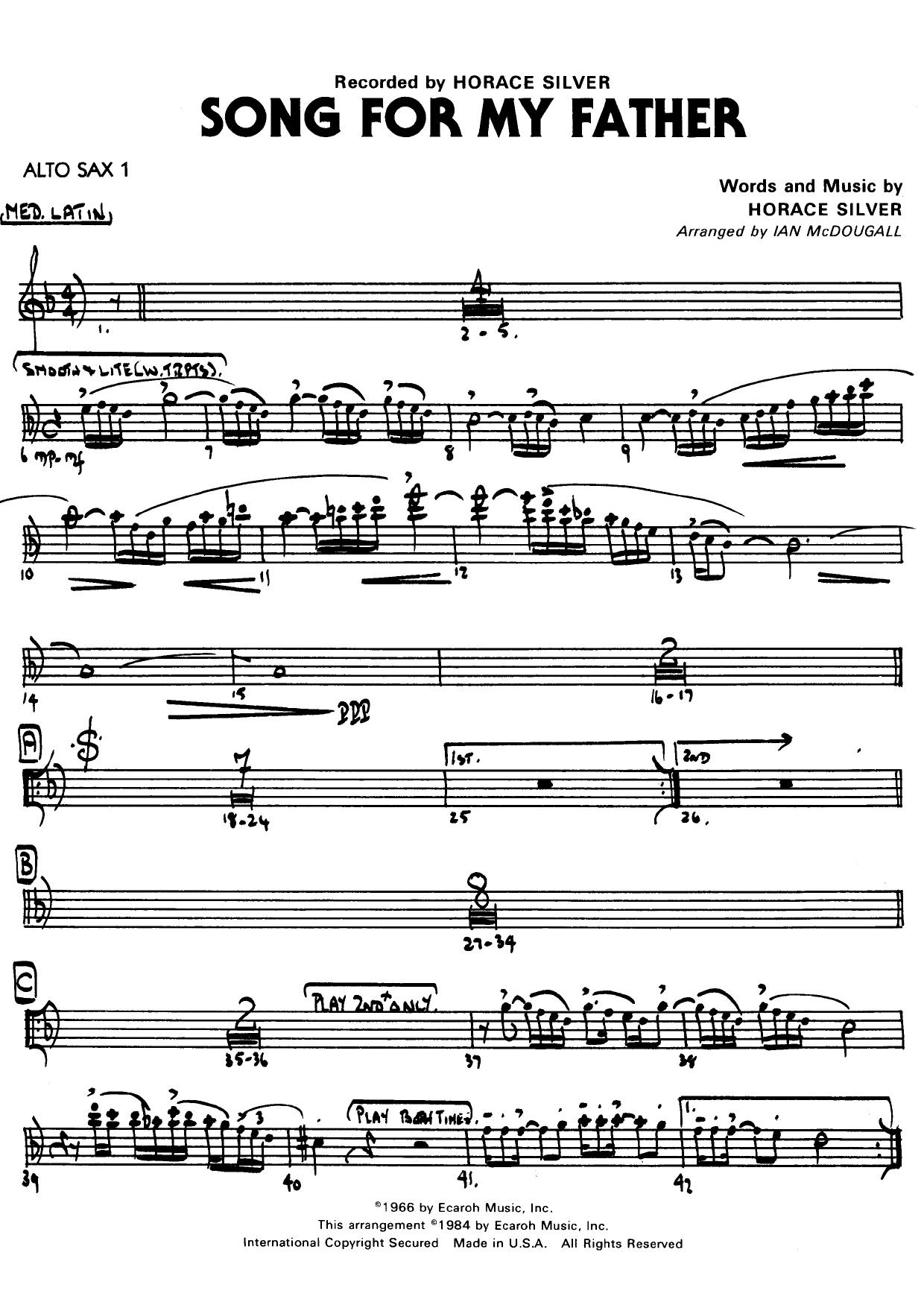
Song For My Father (I.McDougall) sheet music preview

Song For My Father (I.McDougall)

Composed by Horace Silver

Arranged by I.McDougall

  • Ensemble: Big Band
  • Style: Jazz Standard
  • Pages: 56
  • Instruments (18): Alto Sax 1, Alto Sax 2, Tenor Sax 1, Tenor Sax 2, Baritone Sax, Trumpet 1, Trumpet 2, Trumpet 3, Trumpet 4, Trombone 1, Trombone 2, Trombone 3, Trombone 4, Piano, Guitar, Bass, Drums, Aux. Percussion
  • Difficulty: advanced
  • Content: Individual Parts
  • Format: PDF Download (Instant)
  • Price: $24.99

Horace Silver’s iconic "Song for My Father" stands as a monumental pillar of 1960s hard bop and soul jazz, immortalized on the 1964 Blue Note album of the same name. Inspired by Silver’s father, a Portuguese-Cape Verdean folk musician, and infused with the rhythmic vitality Silver absorbed during a trip to Brazil, the tune established a definitive blueprint for combining modal jazz harmonies with infectious, danceable Latin-jazz grooves. The instantly recognizable bassline and catchy, blues-infused head have cemented its status as one of the most performed and beloved jazz standards in the global repertoire, bridging the gap between sophisticated bebop vocabulary and accessible, roots-driven rhythm. In this masterful big band adaptation, arranger Ian McDougall harnesses the earthy, hypnotic 16th-note bossa/calypso hybrid groove of the original recording while expanding its sonic palette for an 18-piece jazz orchestra. Set in a comfortable medium tempo, the arrangement opens with that signature, driving ostinato in the rhythm section before the horns enter with rich, burnished chordal voicings that capture the warmth and soulful swagger of Silver's original Blue Note arrangement. McDougall’s writing is characterized by transparent textures and clever dynamic shifts, allowing the underlying rhythmic tension to build naturally. The mood oscillates between laid-back sophistication and high-energy exuberance, evoking the vibrant atmosphere of a smoky mid-century jazz club combined with the celebratory spirit of a Caribbean carnival. McDougall utilizes the big band forces with exceptional coloristic variety, assigning the iconic head initially to a tight, focused horn soli before opening the form up for improvised solos. The brass and reed sections trade punchy background figures that drive the soloists forward without ever cluttering the texture. Technical demands are well-balanced across the ensemble; while the chart requires precise articulation and a deep internal clock to nail the syncopated Latin-swing hybrid figures, it avoids unnecessarily hyper-fast tempos or extreme altissimo ranges. A powerful, harmonically rich shout chorus serves as the structural climax of the arrangement, building from a low-register murmur into a soaring, brass-heavy proclamation before pulling back to the hypnotic main theme. Advanced high school ensembles with strong rhythm sections, as well as collegiate and professional community big bands, will find this chart to be an exceptionally rewarding addition to their repertoire. It offers an ideal vehicle for teaching students how to balance straight-eighth-note Latin feels with traditional swing phrasing, demanding stylistic versatility and ensemble listening. Directors will appreciate how cleanly the 56-page score lays out the dynamic contours, making it an effective festival showcase piece or a crowd-pleasing centerpiece for any standard jazz concert program. The primary technical challenge in performing this arrangement lies in maintaining an authentic, unhurried groove throughout the rhythm section and horns. The tempo should sit comfortably in a relaxed medium pocket; rushing the 16th-note syncopation will rob the chart of its characteristic warmth and swagger. Drummers should focus on an authentic bossa/calypso hybrid feel on the ride cymbal and cowbell, avoiding heavy rock beats. Brass players must pay close attention to dynamic markings during the background figures behind the soloists, ensuring that muted trumpet or trombone lines remain supportive rather than intrusive. Articulation is paramount: short notes must be crisp and dry, while sustained lines require a warm, vocal vibrato. During rehearsals, isolate the rhythm section first to lock in the foundational ostinato before layering the horn sections. Directors should insist on unified phrasing and matched breath support across the saxophone section to let McDougall’s lush chordal voicings bloom effectively in the ensemble tutti sections. Q: What instruments and parts are included in this big band arrangement? A: The arrangement is scored for a standard 18-instrument big band instrumentation, comprising 2 alto saxophones, 2 tenor saxophones, 1 baritone saxophone, 4 trumpets, 4 trombones, guitar, piano, bass, drums, and auxiliary percussion parts to support the Latin groove. Q: What is the difficulty level of this chart? A: This arrangement is graded as medium-advanced, making it ideal for accomplished high school bands, collegiate ensembles, and professional community big bands looking for a crowd-pleasing standard with depth. Q: What is the musical style and historical background of the piece? A: Based on Horace Silver’s 1964 hard bop and soul-jazz classic, this arrangement blends traditional jazz standards with a infectious Brazilian-influenced Latin groove and rich modal harmonies. Q: What makes Ian McDougall's arrangement unique compared to other versions? A: McDougall's treatment stands out for its masterful balance of transparent, sophisticated horn voicings, dynamic background figures, and a meticulously crafted shout chorus that expands the original small-group tune into a vibrant orchestral experience. Q: What is the recommended performance tempo and duration? A: The piece is set at a comfortable, driving medium tempo (approximately 116–124 BPM) and typically runs for about 4 to 5 minutes depending on the length of the improvised solo sections.

Questions and answers

What is included in the Song For My Father (I.McDougall) PDF?
The verified current file contains individual parts across 56 pages.
How many instruments or parts are listed for Song For My Father (I.McDougall)?
The verified instrumentation list contains 18 entries for this Big Band arrangement.
Who is credited for Song For My Father (I.McDougall)?
Composer: Horace Silver. Arranger: I.McDougall.
What difficulty is listed for Song For My Father (I.McDougall)?
The verified difficulty level is advanced.
What style is listed for Song For My Father (I.McDougall)?
The catalog lists the style as Jazz Standard.
Can I preview Song For My Father (I.McDougall) before buying?
Yes. The product page provides a preview generated from the current PDF file.
How is Song For My Father (I.McDougall) delivered?
After successful payment, the digital PDF is made available for download. The displayed price is $24.99.

Musicians Also Search For

Song For My Father I.McDougall PDFSong For My Father I.McDougall sheet musicSong For My Father arranged by I.McDougallI.McDougall big band chartsI.McDougall jazz arrangements PDFSong For My Father Horace Silver sheet musicSong For My Father Horace Silver big band arrangementsHorace Silver big band chartsSong For My Father big band arrangementsSong For My Father big band PDF downloadSong For My Father jazz sheet musicbig band sheet music downloadSong For My Father individual parts downloadSong For My Father sheet music PDFSong For My Father Jazz Standard chartsJazz Standard big band arrangementsbuy Song For My Father sheet musicdownload Song For My Father PDFSong For My Father jazz chartsbest I.McDougall big band arrangementsHorace Silver arranged by I.McDougallSong For My Father printable sheet musicbig band repertoire PDF

All arrangements by I.McDougall All Horace Silver sheet music