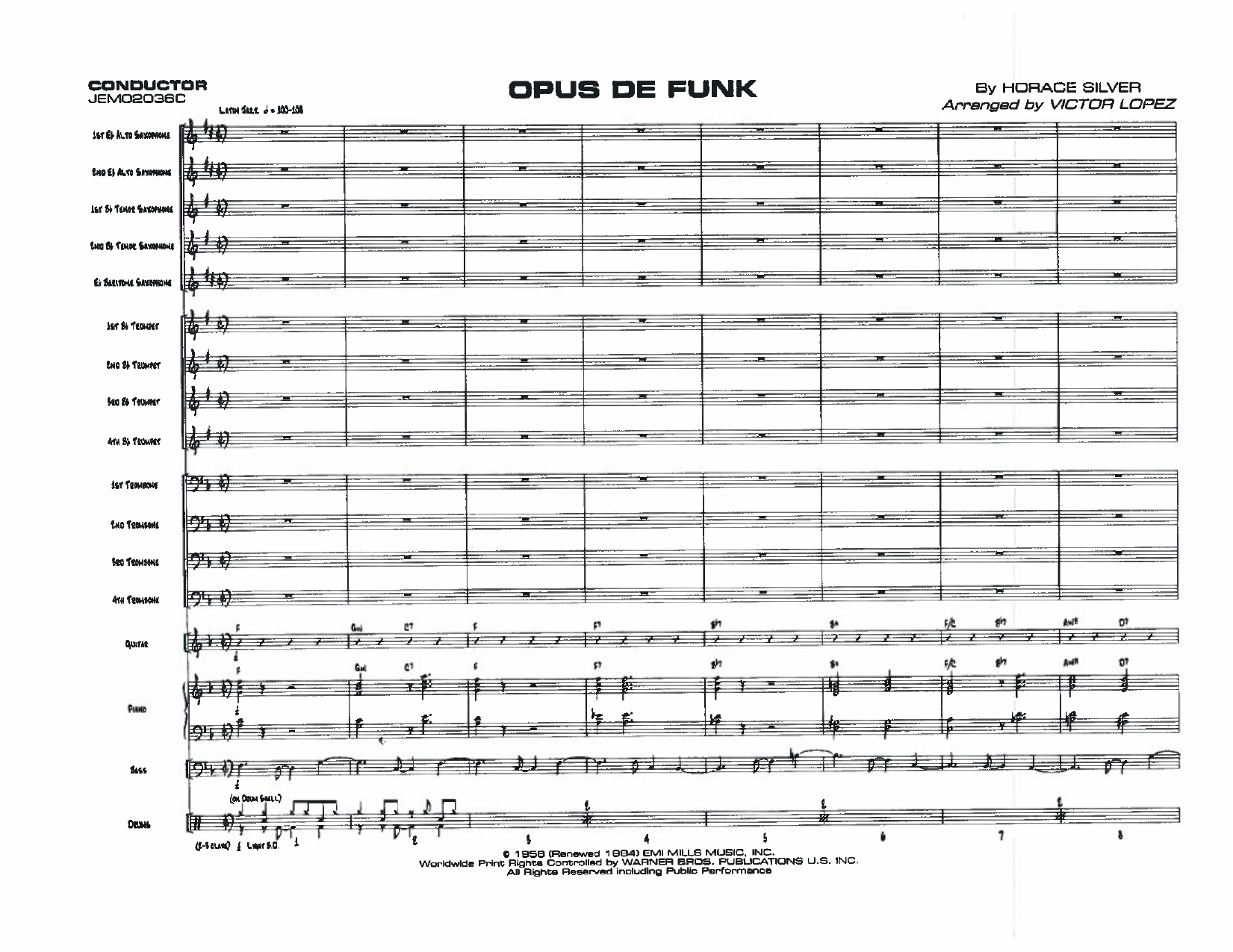
Opus De Funk (V.Lopez)
Composed by Horace Silver
Arranged by Victor Lopez
- Ensemble: Big Band
- Pages: 43
- Instruments (20): Conductor, C Flute, 1st Eb Alto Saxophone, 2nd Eb Alto Saxophone, 1st Bb Tenor Saxophone, 2nd Bb Tenor Saxophone, Eb Baritone Saxophone, 1st Bb Trumpet, 2nd Bb Trumpet, 3rd Bb Trumpet, 4th Bb Trumpet, 1st Trombone, 2nd Trombone, 3rd Trombone, 4th Trombone, Guitar, Piano, Bass, Drums, Auxiliary Percussion (Congas, Shaker, Claves)
- Difficulty: medium
- Content: Individual Parts
- Format: PDF Download (Instant)
- Price: $24.99
Horace Silver’s timeless hard bop anthem "Opus De Funk," originally recorded for Blue Note Records in 1953, stands as a foundational pillar of the 1950s jazz canon. As one of the premier pianist-composers of the hard bop era, Silver fused the sophisticated harmonic framework of bebop with the earthy, soulful grit of rhythm and blues, gospel, and blues-infused phrasing. This classic tune helped define the catchy, groove-oriented small-group writing that revolutionized modern jazz, transforming what was once a localized club style into a national movement. Decades later, its infectious cyclical blues form and driving momentum continue to captivate audiences worldwide, making it an essential vehicle for large jazz ensemble exploration. Driven by an infectious medium-tempo shuffle-swing feel, this chart radiates an irrepressible, foot-tapping energy. The composition is anchored by Silver's unmistakable, blues-drenched motif, moving effortlessly between laid-back modal swagger and high-octane ensemble punch. Victor Lopez capitalizes on this inherent dynamism by injecting rich, vibrant voicings that expand the original quintet texture into a thunderous wall of brass and reed sound. The harmonic language stays true to the hard bop idiom while taking full advantage of the big band's color palette, utilizing tight saxophone solis, crisp dynamic contrast, and punchy syncopated background figures that evoke the smoky ambiance of mid-century jazz clubs. Victor Lopez’s masterful arrangement balances accessibility with authentic stylistic integrity. The melody is initially introduced by the saxophone section before being opened up to the full ensemble with brass counter-lines that heighten the tension and release. A standout feature of the chart is the dynamic shout chorus, which builds organically through clever use of cross-section writing and rhythmic displacement, driving the band toward a powerful, high-energy climax. Solo opportunities are provided over standard blues changes, allowing developing or seasoned improvisers to stretch out comfortably within a familiar harmonic framework without overwhelming the rhythm section. Advanced high school ensembles, collegiate bands, and professional community big bands will find this chart to be an exceptionally rewarding addition to their repertoire. While the technical demands—such as independent swing phrasing, precise articulation, and dynamic control—require a solid foundational understanding of jazz idiom, the scoring is idiomatic and transparent. Rhythmic figures are carefully crafted to teach section tightness and breath support, making it an ideal pedagogical tool for directors aiming to instill authentic swing feel, alongside being an absolute crowd-pleaser for festival programs and concert performances alike. To capture the true essence of this hard bop classic, the rhythm section must lock into a deep, driving medium shuffle-swing feel right from the downbeat. The drummer should maintain a consistent, conversational ride-cymbal pattern with a crisp backbeat on beats two and four, while the bass player walks a strong, quarter-note acoustic or electric bass line that emphasizes the root-fifth foundation of the blues progression. Horn players must pay close attention to short, articulated accents and natural drop-offs, avoiding over-articulation that can rob the chart of its inherent bluesy swagger. Rehearsals should initially focus on sectional balance, ensuring that background figures underneath the soloists never overpower the melodic lead. Pay special attention to the dynamic shifts leading into the shout chorus; letting the ensemble drop to a whisper before unleashing a full-throated fortissimo will maximize the dramatic impact of Lopez's scoring. Q: What instrumentation and parts are included in this big band arrangement? A: This arrangement is scored for a standard 17-instrument big band, consisting of 5 saxophones (2 altos, 2 tenors, 1 baritone), 4 trumpets, 4 trombones, and a standard 4-piece rhythm section (piano, bass, drums, and optional guitar), spanning a total of 43 pages of music. Q: What is the difficulty level of this Victor Lopez arrangement? A: It is graded as medium-advanced, making it well-suited for proficient high school jazz bands, collegiate ensembles, and community big bands looking to develop hard bop stylistic fluency and section tightness. Q: What is the historical background and musical style of "Opus De Funk"? A: Originally composed and recorded by pianist Horace Silver in 1953, it is a quintessential hard bop standard that merges sophisticated bebop harmonies with soulful blues and rhythm-and-blues grooves. Q: What makes this specific arrangement by Victor Lopez unique? A: Lopez successfully translates Silver's intimate quintet recording into a dynamic large-ensemble format by utilizing clever cross-section writing, tight saxophone solis, and a powerful, building shout chorus. Q: What is the performance duration and recommended tempo for this piece? A: The chart is set at a comfortable medium-tempo swing/shuffle groove (approximately quarter note = 120-126 BPM) and typically runs around 3 to 4 minutes depending on solo rotations.
Questions and answers
- What is included in the Opus De Funk (V.Lopez) PDF?
- The verified current file contains a conductor score and individual parts across 43 pages.
- How many instruments or parts are listed for Opus De Funk (V.Lopez)?
- The verified instrumentation list contains 20 entries for this Big Band arrangement.
- Who is credited for Opus De Funk (V.Lopez)?
- Composer: Horace Silver. Arranger: Victor Lopez.
- What difficulty is listed for Opus De Funk (V.Lopez)?
- The verified difficulty level is medium.
- Can I preview Opus De Funk (V.Lopez) before buying?
- Yes. The product page provides a preview generated from the current PDF file.
- How is Opus De Funk (V.Lopez) delivered?
- After successful payment, the digital PDF is made available for download. The displayed price is $24.99.
Musicians Also Search For
Opus De Funk Victor Lopez PDF • Opus De Funk Victor Lopez sheet music • Opus De Funk arranged by Victor Lopez • Victor Lopez big band charts • Victor Lopez jazz arrangements PDF • Opus De Funk Horace Silver sheet music • Opus De Funk Horace Silver big band arrangements • Horace Silver big band charts • Opus De Funk big band arrangements • Opus De Funk big band PDF download • Opus De Funk jazz sheet music • big band sheet music download • Opus De Funk conductor score PDF • Opus De Funk individual parts download • Opus De Funk sheet music PDF • buy Opus De Funk sheet music • download Opus De Funk PDF • Opus De Funk jazz charts • best Victor Lopez big band arrangements • Horace Silver arranged by Victor Lopez • Opus De Funk printable sheet music • big band repertoire PDF