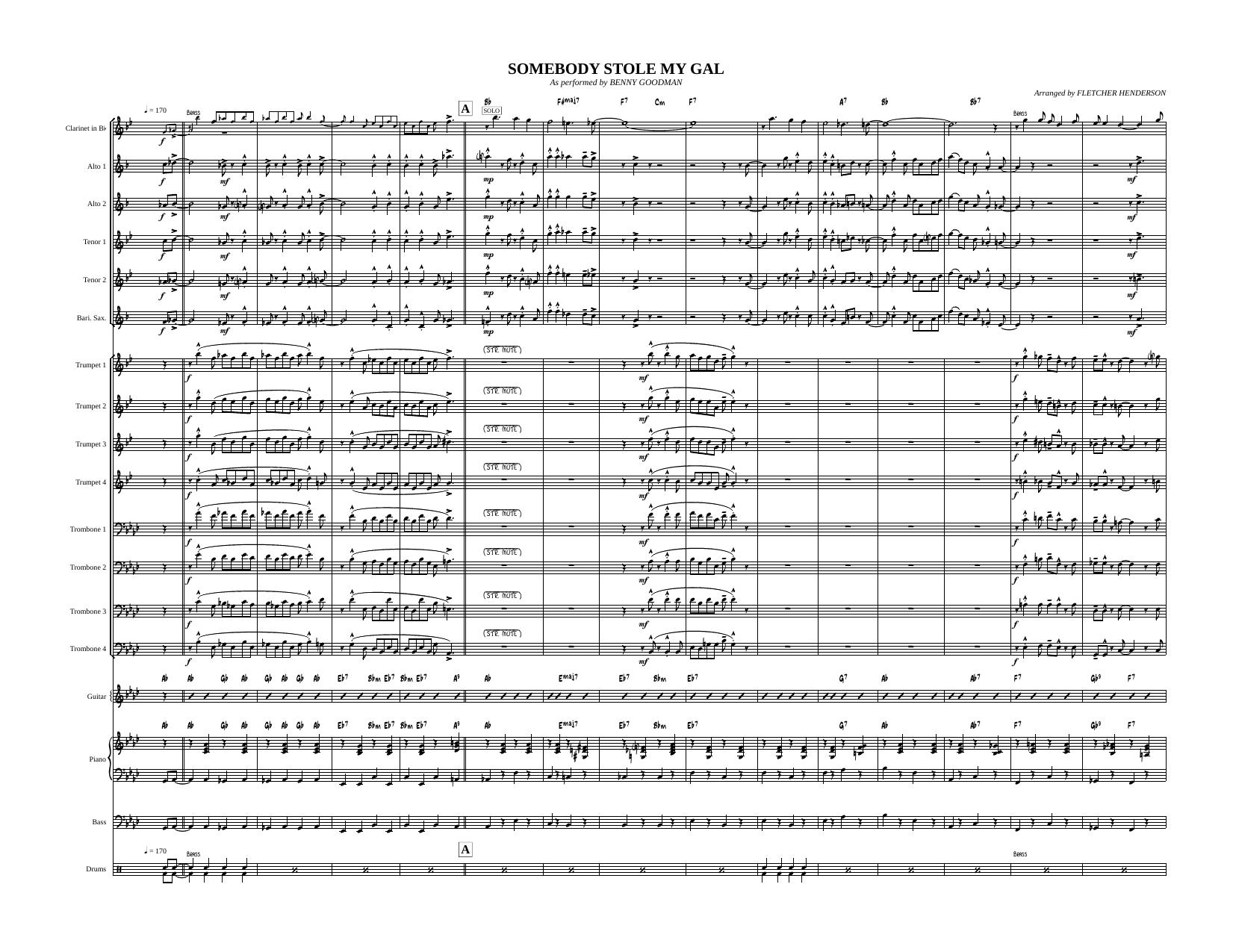
Somebody Stole My Gal (F.Henderson)
Composed by Gus Kahn
Arranged by Fletcher Henderson
- Ensemble: Big Band
- Pages: 63
- Instruments (18): Clarinet in Bb, Alto Saxophone 1, Alto Saxophone 2, Tenor Saxophone 1, Tenor Saxophone 2, Baritone Saxophone, Trumpet 1, Trumpet 2, Trumpet 3, Trumpet 4, Trombone 1, Trombone 2, Trombone 3, Trombone 4, Guitar, Piano, Bass, Drums
- Difficulty: advanced
- Content: Individual Parts
- Format: PDF Download (Instant)
- Price: $24.99
Gus Kahn’s timeless 1918 pop tune "Somebody Stole My Gal" found its definitive jazz incarnation through the pioneering genius of Fletcher Henderson and his orchestra during the vibrant crucible of the 1920s Harlem jazz age. As one of the architects of big band swing, Henderson transformed popular Tin Pan Alley material into sophisticated, driving orchestral vehicles that bridged early New Orleans polyphony with the modern, section-based swing era. Recorded and performed by Henderson’s legendary ensembles—which famously featured luminaries like Louis Armstrong and Coleman Hawkins—this arrangement captures the transitional brilliance of an era where hot jazz met structured, section-based arranging. It stands as a vital historical document of the Harlem Renaissance and a masterclass in early big band architecture. Driving with an infectious, buoyant medium-up swing feel in 4/4 time, the arrangement exudes a jubilant, high-energy vaudevillian charm fused with sophisticated early-swing syncopation. The mood shifts dynamically between cheeky, stride-infused playfulness and roaring ensemble power, evoking the smoky, electrifying atmosphere of 1920s dance halls like the Roseland Ballroom. Henderson's signature compositional approach is immediately evident in his treatment of call-and-response figures between the brass and reed sections, utilizing tight, interlocking voicings that maximize the impact of a smaller ensemble. Rather than relying on massive wall-of-sound orchestration, Henderson achieves transparency and punch through brilliant counterpoint, clever harmonic inversions, and rhythmic displacement that keeps both performers and listeners on the edge of their seats. Melodic duties are shared fluidly across the frontline, with the alto and tenor saxophones weaving intricate counter-melodies around crisp trumpet statements and warm trombone counter-punches, all underpinned by a relentless stride piano foundation. Featured solo opportunities allow individual players to stretch out in an authentic 1920s vernacular style, emphasizing buoyant phrasing, blues-infused chromaticism, and spontaneous dialogue with the rhythm section. Technical challenges lie primarily in maintaining a lightweight, authentic swing articulation—avoiding heavy, modern accents in favor of crisp, staccato tongue placements and stylistic drop-offs. The reward for the ensemble lies in experiencing the sheer momentum of Henderson’s architecture, particularly during the driving transition into the final choruses where the rhythmic tension reaches a fever pitch. Advanced high school, collegiate, and professional or community jazz repertory ensembles will find this 63-page publication an ideal vehicle for exploring the roots of big band jazz. Because it is scored for an agile 8-instrument configuration (including alto sax, tenor sax, trumpet, trombone, and piano-centric rhythm support), it provides the transparency required of smaller horn sections while demanding the stylistic maturity, rhythmic precision, and historical awareness characteristic of professional-grade repertoire. Directors will appreciate how this chart challenges students to step outside modern post-bop idioms and master the joyful, historically rich lexicon of early 20th-century American swing. Achieving an authentic rendition of Fletcher Henderson’s "Somebody Stole My Gal" requires strict adherence to 1920s stylistic conventions. Set the tempo at a bright, manageable medium-swing (around 160–168 BPM) to ensure the rhythm never feels rushed but maintains its danceable, propulsive bounce. The primary technical challenge is mastering the buoyant, non-legato articulation: eighth notes should be played relatively straight compared to later Kansas City swing, leaning toward an even, crisp delivery with sharp accents on the upbeat. Section leaders must ensure that dynamic contrast is strictly observed, allowing the underlying stride piano and rhythm parts to sparkle beneath horn soli passages. Brass players should incorporate stylistic plunger effects, subtle lip glisses, and vintage-style shakes where appropriate, steering clear of aggressive modern overblown tones. Rehearsals should begin with the rhythm section establishing a rock-solid, driving pulse before layering in the horn counterpoint section by section to lock in the intricate ensemble phrasing. Q: What instruments and parts are included in this arrangement? A: This 63-page publication is scored for an 8-instrument chamber jazz ensemble, featuring parts for alto saxophone, tenor saxophone, trumpet, trombone, piano, and foundational rhythm section support. Q: What is the difficulty level of this arrangement? A: This chart is best suited for advanced high school, collegiate, and professional or community jazz ensembles due to its stylistic demands, rhythmic precision, and historical articulation requirements. Q: What is the historical style and context of this piece? A: Composed originally by Gus Kahn in 1918, this arrangement reflects the pioneering 1920s big band style of Fletcher Henderson, capturing the vibrant transition from early hot jazz to structured swing. Q: What makes this Fletcher Henderson arrangement unique? A: It showcases Henderson's masterclass use of call-and-response interplay, tight counterpoint, and transparent section voicings that give an 8-piece ensemble the punch and drive of a much larger orchestra. Q: What is the recommended performance tempo and duration? A: The arrangement is designed for a bright medium-swing feel around 160–168 BPM, with a typical performance duration of approximately 3 to 4 minutes depending on solo rotations.
Questions and answers
- What is included in the Somebody Stole My Gal (F.Henderson) PDF?
- The verified current file contains a conductor score and individual parts across 63 pages.
- How many instruments or parts are listed for Somebody Stole My Gal (F.Henderson)?
- The verified instrumentation list contains 18 entries for this Big Band arrangement.
- Who is credited for Somebody Stole My Gal (F.Henderson)?
- Composer: Gus Kahn. Arranger: Fletcher Henderson.
- What difficulty is listed for Somebody Stole My Gal (F.Henderson)?
- The verified difficulty level is advanced.
- Can I preview Somebody Stole My Gal (F.Henderson) before buying?
- Yes. The product page provides a preview generated from the current PDF file.
- How is Somebody Stole My Gal (F.Henderson) delivered?
- After successful payment, the digital PDF is made available for download. The displayed price is $24.99.
Musicians Also Search For
Somebody Stole My Gal Fletcher Henderson PDF • Somebody Stole My Gal Fletcher Henderson sheet music • Somebody Stole My Gal arranged by Fletcher Henderson • Fletcher Henderson big band charts • Fletcher Henderson jazz arrangements PDF • Somebody Stole My Gal Gus Kahn sheet music • Somebody Stole My Gal Gus Kahn big band arrangements • Gus Kahn big band charts • Somebody Stole My Gal big band arrangements • Somebody Stole My Gal big band PDF download • Somebody Stole My Gal jazz sheet music • big band sheet music download • Somebody Stole My Gal conductor score PDF • Somebody Stole My Gal individual parts download • Somebody Stole My Gal sheet music PDF • buy Somebody Stole My Gal sheet music • download Somebody Stole My Gal PDF • Somebody Stole My Gal jazz charts • best Fletcher Henderson big band arrangements • Gus Kahn arranged by Fletcher Henderson • Somebody Stole My Gal printable sheet music • big band repertoire PDF