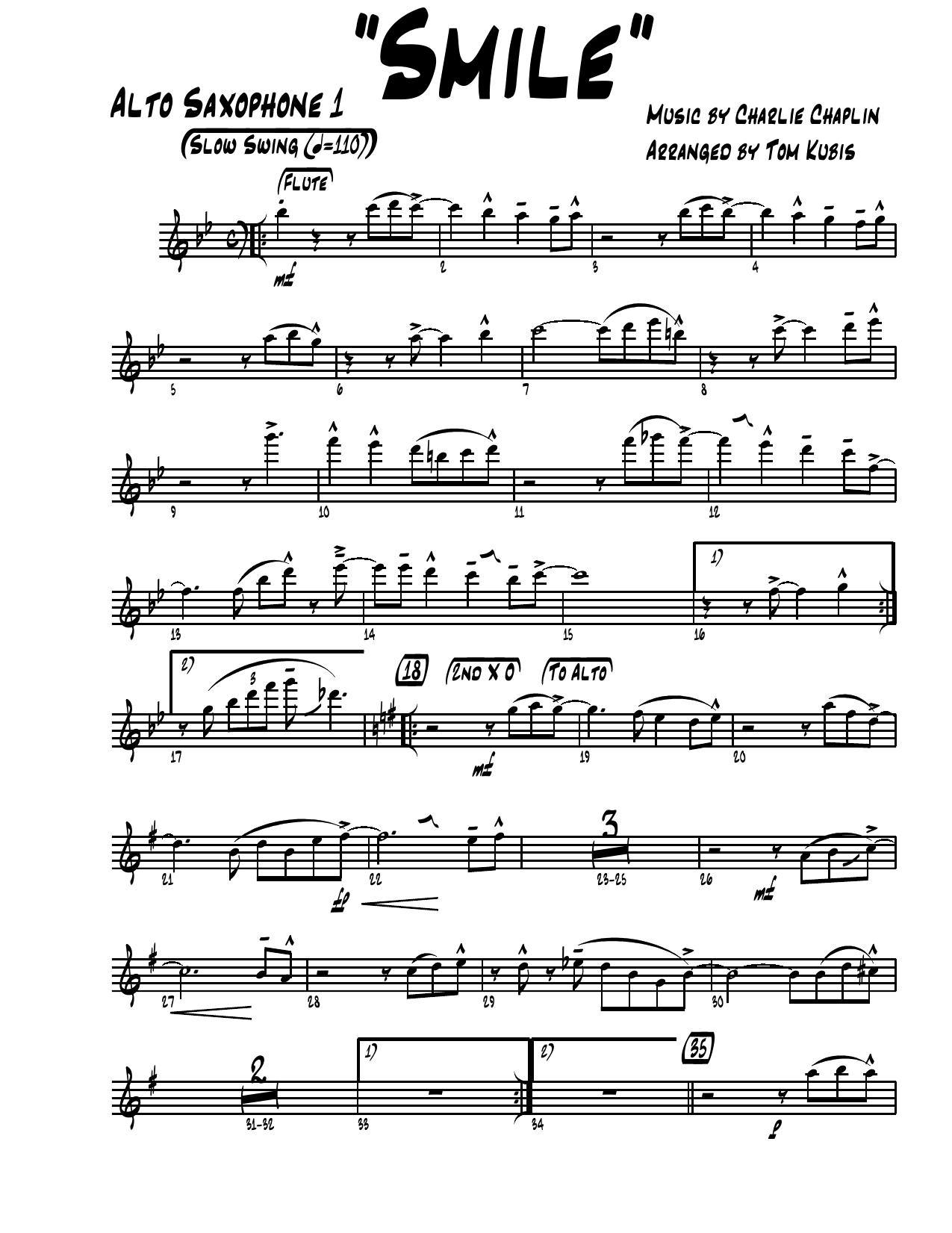
Smile (T.Kubis)
Composed by Charlie Chaplin
Arranged by Tom Kubis
- Ensemble: Big Band
- Pages: 48
- Instruments (17): Alto Saxophone 1, Alto Saxophone 2, Tenor Saxophone 1, Tenor Saxophone 2, Baritone Saxophone, Trumpet 1, Trumpet 2, Trumpet 3, Trumpet 4, Trombone 1, Trombone 2, Trombone 3, Bass Trombone, Guitar, Piano, Bass, Drums
- Difficulty: medium
- Content: Individual Parts
- Format: PDF Download (Instant)
- Price: $24.99
Charlie Chaplin originally composed the hauntingly beautiful melody for "Smile" as the closing theme to his 1936 cinematic masterpiece, *Modern Times*, sealing its legacy as one of the most enduring and poignant tunes of the 20th century. Over the decades, the song transcended its film-score origins to become a cornerstone of the Great American Songbook, interpreted by vocal and instrumental jazz icons alike, from Nat King Cole to Dexter Gordon. Its deceptively simple, descending chromatic line carries a profound emotional weight, balancing melancholy with an underlying message of resilient optimism. When filtered through the sophisticated harmonic lens of jazz, the composition reveals a rich framework that invites imaginative reharmonization and expressive, rubato-inflected phrasing. Tom Kubis elevates this timeless classic into a masterclass of modern big band writing, casting the tune in a lush, expressive medium-tempo groove that alternates between delicate sensitivity and sweeping, cinematic grandeur. Kubis avoids a straightforward ballad treatment, instead anchoring the arrangement in a buoyant, flowing feel that propels the melody forward while preserving its intrinsic warmth and vulnerability. The emotional arc transitions seamlessly from intimate, exposed section work to breathtaking, harmonically dense ensemble climaxes. The arrangement thrives on rich, extended chord voicings in the brass and cascading woodwind counterlines, evoking a sophisticated West Coast cool jazz sensibility infused with contemporary harmonic color. Throughout the chart, Kubis showcases his signature knack for dynamic contrasting and inventive orchestration. The woodwinds—featuring versatile doubling—take a prominent role in coloring the texture, while the saxophones are treated to lush, tightly knit solis that demand precise intonation and unified articulation. Brass writing balances warm, muted statements with soaring, open-bell counterpoint, leading into a meticulously crafted shout chorus that reinterpreting the iconic melody with towering, stacked major-seventh and altered dominant sonorities. Featured solo space allows a capable soloist to stretch out over a sophisticated harmonic landscape, transitioning the mood from introspective reflection to an uplifting, triumphant peak before settling back into a gentle, lingering denouement. Advanced high school ensembles with strong section players, as well as collegiate, community, and professional jazz orchestras, will find this chart an immensely rewarding centerpiece for a concert program. The technical demands lie less in breakneck speed and more in the realm of musical maturity: maintaining breath support during long, sustained phrases, balancing complex chordal layers at soft dynamic levels, and locking in a sensitive, pliable groove. Conductors seeking to challenge their band's lyrical depth, blend, and stylistic nuance will discover that Kubis’s brilliant craftsmanship turns a familiar cinematic melody into an unforgettable big band experience. Success with this arrangement hinges heavily on the ensemble's ability to balance lyrical expression with precise rhythmic control. The tempo should be kept at a comfortable, flowing medium-swing or groove feel—never rushed, allowing the eighth-note subdivisions to breathe naturally. Key technical challenges involve intonation within the sax solis and rich brass chords; players must lock their pitch tendencies, particularly on altered extensions. Woodwind doubles require quick, clean instrument changes and careful blending with the brass section to maintain a seamless sonic fabric. Conductors should pay close attention to dynamic contrast, ensuring the rhythm section maintains a light, transparent foundation beneath the horns. Encourage the lead trumpet and lead alto to shape phrases with vocal-like inflection, treating every melodic entry as a continuation of Chaplin's original cinematic narrative. Avoid heavy articulation; use soft, warm tongue strokes and smooth, connected phrasing throughout. Q: What instruments and parts are included in this big band arrangement? A: The chart is scored for a standard 18-instrument big band lineup, including Alto Saxophone 1 (with flute double), Alto Saxophone 2, Tenor Saxophone 1, Tenor Saxophone 2, Baritone Saxophone, 4 Trumpets, 4 Trombones, Piano, Guitar, Bass, and Drums, complete with a full conductor score across 48 pages. Q: What is the difficulty level of this arrangement? A: This arrangement is graded as advanced, making it ideal for high-level high school, collegiate, community, and professional jazz bands that excel in lyrical interpretation, extended harmony reading, and sectional blend. Q: What is the style and historical context of the music? A: The piece is a sophisticated jazz big band adaptation of Charlie Chaplin's 1936 cinematic theme from *Modern Times*, arranged in a lush, expressive style that bridges traditional songbook elegance with modern West Coast arranging techniques. Q: What makes Tom Kubis's treatment of "Smile" unique? A: Kubis transforms a familiar melody away from a standard slow ballad format into a flowing, harmonically rich medium-groove chart featuring intricate woodwind textures, lush saxophone solis, and a sweeping, emotionally charged shout chorus. Q: What is the performance duration and tempo feel of the piece? A: While performance time varies slightly based on soloist length and chosen tempo, it is designed as a substantial concert work paced at a comfortable, flowing medium tempo that emphasizes musical depth over speed.
Questions and answers
- What is included in the Smile (T.Kubis) PDF?
- The verified current file contains a conductor score and individual parts across 48 pages.
- How many instruments or parts are listed for Smile (T.Kubis)?
- The verified instrumentation list contains 17 entries for this Big Band arrangement.
- Who is credited for Smile (T.Kubis)?
- Composer: Charlie Chaplin. Arranger: Tom Kubis.
- What difficulty is listed for Smile (T.Kubis)?
- The verified difficulty level is medium.
- Can I preview Smile (T.Kubis) before buying?
- Yes. The product page provides a preview generated from the current PDF file.
- How is Smile (T.Kubis) delivered?
- After successful payment, the digital PDF is made available for download. The displayed price is $24.99.
Musicians Also Search For
Smile Tom Kubis PDF • Smile Tom Kubis sheet music • Smile arranged by Tom Kubis • Tom Kubis big band charts • Tom Kubis jazz arrangements PDF • Smile Charlie Chaplin sheet music • Smile Charlie Chaplin big band arrangements • Charlie Chaplin big band charts • Smile big band arrangements • Smile big band PDF download • Smile jazz sheet music • big band sheet music download • Smile conductor score PDF • Smile individual parts download • Smile sheet music PDF • buy Smile sheet music • download Smile PDF • Smile jazz charts • best Tom Kubis big band arrangements • Charlie Chaplin arranged by Tom Kubis • Smile printable sheet music • big band repertoire PDF