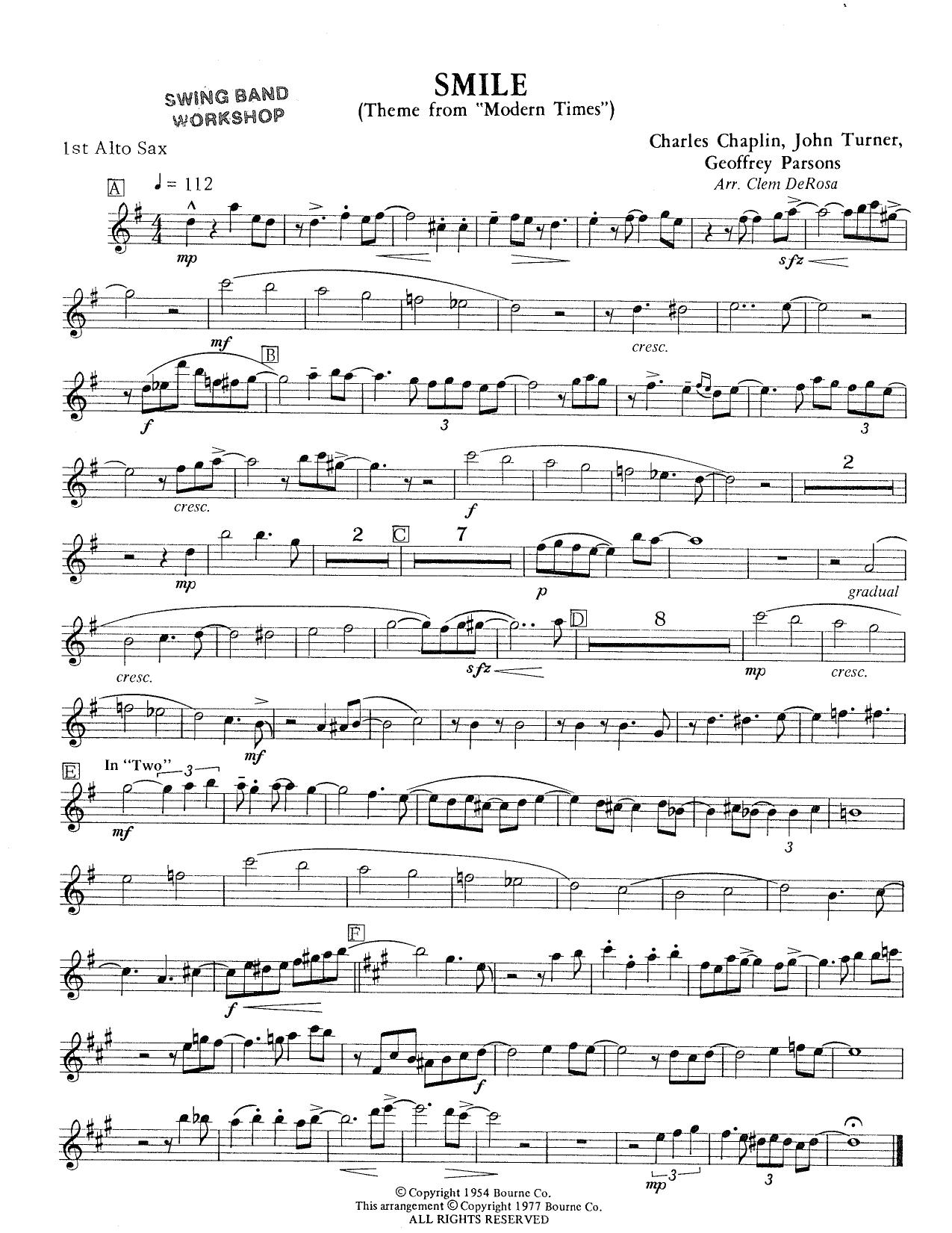
Smile (C.DeRosa)
Composed by Charlie Chaplin
Arranged by C.DeRosa
- Ensemble: Big Band
- Style: Jazz Standard
- Pages: 24
- Instruments (16): 1st Alto Sax, 2nd Alto Sax, 1st Tenor Sax, 2nd Tenor Sax, Baritone Sax, 1st Trumpet, 2nd Trumpet, 3rd Trumpet, 4th Trumpet, 1st Trombone, 2nd Trombone, 3rd Trombone, 4th Trombone, Piano, Bass, Drums
- Difficulty: medium
- Content: Individual Parts
- Format: PDF Download (Instant)
- Price: $24.99
Charlie Chaplin originally composed "Smile" as the haunting theme for his 1936 cinematic masterpiece *Modern Times*, encoding a bittersweet elegance that would eventually transcend its silent-film origins to become one of the most enduring lyric-less and lyrical jazz standards of the twentieth century. Nat King Cole immortalized the song with his 1954 vocal recording, cementing its status in the Great American Songbook and inviting countless instrumental interpretations across the bebop and post-bop landscapes. Its unique blend of major-mode aspiration and minor-mode melancholy provides a sophisticated harmonic canvas that continues to captivate modern arrangers and jazz ensemble directors alike. C.DeRosa approaches this timeless vehicle as a lush, emotionally resonant modern jazz ballad, maintaining a rubato-leaning contemplative feel that gradually unfolds into rich, harmonically dense ensemble textures. Set in a comfortable yet expressive tempo, the arrangement balances transparent, delicate trio and sectional writing with sweeping, cinematic chord progressions. The mood oscillates between introspective vulnerability and triumphant warmth, evoking a profound emotional journey through extended upper-structure triads, contemporary modal colorations, and subtle chromatic voice-leading that honors Chaplin's original melodic contour while expanding its harmonic vocabulary. The arrangement opens with a rubato atmospheric introduction led by the rhythm section and a poignant, exposed statement of the melody in the lead alto saxophone. As the chart progresses into a gentle, flowing swing or broken-time ballad feel, the saxophones and muted brass share interlocking countermelodies that create a rich tapestry of sound. Solo opportunities are thoughtfully integrated, featuring a designated space for a expressive horn soloist—ideally flugelhorn or tenor saxophone—to stretch over a sophisticated modal-interchange background. The ensemble writing demands refined dynamic control, demanding that the brass maintain a warm, velvety timbre even during the fuller, harmonically rich climactic peaks. Advanced high school ensembles with mature lead players, collegiate jazz orchestras, and professional big bands will find this chart an exceptional vehicle for developing sensitivity, blend, and phrasing. While the technical demands are moderate in terms of raw velocity, the true challenge lies in the nuanced execution of intonation, balance across the 17-piece instrumentation, and stylistic interpretation. Directors will appreciate how this chart challenges the ensemble to prioritize musical storytelling, making it a standout ballad choice for formal concert programs, festival adjudication, and sophisticated club settings. Achieving success with this arrangement requires prioritizing pristine intonation, breath support, and dynamic restraint above all else. The conductor should establish a flexible, conversational tempo feel that breathes with the soloist, avoiding a rigid metronomic pulse during the rubato sections. Saxophone sections must focus on seamless blend and delicate vibrato usage, particularly during the dense soli passages. Brass players should utilize warm cup or bucket mutes where indicated to achieve a dark, pillowy texture that blends smoothly with the reeds. Rehearsal strategy ought to begin with sectional balancing of the inner voices, ensuring that the rich chordal extensions voiced in the trombones and lower saxophones do not overpower the melody. Pay careful attention to the dynamic swells; the climactic moments require a massive, full-ensemble sound that remains round and unforced, avoiding any harsh or brassy edge. Q: What instruments and parts are included in this big band arrangement? A: The arrangement is scored for a standard 17-instrument big band instrumentation, comprising 2 alto saxophones, 2 tenor saxophones, 1 baritone saxophone, 4 trumpets, 4 trombones, and a full rhythm section including piano, guitar, bass, and drums. Q: What is the difficulty level of this chart? A: This arrangement is graded as medium-advanced, making it ideal for skilled high school jazz bands, collegiate ensembles, and professional groups that possess strong control over ballad playing, intonation, and dynamic shading. Q: What is the musical style and historical context of this piece? A: It is a modern jazz ballad treatment of Charlie Chaplin's iconic 1936 theme from *Modern Times*, drawing inspiration from the rich tradition of vocal and instrumental jazz standards found in the Great American Songbook. Q: What makes C.DeRosa’s arrangement unique compared to other versions? A: This arrangement stands out through its sophisticated harmonic reharmonizations, seamless blend of contemporary modal writing, and lush, cinematic voicings that elevate a classic melody into a modern concert showcase. Q: What is the approximate performance duration and tempo guidance? A: The arrangement runs approximately 4 to 5 minutes in duration, conceived as a expressive, flowing ballad with a flexible, conversational tempo that allows ample room for rubato phrasing and a featured soloist.
Questions and answers
- What is included in the Smile (C.DeRosa) PDF?
- The verified current file contains individual parts across 24 pages.
- How many instruments or parts are listed for Smile (C.DeRosa)?
- The verified instrumentation list contains 16 entries for this Big Band arrangement.
- Who is credited for Smile (C.DeRosa)?
- Composer: Charlie Chaplin. Arranger: C.DeRosa.
- What difficulty is listed for Smile (C.DeRosa)?
- The verified difficulty level is medium.
- What style is listed for Smile (C.DeRosa)?
- The catalog lists the style as Jazz Standard.
- Can I preview Smile (C.DeRosa) before buying?
- Yes. The product page provides a preview generated from the current PDF file.
- How is Smile (C.DeRosa) delivered?
- After successful payment, the digital PDF is made available for download. The displayed price is $24.99.
Musicians Also Search For
Smile C.DeRosa PDF • Smile C.DeRosa sheet music • Smile arranged by C.DeRosa • C.DeRosa big band charts • C.DeRosa jazz arrangements PDF • Smile Charlie Chaplin sheet music • Smile Charlie Chaplin big band arrangements • Charlie Chaplin big band charts • Smile big band arrangements • Smile big band PDF download • Smile jazz sheet music • big band sheet music download • Smile individual parts download • Smile sheet music PDF • Smile Jazz Standard charts • Jazz Standard big band arrangements • buy Smile sheet music • download Smile PDF • Smile jazz charts • best C.DeRosa big band arrangements • Charlie Chaplin arranged by C.DeRosa • Smile printable sheet music • big band repertoire PDF